Zoho One vs Microsoft 365 for Small Business: Which Is Better in 2026?
- Zoho One vs Microsoft 365 is not a direct like-for-like comparison. Zoho One focuses on running different parts of a business, while Microsoft 365 mainly focuses on productivity, communication, and document collaboration.
- Zoho One may be a better fit if you need CRM, accounting, HR, support, marketing, and business automation in one ecosystem.
- Microsoft 365 may be the better choice if your team depends heavily on Excel, Word, PowerPoint, Teams, and Microsoft-based collaboration.
- The right choice depends on what your business actually needs to manage every day.
What Is the Difference Between Zoho One and Microsoft 365?
The main difference is simple. Zoho One is designed to help businesses run different parts of their operations, while Microsoft 365 is mainly designed to help teams create, communicate, collaborate, and manage documents.
Zoho One includes a large collection of business applications for areas such as sales, finance, HR, support, marketing, and operations.
Microsoft 365 includes familiar productivity and collaboration tools such as Word, Excel, PowerPoint, Outlook, Teams, OneDrive, SharePoint, Forms, and Planner.
Quick Answer
Zoho One is generally a better fit for businesses looking for a wider set of connected business applications, including CRM, finance, HR, support, and automation. Microsoft 365 is often a better fit for teams that depend heavily on Office applications, Teams, Outlook, and Microsoft-based document collaboration.
That is the most important difference to understand before comparing prices.
If you are still learning what Zoho One includes and how the suite works, start with the basics before comparing it with Microsoft 365.
What Are You Actually Comparing?
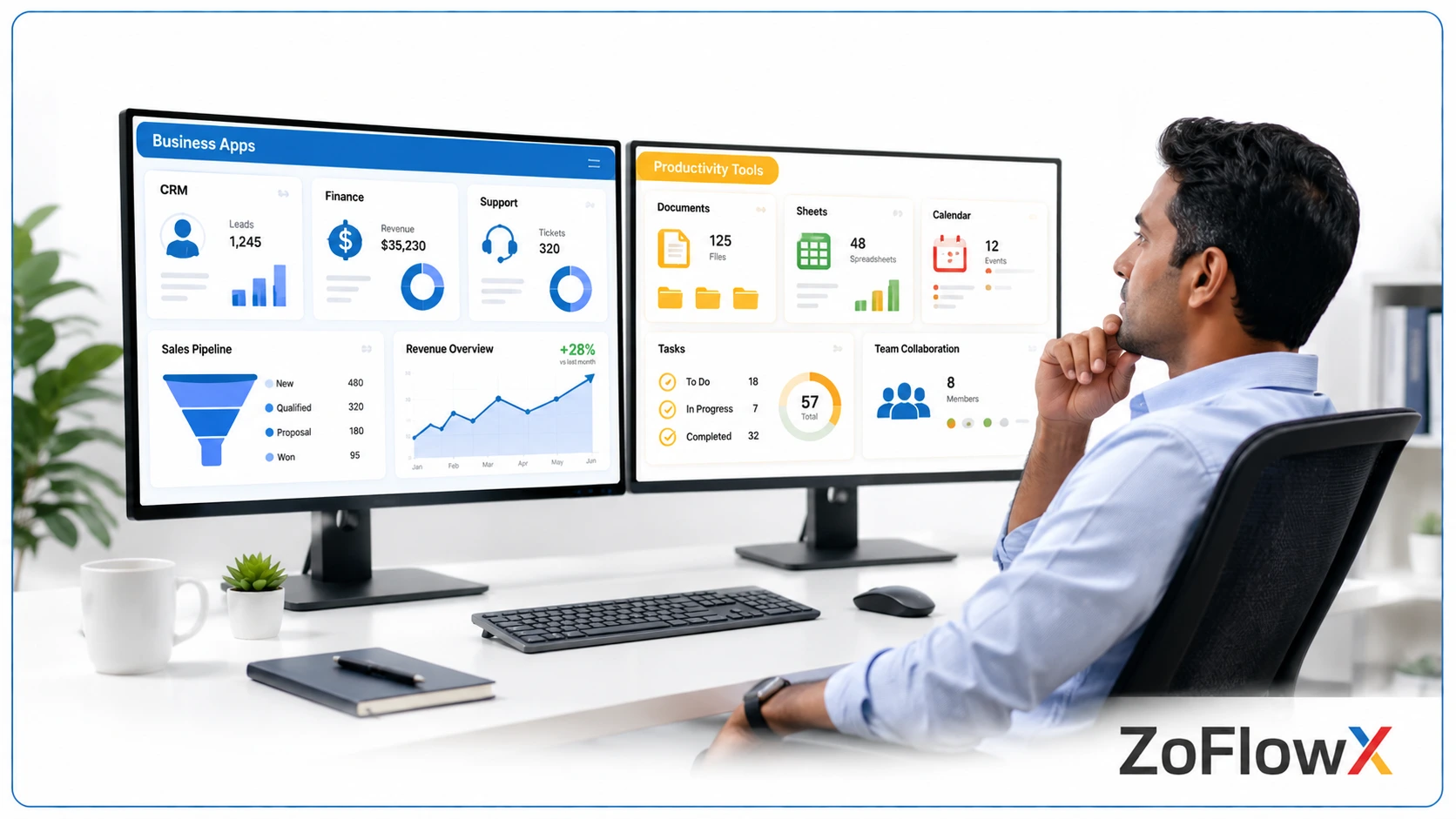
Before choosing between Zoho One and Microsoft 365, it helps to understand that they solve different problems.
Zoho One
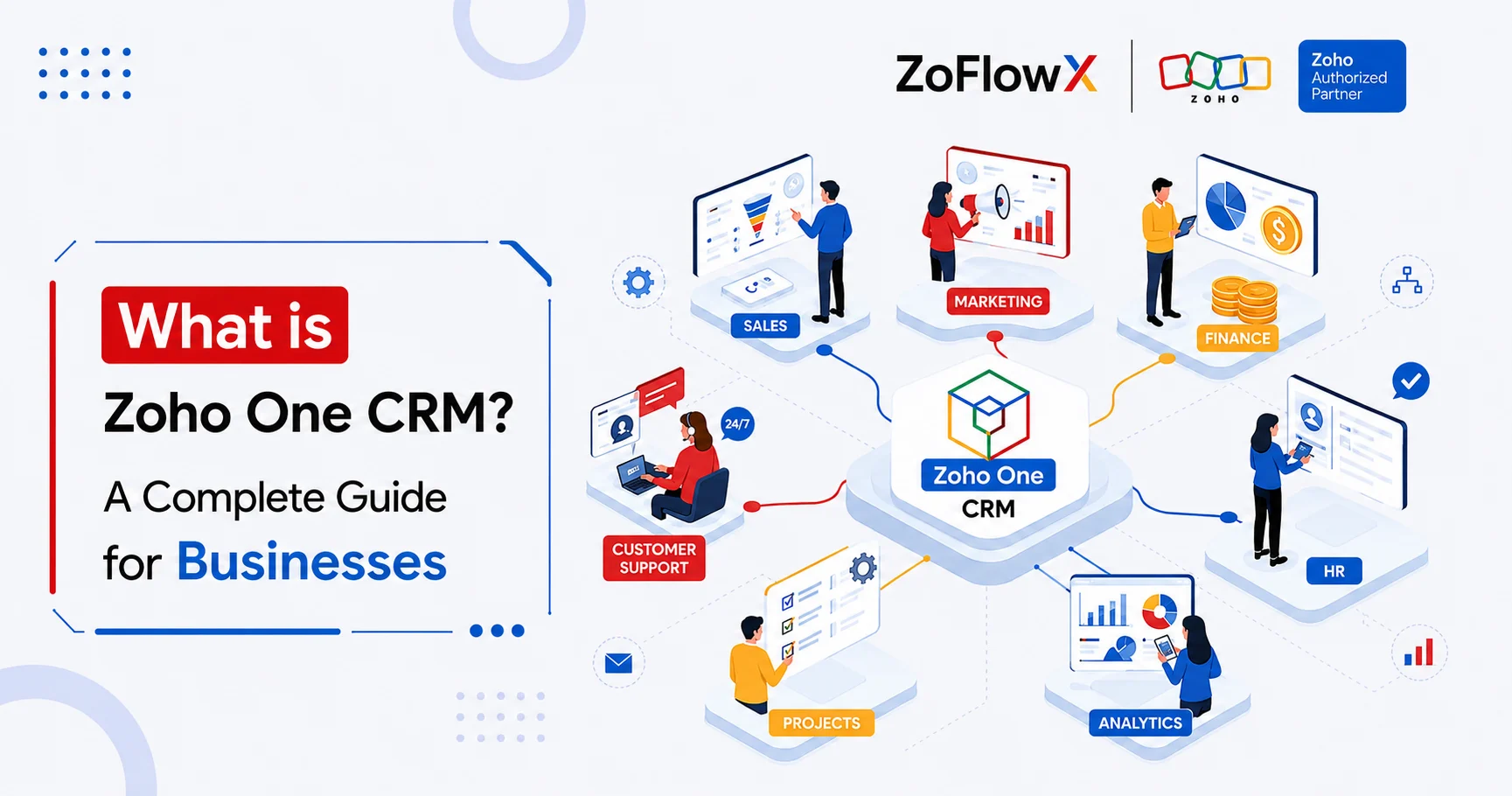
Zoho One brings together business applications for:
- Sales and CRM
- Accounting and finance
- HR and employee management
- Customer support
- Marketing
- Projects
- Team communication
- File management
- Reporting and analytics
- Business automation
Microsoft 365
Microsoft 365 focuses mainly on:
- Word processing
- Spreadsheets
- Presentations
- Business email
- Team meetings and chat
- Cloud storage
- Document collaboration
- Internal communication
- Basic planning and forms
Microsoft 365 can be part of a wider business software setup, but a company may need additional products or services if it wants dedicated CRM, accounting, HR, marketing automation, or customer support software.
According to ZoFlowX, the decision becomes much easier when you first identify whether your biggest need is business management or productivity and collaboration.
Zoho One vs Microsoft 365: How Do the Features Compare?
The key point is not that one platform includes "more."
The real question is whether your business needs those additional functions.
If you mainly work with documents, spreadsheets, presentations, email, and meetings, Microsoft 365 may already cover most of your daily needs.
If you also need to manage customers, invoices, employees, support requests, marketing, and internal workflows, Zoho One may reduce the number of separate subscriptions your business needs.
Is Zoho One Cheaper Than Microsoft 365?
The answer depends on what you are comparing.
If you only need Word, Excel, Outlook, Teams, and cloud storage, comparing Zoho One with Microsoft 365 on price alone may not make sense. Microsoft 365 could be the more focused option.
However, the comparison changes when your business also needs:
- CRM
- Accounting
- HR
- Customer support
- Marketing tools
- Project management
- Business automation
Quick Cost Comparison
Zoho One can offer better overall value when a business needs several connected applications. Microsoft 365 may cost less when the main requirement is productivity, communication, and document collaboration.
Always compare the full software stack your business needs, not just the base subscription price.
Zoho's pricing can change based on region, plan, billing period, and promotions.
Microsoft 365 pricing also varies depending on the plan and features selected.
For that reason, it is better to compare your actual software requirements instead of assuming that one platform will always be cheaper. You can also review Zoho One total pricing before making a final cost comparison.
Does Zoho One Include More Business Applications?
Yes. This is one of the biggest differences between the two platforms.
Zoho One includes applications that cover several business functions.
For example:
Sales
- Zoho CRM
- Sales automation
- Lead management
- Deal tracking
Finance
- Zoho Books
- Zoho Invoice
- Zoho Expense
- Zoho Inventory
HR
- Zoho People
- Recruitment tools
- Employee management
Customer Support
- Zoho Desk
- Customer service tools
Marketing
- Zoho Campaigns
- Marketing automation
- Social media tools
Operations
- Zoho Projects
- Zoho Creator
- Workflow automation
Microsoft 365 does not aim to provide the same type of all-in-one business application suite.
Its strength is productivity and collaboration.
That difference should guide your decision.
Which Is Better for CRM and Sales Management?
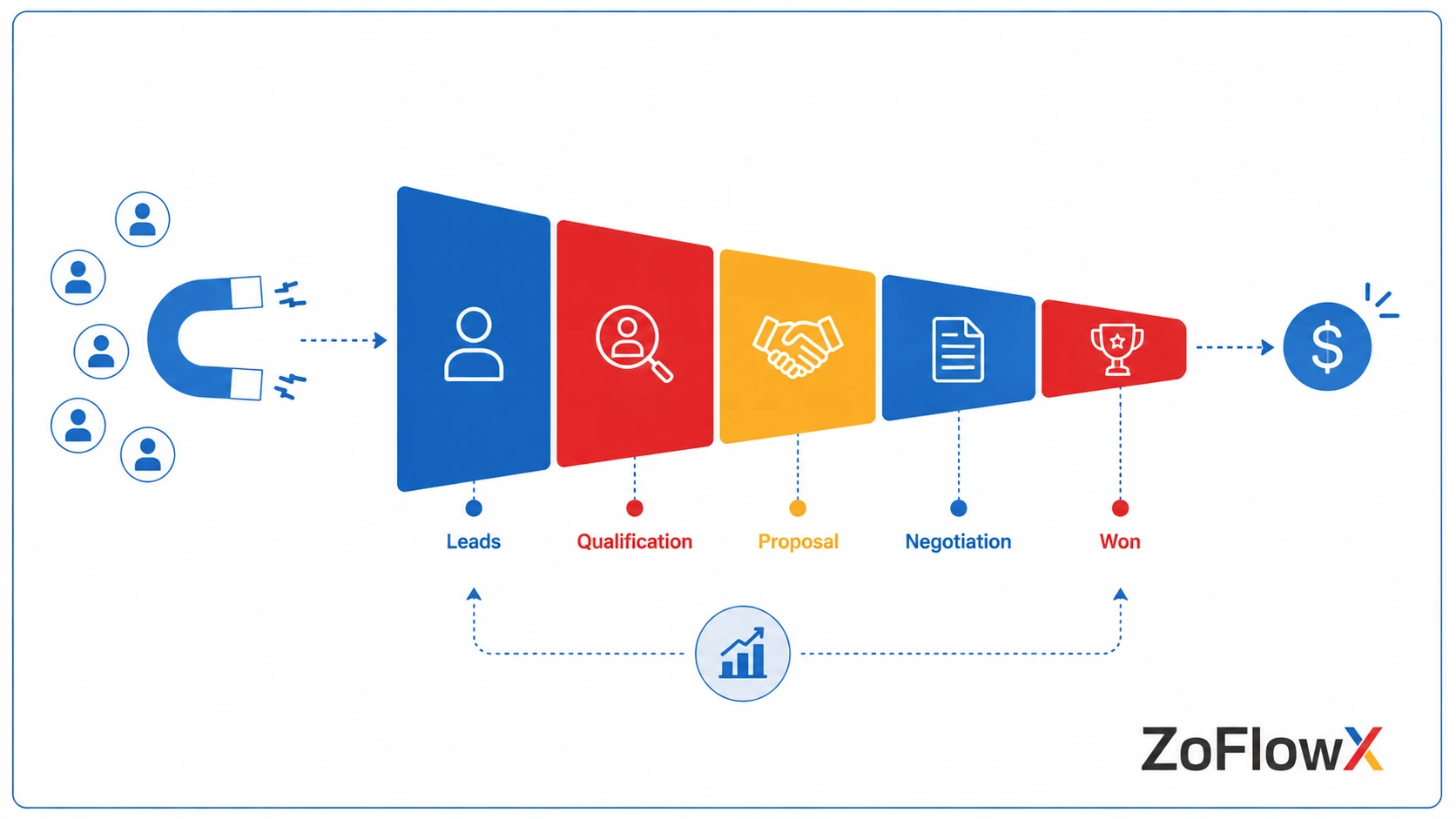
If your business needs a dedicated CRM, Zoho One has an advantage because Zoho CRM is part of the ecosystem.
Zoho CRM can help businesses manage:
- Leads
- Contacts
- Deals
- Sales pipelines
- Customer communication
- Sales workflows
- Reports
Microsoft 365 does not include a full CRM as part of its core productivity suite.
This does not mean Microsoft 365 is unsuitable for sales teams. A business can still use Microsoft 365 alongside a separate CRM.
The difference is simply that Zoho One brings CRM and other business applications into the same ecosystem.
According to ZoFlowX, businesses should avoid choosing a platform based only on the number of applications. The better question is: Which tools will your team actually use?
Which Is Better for Communication and Productivity?
This is where Microsoft 365 can have a strong advantage.
Microsoft 365 is built around familiar tools such as:
- Word
- Excel
- PowerPoint
- Outlook
- Teams
- OneDrive
- SharePoint
Teams that spend most of their day working with complex spreadsheets, presentations, Word documents, and Microsoft-based collaboration may find Microsoft 365 easier to continue using.
Zoho One also includes tools for documents, email, chat, meetings, and file management.
However, the two ecosystems have different strengths.
Choose Microsoft 365 when:
- Your team heavily depends on advanced Excel features.
- Word and PowerPoint are central to your daily work.
- Your clients mainly use Microsoft file formats and collaboration tools.
- Your organisation already has a strong Microsoft-based workflow.
Choose Zoho One when:
- Your team needs productivity tools along with CRM, finance, HR, support, and automation.
- You want business applications to work within one ecosystem.
- You are trying to reduce the number of separate software subscriptions.
How Do Zoho WorkDrive and OneDrive Compare?
Both platforms provide cloud storage and collaboration.
OneDrive works closely with Microsoft's productivity tools. It is a natural choice for teams that work mainly with Word, Excel, and PowerPoint.
Zoho WorkDrive is designed to work within the Zoho ecosystem and can support collaboration across different Zoho applications.
The better option depends on where your team already works.
If most of your work happens inside Microsoft Office, OneDrive may feel more natural.
If your business uses several Zoho applications, WorkDrive may make it easier to keep files connected to your business processes.
How Do Zoho One and Microsoft 365 Handle Business Automation?
Zoho One is built to connect different business functions.
For example, a sales process can potentially connect with customer records, projects, support, finance, and other workflows inside the Zoho ecosystem.
Microsoft 365 can also support automation through Microsoft's broader tools and services.
However, the purpose of the two platforms is different.
Zoho One focuses more on connecting different business applications.
Microsoft 365 focuses more on productivity and collaboration, with additional Microsoft tools available for businesses that need broader automation.
What About AI Features?
Both Zoho and Microsoft continue to add AI features to their products.
The exact features available can depend on:
- The application
- The subscription plan
- Your region
- Product updates
- Additional licensing
Microsoft offers AI capabilities through products such as Copilot, while Zoho provides AI capabilities across selected applications and features.
Because AI products and pricing can change frequently, it is best to check the current plan details before making a decision.
For most small businesses, AI should not be the only reason to choose a platform.
First, make sure the platform handles your core business needs.
Which Platform Is Better for a Small Business?
There is no single winner for every business.
Choose Zoho One if You Need:
- CRM and sales management
- Accounting or finance tools
- HR applications
- Customer support software
- Marketing tools
- Project management
- Business automation
- Connected applications across multiple departments
Zoho One can make sense when you are currently paying for several separate business tools.
You should also consider your industry and workflow before deciding. Some sectors benefit more from connected business applications than others, so reviewing your business fit can help you make a more practical decision.
Choose Microsoft 365 if You Need:
- Advanced Word, Excel, or PowerPoint features
- Outlook and Microsoft-based email workflows
- Teams for communication and meetings
- OneDrive and SharePoint collaboration
- A familiar Microsoft working environment
Microsoft 365 can be a strong choice when your main requirement is productivity and collaboration.
Can a Business Use Zoho One and Microsoft 365 Together?
Yes.
You do not always have to replace one platform with the other.
Some businesses continue using Microsoft 365 for:
- Excel
- Word
- PowerPoint
- Outlook
- Teams
At the same time, they use Zoho applications for:
- CRM
- Accounting
- HR
- Customer support
- Automation
This approach may be useful for businesses that already depend heavily on Microsoft Office but want more connected business management tools.
The decision does not always have to be "Zoho or Microsoft."
It can be about choosing the right combination for your business.
Should You Switch from Microsoft 365 to Zoho One?
A switch may make sense if your business is mainly paying for Microsoft 365 but also buying several additional tools for CRM, finance, HR, marketing, and support.
Before switching, review:
- Which Microsoft tools your team uses every day.
- Which features are difficult to replace.
- What other software subscriptions you currently pay for.
- Whether your data needs to be migrated.
- How much employee training will be required.
Do not switch simply because one platform appears cheaper.
A lower subscription cost does not always mean a lower business cost if the new system creates training problems or disrupts your team's daily work.
What Is the Best Way to Decide?
Start with your current software list.
Write down every tool your business pays for.
Then place each tool under one of these categories:
- Productivity
- Communication
- Sales
- Finance
- HR
- Marketing
- Support
- Operations
You will quickly see what your business actually needs.
A Simple Decision Rule
Choose Zoho One when your business needs several connected applications across different departments.
Choose Microsoft 365 when productivity, document work, communication, and Microsoft collaboration are your main priorities. If you need both, a combined setup may also make sense.
According to ZoFlowX, the best decision is based on your actual workflows, not on which platform has the longest feature list.
Conclusion
The Zoho One vs Microsoft 365 decision becomes much easier once you stop treating them as identical products.
Zoho One is built for businesses that need several connected applications to manage sales, finance, HR, support, marketing, and operations.
Microsoft 365 is built around productivity, communication, documents, and collaboration.
If your business mainly lives in Excel, Word, Outlook, Teams, and Microsoft-based file sharing, Microsoft 365 may be the better fit.
If you are managing customers, invoices, employees, support requests, marketing, and other business processes across several separate tools, Zoho One may help bring more of that work into one ecosystem.
The best choice is the one that fits how your team works today and supports where your business is going next.
Need Help Choosing the Right Business Software?
Compare your current tools and business needs with the right Zoho One approach for your team.
Talk to a Zoho ExpertFrequently Asked Questions
Is Zoho One better than Microsoft 365 for small businesses?
It depends on your needs. Zoho One may be better for businesses that need CRM, finance, HR, support, and automation in addition to productivity tools. Microsoft 365 may be better for businesses focused mainly on documents, spreadsheets, email, meetings, and collaboration.
Does Microsoft 365 include a CRM?
Microsoft 365's core productivity plans do not include a full CRM. Businesses that need CRM functionality can use a separate CRM product or service.
Can Zoho One replace Microsoft 365?
For some businesses, yes. Zoho One includes tools for email, documents, chat, file management, CRM, finance, HR, and other business functions.
However, teams that depend heavily on advanced Microsoft Office features may prefer to continue using Microsoft 365.
Which is better for Excel and document work?
Microsoft 365 is generally the stronger choice for businesses that rely heavily on advanced Excel, Word, and PowerPoint features.
Which is better for business automation?
Zoho One is designed to connect workflows across different business applications. This can make it useful for businesses that want to connect sales, support, finance, projects, and other processes.
Can I use Zoho One and Microsoft 365 together?
Yes. Some businesses use Microsoft 365 for productivity and collaboration while using Zoho applications for CRM, finance, HR, and other business operations.