10 Industries That Benefit Most from Zoho One in 2026
- Zoho One is a unified business operating system with 45+ integrated apps covering CRM, finance, HR, marketing, projects, and analytics.
- Manufacturing, real estate, healthcare, education, IT, e-commerce, logistics, and consulting are among the industries that benefit from Zoho One the most.
- The biggest wins are fewer software silos, automated workflows, lower tool costs, and real-time visibility across departments.
- Small businesses, mid-sized firms, and growing startups all get enterprise-grade capability at a fraction of the usual cost.
- Most teams see faster, cleaner results when an experienced Zoho partner handles process mapping, configuration, and data migration.
The industries that benefit from Zoho One the most are those that are struggling to manage sales, operations, finance, and support in too many disjointed tools. Teams no longer have to switch tabs, they move faster with Zoho One. Below are the sectors that benefit the most, the apps that are important to each sector and how to set it up without spending months.
What is Zoho One?
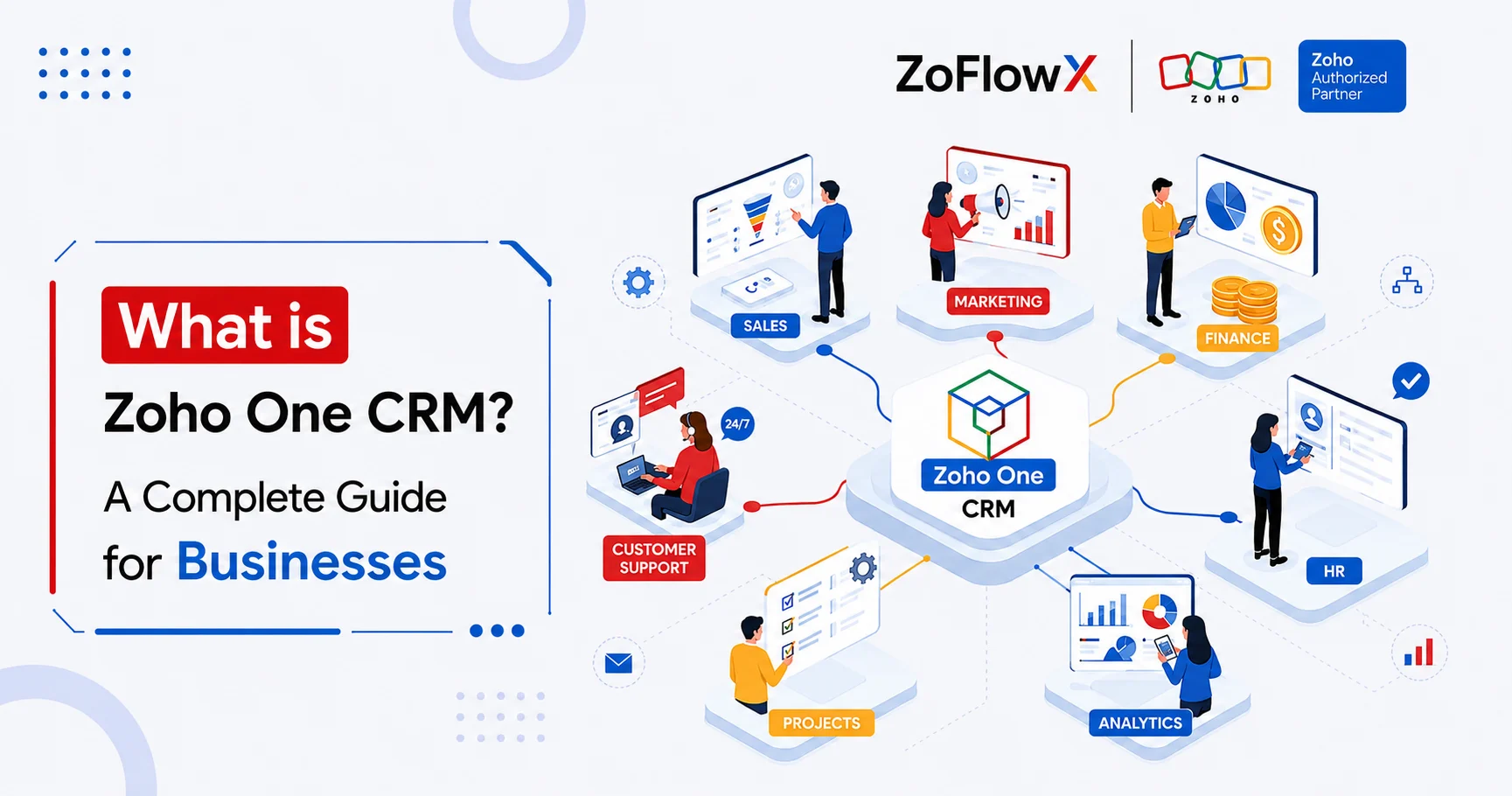
Zoho One is an all-in-one business software suite that bundles 45+ integrated business applications under a single license and one shared data layer. Instead of buying separate tools for sales, accounting, marketing, and support, you run your whole company on one connected platform.
Consider it a business operating system. Your CRM talks to your finance app, which talks to your HR system, which talks to your analytics dashboards, all without messy third-party connectors.
The core modules most companies start with include:
- Zoho CRM for sales and pipeline management
- Zoho Books for accounting and invoicing
- Zoho People and Zoho Recruit for HR and hiring
- Zoho Campaigns and Zoho Marketing Automation for marketing
- Zoho Projects for delivery and task tracking
- Zoho Analytics for reporting in all apps
Quick answer: Zoho One is a single subscription that provides a business with over 45 connected apps for sales, finance, HR, marketing, support, and operations. It replaces a series of individual tools with a single ecosystem that allows data to flow seamlessly between departments.
Before looking at industry fit, it helps to understand what Zoho One is and how its 40+ integrated apps work together.
Why do industry-specific software needs actually matter?
Since no two industries operate in the same manner. A manufacturer is concerned with inventory and production plans. Site visits and lead follow-up are the lifeblood of a real estate company. A clinic cares about appointments and patient records.
A generic tool makes all businesses fit into the same template. The industries that benefit from Zoho One get the opposite experience, as the platform adapts to the workflow, not the other way around.
Here is why that flexibility matters:
- Unique challenges: Each sector has its own bottlenecks, compliance rules, and customer journeys.
- Customization: Custom fields, layouts, and modules allow you to model your real process, not a template.
- Workflow automation: Repetitive manual tasks get handed off to rules and triggers.
- Data visibility: Leadership sees one source of truth across every department.
- Scalability: The same setup grows from 5 users to 500 without ripping anything out.
While the core suite stays the same, the real value comes from industry-specific Zoho solutions that map modules like CRM, Inventory, and Desk to how your sector actually operates.
Across manufacturing, healthcare, real estate, and travel, the businesses that get the most from Zoho One are usually the ones that configure it to their workflows from day one. That's where working with a Zoho Authorized Partner like ZoFlowX makes the difference, with 20+ implementations delivered across these exact sectors. Find out who can help you set up Zoho One before you get started.
How does Zoho One help the manufacturing industry?
Manufacturing is one of the clearest industries that benefit from Zoho One, because the entire lead-to-order-to-delivery chain sits inside one platform. Sales, purchasing, inventory, and reporting finally share the same data.
A manufacturer can capture an enquiry in CRM, convert it to a sales order, check stock in real time, and trigger a purchase order to a supplier, all without spreadsheets in between.
Where Zoho One delivers for manufacturers:
- Lead-to-order management that keeps quotes, orders, and approvals in one flow
- Vendor and supplier coordination with purchase orders and bill tracking
- Inventory visibility across warehouses and locations
- Production tracking through custom workflows and project boards
- Reporting and analytics that convert shop-floor data into decisions.
Recommended apps: Zoho CRM, Zoho Inventory, Zoho Projects, Zoho Analytics.
Zoho One helps manufacturers to integrate sales, inventory, purchasing, and production into a single system. Teams keep track of leads, stock, suppliers and pull live reports from one platform, eliminating manual data entry and expensive order delays.
If you're in the manufacturing industry and want to see how Zoho One can simplify your day-to-day operations, read our detailed guide on Zoho One for Manufacturing Companies. We cover everything from inventory management to production planning and automation.
How does Zoho One support the real estate industry?
Real estate runs on speed of follow-up, and that is exactly where Zoho One shines. Every property enquiry lands in one place, gets routed to the right agent, and never slips through the cracks.
Agents spend less time chasing notes and more time closing. Managers get to see what listings, campaigns and people are actually working.
What real estate firms gain:
- Property inquiry management and automatic lead capture from web forms.
- Lead nurturing through drip emails and reminders
- Site visit scheduling that customers can book themselves
- Clean dashboards for agent performance tracking.
- Marketing automation across email and SMS
Recommended apps: Zoho CRM, Zoho Campaigns, Zoho Forms, Zoho Bookings.
Can healthcare clinics use Zoho One effectively?
Yes. Clinics and small healthcare practices use Zoho One to handle the front-office chaos that pulls staff away from patients. Appointments, reminders, records, and reporting all live together.
Patients book online, get automatic reminders, and the team keeps documents organized and secure. Administrators see capacity and no-show trends at a glance.
Healthcare wins with Zoho One:
- Appointment scheduling with self-service booking and reminders
- Patient communication through automated email and SMS
- Staff management for shifts, tasks, and internal collaboration
- Document storage in a centralized, permission-controlled drive
- Operational reporting on visits, revenue, and utilization
Recommended apps: Zoho Bookings, Zoho CRM, Zoho WorkDrive, Zoho Analytics.
How do educational institutions benefit from Zoho One?
Schools, colleges and coaching centers receive a continuous stream of enquiries, admissions and parent communication. Zoho One transforms that flow into a managed pipeline.
All prospective student enquiries are followed from initial contact to enrolment. Counselors end up not losing leads and leadership gains visibility into the admissions funnel.
Where it helps:
- Student inquiry management with a single admissions pipeline
- Admission workflows that automate stages and approvals
- Parent communication via scheduled email and updates
- Event management for open days, webinars, and orientation
- Reporting dashboards on enquiries, conversions, and sources
Recommended apps: Zoho CRM, Zoho Campaigns, Zoho Forms, Zoho Survey.
Why is Zoho One popular with IT and software companies?
IT and software firms are among the industries that benefit from Zoho One because they live across sales, delivery, and support at the same time. One platform manages the lead, the project, and the help desk ticket.
A deal closed in CRM can automatically create a project. Support tickets are linked to the same customer record, so no one is working in the dark.
What tech teams get:
- Lead management with a clean sales pipeline
- Project tracking for sprints, tasks, and timelines
- Helpdesk operations with SLAs and ticket routing
- Time tracking tied to billing and projects
- Team collaboration through chat and shared channels
Recommended apps: Zoho CRM, Zoho Projects, Zoho Desk, Zoho Cliq.
How does Zoho One work for e-commerce businesses?
E-commerce brands win and lose on customer experience, and Zoho One ties the full journey together. Acquisition, fulfillment, support, and analytics finally share one view of the customer.
You can capture buyers, run automated campaigns, manage stock and respond to support tickets without switching between five disconnected apps.
E-commerce gains:
- Customer acquisition through landing pages and forms
- Marketing automation with segmented email and journeys
- Order management linked to inventory and invoicing
- Customer support across email, chat, and social
- Business analytics on sales, retention, and channel performance
Recommended apps: Zoho CRM, Zoho Campaigns, Zoho Inventory, Zoho Analytics.
How does Zoho One help logistics and transportation companies?
Logistics is about coordination, and Zoho One gives operators one control center for customers, vendors, and service issues. Custom apps handle the parts that off-the-shelf software usually misses.
Dispatch teams track shipments, communicate proactively with customers, and resolve service tickets without juggling phone calls and spreadsheets.
What logistics firms gain:
- Shipment tracking through custom apps built on Zoho Creator
- Customer communication with automated status updates
- Fleet coordination using shared schedules and tasks
- Vendor management for carriers and partners
- Service ticket management with structured support queues
Recommended apps: Zoho CRM, Zoho Desk, Zoho Creator, Zoho Analytics.
Why do financial services and consulting firms choose Zoho One?
Professional services firms run on trust, documents, and deadlines. Zoho One keeps client onboarding tight, paperwork organized, and follow-ups automatic.
A new client can be onboarded, documents sent for signing, a meeting scheduled and tracked through a workflow, all within one secure system.
Where it delivers:
- Client onboarding with structured, repeatable workflows
- Document management in a controlled, searchable drive.
- Appointment scheduling that clients book themselves
- Workflow automation for renewals, reviews, and reminders
- Compliance reporting with audit-friendly records
Recommended apps: Zoho CRM, Zoho Sign, Zoho WorkDrive, Zoho Bookings.
What are the key benefits of Zoho One across every industry?
No matter the sector, the wins look similar once everything runs on one platform. According to ZoFlowX, the firms that consolidate onto Zoho One usually cut their software bill while gaining far more capability than they had before.
Across industries, Zoho One delivers a single source of truth, lower software costs, automated workflows, stronger collaboration, and real-time analytics. Connecting every department in one ecosystem helps leadership make faster decisions and gives customers a smoother, more consistent experience.
The shared benefits include:
- Single source of truth so every team works from the same data
- Reduced software costs by replacing many subscriptions with one
- Better collaboration through built-in chat, docs, and shared records
- Workflow automation to eliminate repetitive manual tasks
- Scalability that grows with headcount and revenue
- Real-time analytics across sales, finance, and operations
- Improved customer experience from faster, more informed service
How do I choose the right Zoho One setup for my industry?
Start by mapping your real process, not the software. The industries that benefit from Zoho One the most are the ones that configure it around how they already work, then automate the gaps.
Here is a simple step-by-step process:
- Assess your business processes. Document how leads, orders, projects, and support actually flow today.
- Select the right applications. Select the key apps that align with those flows, then add more later.
- Plan your integrations. Decide how Zoho connects to your existing tools, payments, and data.
- Build a user adoption strategy. Identify champions and roll out in phases, not all at once.
- Handle training. Give each team short, role-specific training so the platform actually gets used.
- Work with a Zoho implementation partner. Bring in experts for configuration, migration, and customization.
Before you start, check the Zoho One implementation timeline to plan your rollout.
Manufacturers, healthcare providers, and real estate firms each need different module configurations, which is why most businesses see faster results with professional Zoho One implementation services rather than a DIY rollout.
According to ZoFlowX, the single biggest predictor of a successful rollout is not company size. It is whether the setup matches the day-to-day workflow before automation is layered on top.
Conclusion
The industries that benefit from Zoho One span manufacturing, real estate, healthcare, education, IT, e-commerce, logistics, and consulting, and the pattern is consistent. Any business running too many disconnected tools gains the most from moving to one ecosystem.
The platform replaces a tangle of subscriptions with a single, connected system where data flows automatically and reporting is live. You spend less, see more, and your teams stop wasting hours switching between apps. See our Zoho One pricing guide for a complete cost breakdown.
What makes the difference is customization. The industries that benefit from Zoho One are the ones that shape it around their real process instead of forcing their process into generic software. That is also why a guided, professional implementation beats a rushed DIY attempt almost every time.
If your business is weighing a move, this is the moment to act. Book a consultation, get your processes mapped, and turn 45+ apps into one engine that runs your company. Choose Zoho One, set it up right, and give your team the unified platform it has been missing.
Ready to talk it through? Call ZoFlowX on +91 8190009222 or email info@zoflowx.com, and we will map the right Zoho One setup for your industry.
Ready to see how Zoho One can transform your industry?
Get a free consultation with ZoFlowX to identify the right Zoho One applications, automate workflows, and implement a solution tailored to your business needs.
Book a Free Zoho One Consultation TodayFrequently Asked Questions
Which industries benefit the most from Zoho One?
Yes, industries such as manufacturing, real estate, healthcare, education, IT services, logistics, e-commerce, and consulting benefit significantly from Zoho One. The platform combines CRM, finance, HR, marketing, project management, and analytics tools into a single ecosystem. This helps businesses eliminate software silos, automate workflows, improve collaboration, and gain better visibility into operations, regardless of industry size or complexity.
Is Zoho One suitable for small businesses?
Yes, Zoho One is an excellent choice for small businesses. It provides access to a comprehensive suite of business applications at a cost-effective price compared to purchasing multiple standalone tools. Small businesses can manage sales, marketing, customer support, accounting, and employee operations from one platform. As the business grows, Zoho One can scale with changing requirements without the need for major software replacements.
How does Zoho One help manufacturing companies?
Zoho One helps manufacturing companies streamline operations by connecting sales, inventory, production, purchasing, and reporting processes. Businesses can track leads, manage suppliers, monitor stock levels, and generate real-time analytics from a centralized platform. By reducing manual tasks and improving data visibility, manufacturers can increase efficiency, minimize operational delays, and make more informed business decisions.
Can real estate businesses use Zoho One effectively?
Yes, real estate businesses can use Zoho One to manage property inquiries, automate lead nurturing, schedule site visits, and track sales performance. The platform enables agents and managers to maintain organized customer records and improve communication throughout the sales cycle. With integrated marketing and reporting tools, real estate firms can generate more qualified leads and improve conversion rates.
Why is Zoho One popular among IT and software companies?
Zoho One is popular among IT and software companies because it combines CRM, project management, helpdesk, collaboration, and analytics tools within a single platform. Teams can manage client relationships, track projects, handle support requests, and monitor performance without switching between multiple applications. This improves productivity, enhances customer service, and creates a more streamlined operational workflow.
What are the main benefits of Zoho One across different industries?
The main benefits of Zoho One include workflow automation, centralized data management, improved collaboration, lower software costs, and real-time business insights. Regardless of industry, organizations can connect departments and eliminate repetitive manual processes. Having all business information in one ecosystem helps leadership teams make faster decisions and improves the overall customer and employee experience.
Can Zoho One be customized for industry-specific requirements?
Yes, Zoho One can be customized to fit industry-specific business processes. Organizations can create custom workflows, fields, forms, dashboards, and automation rules that align with their operational needs. Using applications like Zoho Creator and Zoho CRM, businesses can tailor the platform to support unique requirements while maintaining seamless integration with other Zoho applications.
Do businesses need a Zoho One implementation partner?
While businesses can implement Zoho One independently, working with a Zoho One implementation partner often leads to faster and more successful results. An experienced partner helps with process mapping, application selection, customization, integrations, data migration, and user training. This reduces implementation risks and ensures businesses maximize their return on investment from the Zoho One platform.