Zoho One for Manufacturing Companies: Complete Guide to Streamlining Operations
- Zoho One for Manufacturing Companies replaces a stack of disconnected tools with one suite covering sales, inventory, accounting, production, support, and HR.
- Most factories lose hours every week reconciling data between systems that do not talk to each other. A unified platform removes that friction.
- The apps that matter most for manufacturers are Zoho CRM, Inventory, Books, Analytics, Creator, Projects, and People.
- Automation handles repetitive work such as purchase orders, stock updates, and invoicing, so your team focuses on production, not paperwork.
- For Indian manufacturers, Zoho One handles GST, Tally migration, and INR billing without third-party patches.
- A proper implementation maps your bill of materials, work orders, and multi-warehouse stock to how your shop floor actually runs.
Here is a number worth sitting with. Nearly 80% of manufacturers are investing at least 20% of their improvement dollars in smart, connected systems. That transition typically begins with one decision, and for small and mid-sized factories, it begins with Zoho One for Manufacturing Companies.
Why This Conversation Matters Right Now
Indian factories are not running in a quiet market. India's manufacturing sector recorded GVA growth of 7.72% in Q1 and 9.13% in Q2 of FY 2025-26, and the manufacturing PMI has stayed firmly in expansion territory. Demand is rising. Orders are getting bigger and more complex.
The problem is that weak systems are revealed by growth. A factory that was fine on spreadsheets and three separate apps at 50 orders per month begins to lose balls at 300. That's where Zoho One for manufacturing becomes the glue that holds it all together.
So let's dive into what Zoho One is, how it fits on a shop floor and how to make it work for a manufacturing business.
What Is Zoho One?
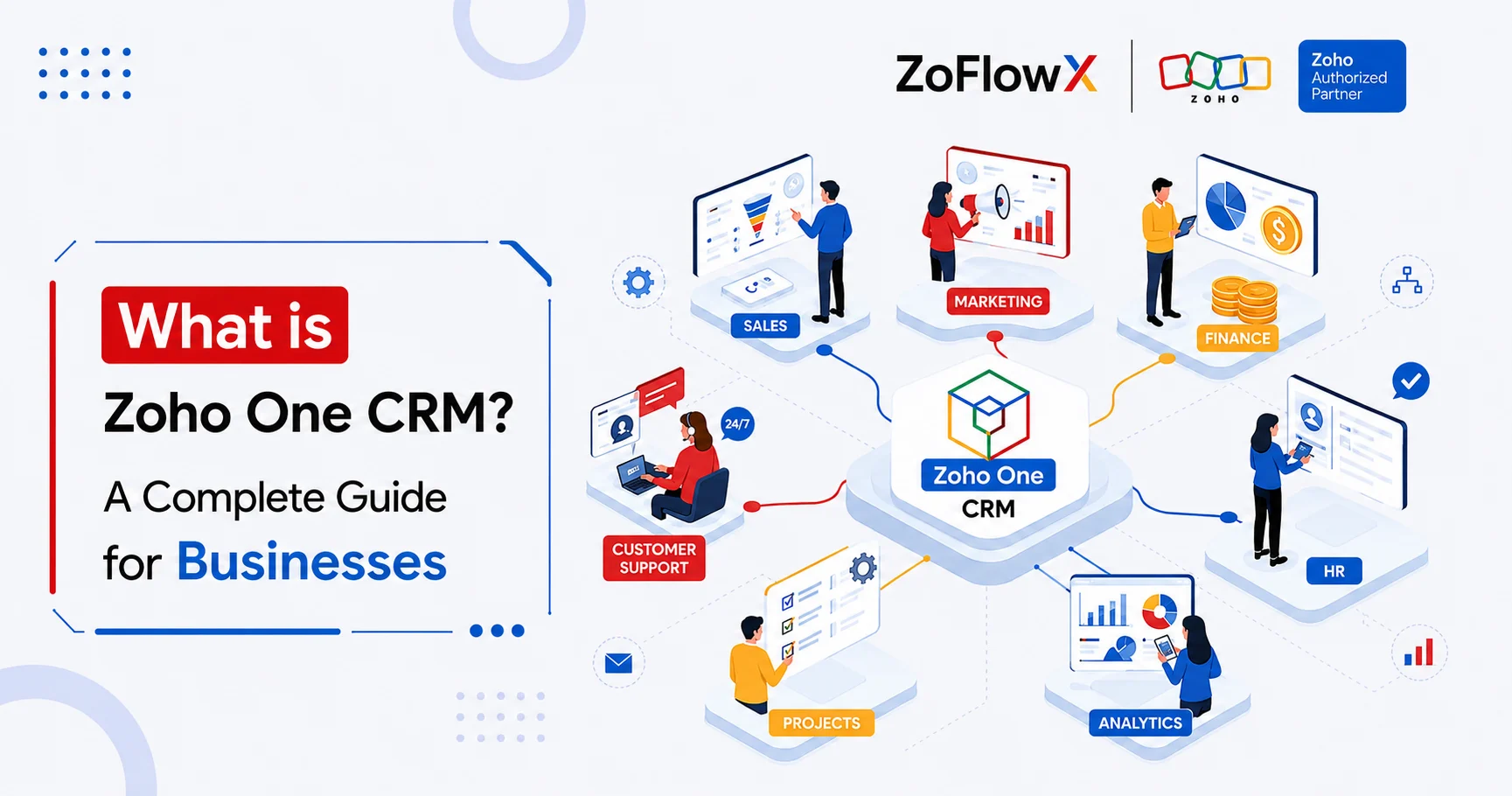
Zoho One is a business suite that is all in one. You don't need to purchase individual tools for sales, accounting, inventory, support, and HR, you have over 45 integrated applications all under one license.
Consider it more of a collection of apps that are already familiar with one another. When you sell a product, you update the inventory in CRM. A confirmed order shows up in your accounting books. A purchase order may be generated when a low stock alert is issued. There is no need to copy by hand from one screen to another.
That's the whole point for manufacturers. A factory is not a single process. It is sales, procurement, production, dispatch, finance and after-sales support, all of which rely on one another. If they run in separate software, the money leaks between them.
The Real Problems Manufacturing Companies Face
Let's be honest about the pain before we discuss solutions. The majority of manufacturing companies we serve have some form of these issues:
- Inventory that nobody trusts. Stock counts on paper say one thing, the warehouse says another, and the sales team promises a third.
- Departments that do not talk. Sales confirms an order, production finds out three days later, and procurement learns about it when raw material runs out.
- Production delays with no clear cause. Without visibility, a delay is a mystery instead of a fixable bottleneck.
- Procurement that is always reactive. Purchase orders go out only after something runs dry, which means rush charges and idle machines.
- Order tracking by phone and memory. Customers call asking where their order is, and someone goes hunting for the answer.
- Too many software tools. A CRM here, Tally for accounts, an Excel sheet for inventory, WhatsApp for the floor. None of it connects.
If two or three of those sound familiar, you already understand why running a manufacturing business on Zoho One appeals to so many factory owners. It collapses that scattered stack into one connected system.
How Zoho One Helps Manufacturing Companies
Here is where Zoho One for Manufacturing Companies earns its keep. The value is not in any single feature. It is when the entire operation finally moves as a single piece.
- Centralized business management. One login, one source of truth. All users have access to the same live data, whether you're the owner looking at margins or a supervisor looking at a work order.
- Inventory control that holds up. Stock levels in several warehouses, automatic deductions when goods are used or sold, and low-stock alerts before you run out of stock.
- Sales and CRM in the same system. Leads, quotes and orders are next to your inventory and finance, and a confirmed order goes directly to production planning.
- Production planning. Custom workflows monitor jobs from raw material to finished goods, and every stage is visible and time stamped.
- Vendor and procurement management. Purchase orders, vendor records and goods receipts all in one place, and frequently automatically generated when stock levels drop.
- Financial management built for India. GST-ready invoicing, INR billing and clean reporting, with a much smoother path than Tally exports.
- HR and workforce. Attendance, leave and employee records for your floor staff and office team, without a separate payroll tool.
That combination is why so many owners describe managing manufacturing with Zoho One as finally being able to see their whole business at a glance.
Essential Zoho One Apps for Manufacturers
You won't be turning on all 40+ apps on day one, and you shouldn't. These are the ones that do the heavy lifting for Zoho One for manufacturing businesses.
Zoho CRM
Your sales engine. Follow up leads, send quotes, convert orders and maintain all customer interactions in one history. This is also where many factories begin their Zoho CRM implementation before moving onto the rest of the suite.
Zoho Inventory
The backbone for any factory. Multi-warehouse tracking, batch and serial numbers, purchase and sales orders, and live stock visibility. The most common win is inventory accuracy.
Zoho Books
GST compliant accounting, invoicing in INR, payment tracking and financial reports. This bridges the gap between operations and accounts for businesses that are moving off Tally.
Zoho Analytics
Dashboards that transform operational data into decisions. Production output, inventory turns, sales trends and vendor performance all in one view.
Zoho Creator
The flexible piece. If your process doesn't fit a standard app, Creator allows you to create custom apps for work orders, quality checks, or shop-floor data capture. Most serious Zoho customization services lean heavily on Creator.
Zoho Projects
For make-to-order or project-based manufacturing, it monitors tasks, schedules and team workloads for jobs.
Zoho People
HR for your employees. Attendance, shifts, leave and employee records – helpful when your floor team and office staff need to be managed together.
Zoho Flow and Zoho Desk
Flow connects Zoho apps to outside systems and automates cross-app workflows. Desk processes after-sales support tickets, warranty claims and service requests.
Benefits of Running a Manufacturing Business on Zoho One
Let's be specific about what changes when the system is live.
- Higher operational efficiency. Previously, work would flow from one tool to another, but now it's all in one place without any manual handoffs.
- Less manual work and fewer errors. Automated stock updates and order flows mean fewer typos, missed entries, and reconciliation headaches.
- Real-time reporting. No more waiting for someone to compile a monthly sheet. The numbers are live.
- Inventory accuracy you can act on. Knowing true stock levels means you stop over-ordering and stop running dry.
- Faster order processing. A lead can be transferred to quote, order, production and invoice without leaving the platform.
- Automation across departments. Approval, notification and document generation occur independently.
- Real cost savings. One license, rather than five subscriptions, and the hours your team saves.
That's why Zoho One for production management is so attractive to expanding factories. The system grows with the order volume, rather than collapsing.
A Real Manufacturing Workflow on Zoho One
It's good to have a theory, but here's what it looks like on the floor. Imagine a medium-sized component manufacturer in Tamil Nadu, who is using Zoho One end to end.
- Lead captured. A buyer enquiry is received in Zoho CRM, either through the website form or a sales call.
- Quote generated. The sales rep builds a quote in CRM using current pricing, and sends it for approval.
- Sales order created. The customer confirms and the quote becomes a sales order.
- Inventory checked and updated. Zoho Inventory checks if raw material is available and reserves it.
- Purchase order generated. When there is a shortage of material, a purchase order is sent to the vendor, which is usually generated automatically.
- Production tracked. A work order moves through stages, from cutting to assembly to finishing, each step logged.
- Dispatch and delivery. Finished goods are packed, shipped, and tracked.
- Invoice raised. Zoho Books generates a GST-compliant invoice in INR.
- Customer support. Any post-sale issue becomes a ticket in Zoho Desk, linked to the original order.
Every one of those steps used to live in a different place. Now it is one connected chain. That is the promise of Zoho One for manufacturers, and when it is set up right, it genuinely runs that smoothly.
Zoho One for Production Management: Where Setup Makes or Breaks It
This is the truthful part that most vendors overlook. The apps don't provide you with a working factory system. The setup does.
Setting up Zoho One for a manufacturing business involves creating BOMs, work orders, and multi-warehouse inventory in CRM, Books, and Inventory, which is not always a seamless process. Manufacturers who do this typically hire a certified Zoho partner early, before disconnected apps and poor data start to accumulate on the manufacturing floor.
The reason is simple. Your bill of materials, your work order stages, and your warehouse structure are unique to your business. A generic setup doesn't care about all that and leaves you with apps that are technically functional but not how you actually create anything.
This is also where the global picture matters. Deloitte's 2026 Manufacturing Industry Outlook found that the majority of manufacturers are now investing seriously in smart, connected systems precisely because the gains in output and visibility are real. The factories pulling ahead are the ones treating their software stack as core infrastructure, not an afterthought.
Why Work With a Zoho One Implementation Partner
You can buy Zoho One yourself in five minutes. Making it run your factory is a different job.
Here's the thing, just switching on the apps won't get you production planning, inventory, and CRM working together. Someone has to map each module to how your shop floor actually runs. That's really what a proper Zoho One implementation for manufacturing is about, getting your BOMs, work orders, and vendor workflows set up so the system matches the way you already work, not the other way around.
A good implementation partner brings:
- Faster deployment. Weeks instead of months of trial and error.
- Custom workflows. Built around your process, not a template.
- Manufacturing automation. Purchase orders, approvals, and stock updates set to run on their own.
- Clean data migration. Moving your existing records, including Tally history, without losing or duplicating anything.
- Integration support. Connecting Zoho One to your existing ERP, eCommerce, or shipping tools through APIs and Zoho Flow.
- Employee training. Your team is using the system confidently from day one.
- Ongoing maintenance. Someone to call when you need to change a workflow or add a process.
If you want a broader view of what fits your operation, our Zoho consulting services team starts with how your factory runs before recommending a single app. You can also contact our Zoho experts for a workflow assessment.
Conclusion
A factory is only as strong as the systems running behind it. When sales, inventory, production, and finance live in separate tools, growth turns into chaos. When they run as one, growth turns into profit. That is the real case for Zoho One for Manufacturing Companies.
It provides you with one connected platform that manages your orders, your stock, your shop floor, and your books, and automation takes care of the repetitive work, while live dashboards tell you exactly where you stand.
For Indian manufacturers especially, the fit is hard to beat. GST-ready accounting, smooth Tally migration, INR billing, and the flexibility to scale app by app as you grow. You are not locked into oversized software, and you are not stitching five subscriptions together by hand.
If you are serious about running a manufacturing business on Zoho One, the smartest move is to set it up correctly the first time with people who know both the platform and the factory floor.
Talk to the ZoFlowX team about your manufacturing setup. Call +91 8190009222 or email info@zoflowx.com and get a system built around the way your factory actually works.
Ready to Streamline Your Manufacturing Operations?
Replace disconnected systems with one powerful platform built for manufacturing businesses. Let our Zoho experts help you implement Zoho One the right way from day one.
Book a Free Zoho One ConsultationFrequently Asked Questions
Is Zoho One good for manufacturing companies?
Yes, Zoho One is an excellent choice for manufacturing companies. It provides an integrated suite of applications to manage sales, inventory, procurement, finance, production workflows, customer support, and employee management from a single platform. By connecting departments and automating repetitive tasks, manufacturers can improve efficiency, reduce manual errors, and gain real-time visibility into their operations.
Which Zoho One apps are most useful for manufacturers?
The most useful Zoho One apps for manufacturers include Zoho CRM, Zoho Inventory, Zoho Books, Zoho Analytics, Zoho Projects, Zoho Creator, and Zoho People. Together, these applications help manage customer relationships, inventory, production planning, accounting, reporting, employee records, and custom manufacturing workflows. Businesses can choose the apps that best fit their operational needs.
Can Zoho One help with inventory management?
Yes, Zoho One includes powerful inventory management capabilities through Zoho Inventory. Manufacturers can track stock levels, manage warehouses, monitor purchase orders, generate sales orders, and receive low-stock alerts. Real-time inventory visibility helps prevent stock shortages, reduce overstocking, and ensure smooth production planning while improving overall supply chain efficiency.
Can Zoho One automate manufacturing workflows?
Yes, Zoho One can automate many manufacturing workflows. Using workflow automation, custom functions, and integrations, businesses can automatically generate purchase orders, assign production tasks, update inventory, send approval notifications, and create invoices. Automation reduces manual work, speeds up operations, and minimizes errors across multiple departments.
Is Zoho One suitable for small and medium-sized manufacturing businesses?
Yes, Zoho One is especially well-suited for small and medium-sized manufacturing businesses. Its all-in-one licensing model gives companies access to a wide range of business applications without purchasing separate software. As the business grows, additional apps, users, and customizations can be added, making it a scalable solution for expanding manufacturers.
Can Zoho One integrate with existing manufacturing software?
Yes, Zoho One can integrate with many existing manufacturing systems and third-party applications. Through APIs, integration tools, and Zoho Flow, businesses can connect ERP systems, eCommerce platforms, accounting software, shipping providers, and other business applications. This allows companies to maintain existing processes while improving data synchronization across departments.
How long does it take to implement Zoho One for a manufacturing company?
The implementation timeline depends on the size and complexity of the business. A basic Zoho One setup may take a few weeks, while larger manufacturers requiring custom workflows, data migration, integrations, and employee training may need several months. Working with an experienced Zoho implementation partner can help ensure a smoother and faster deployment.
Why should manufacturing companies work with a Zoho One implementation partner?
Working with a Zoho One implementation partner helps manufacturers achieve better results faster. Certified experts can design custom workflows, migrate existing data, integrate business systems, automate processes, and train employees. Their expertise reduces implementation risks, shortens deployment time, and ensures the platform is configured to meet the company's unique operational requirements.