Zoho One vs Zoho CRM Plus: Which Fits Your Business?
- Zoho One vs Zoho CRM Plus comes down to scope: Zoho One runs your whole company, while CRM Plus focuses on customer-facing teams.
- Zoho One bundles 45 or more apps (sales, finance, HR, operations) from US$45 per employee per month, but you must license every employee.
- Zoho CRM Plus comes in two editions, Starter at US$25 and Enterprise at US$69 per user per month, and you license only who needs it.
- Zoho One's catch is the all-employee rule. You must license everyone on payroll to get the lowest rate.
- Choose CRM Plus when only sales, marketing, and support need software. Choose Zoho One when the whole business is going digital.
According to ZoFlowX, most buyers pick the wrong suite because they compare price tags instead of comparing who actually needs a login.
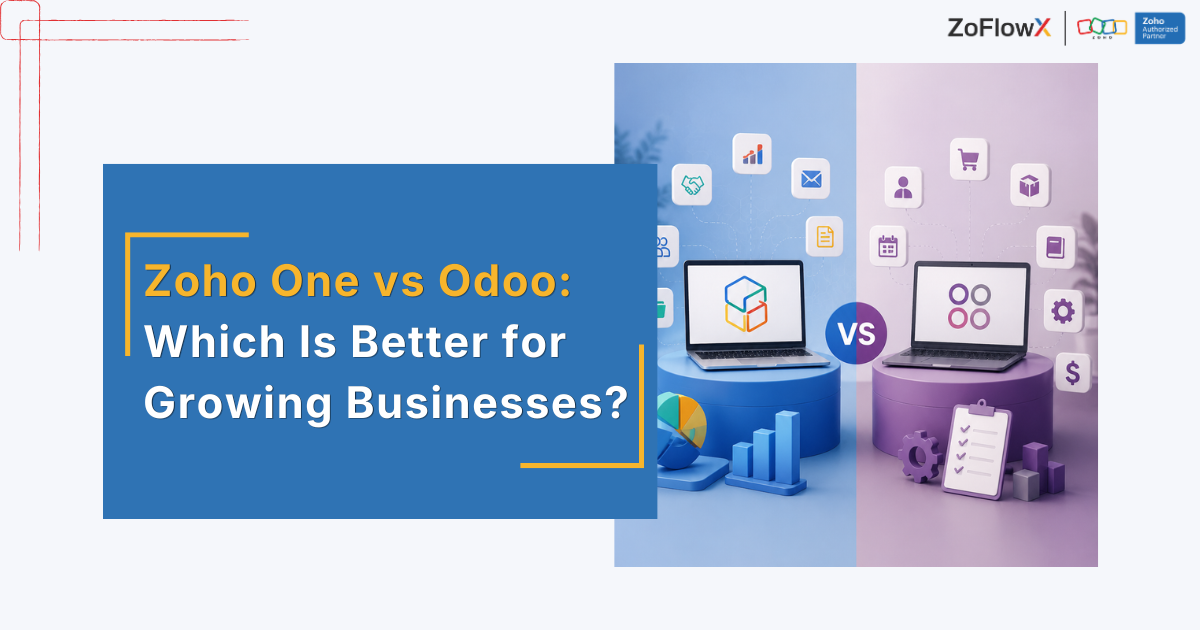
The short answer to Zoho One vs Zoho CRM Plus is this: Zoho One is an operating system for your entire business, and Zoho CRM Plus is a focused toolkit for your customer-facing teams. Zoho One packs 45 or more integrated apps covering sales, marketing, finance, HR, and operations. Zoho CRM Plus bundles about nine apps built around the customer journey. If every department needs software, Zoho One usually wins. If only sales, marketing, and support need it, CRM Plus keeps things lean.
This is the headline. Now let's dive into the details that will make you change your mind, since the price on the pricing page is not always the price you will pay.
What Is the Difference Between Zoho One and Zoho CRM Plus?
The difference between Zoho One and Zoho CRM Plus is coverage. One is a company-wide suite. The other is a department-wide suite.
Zoho CRM Plus brings the customer into a close embrace. It hosts sales, marketing, support, and analytics. All of the other things that are outside that circle, such as accounting, inventory, payroll, and recruitment, are elsewhere.
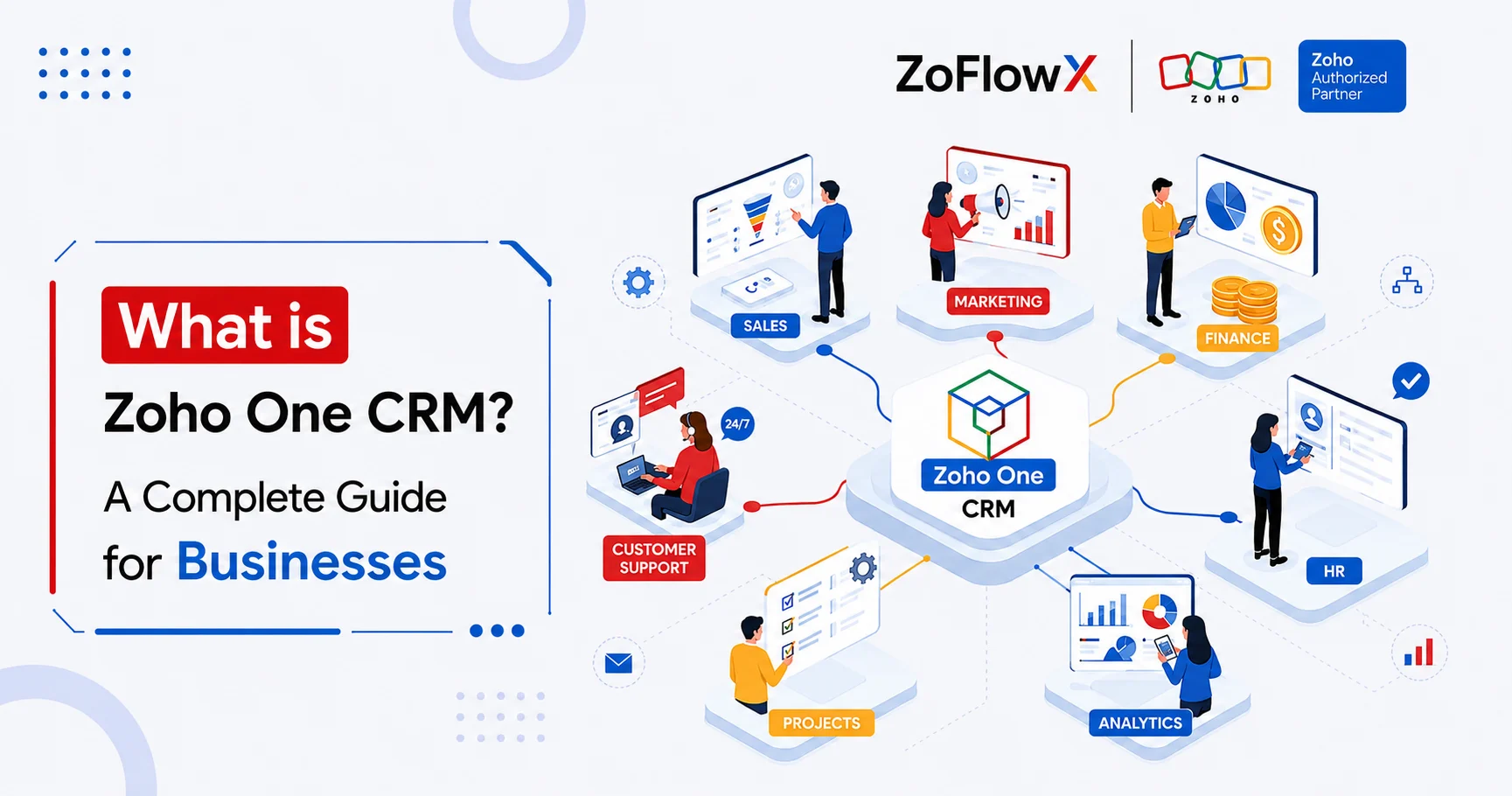
Zoho One encircles the entire business. The customer apps are in there too, but so are your books, your HR, your projects, and your low-code build tools. It is the Zoho version that has finance and sales on the same backbone.
Here is the plain-language split:
- Zoho CRM Plus: customer experience suite. Best for sales, marketing, and service teams.
- Zoho One: business operating system. Best for companies digitizing every function at once.
If you are new to the ecosystem, our primer on Zoho One CRM is a good place to see how the CRM sits inside the wider suite before you commit either way.
What Is Zoho CRM Plus, and Who Is It For?
Zoho CRM Plus is Zoho's all-in-one customer experience platform. It integrates Zoho CRM with the apps a revenue team requires to attract, convert and support customers, all using a single contact database.
The package usually comes with Zoho CRM, SalesIQ (live chat), Campaigns (email marketing), Desk (support tickets), Social, Survey, Projects, Analytics, and Sign. All apps access the same customer record, eliminating the need for marketing, sales, and support to disagree about whose data is correct.
It comes in two versions. Starter is designed for small teams, while Enterprise provides access to more features, such as larger storage tiers, more workflow rules, and more Blueprints. When automation becomes a factor, most growing sales teams end up on Enterprise.
Who it fits well:
- Sales-led teams with email campaigns and live chat.
- Support teams who wish to have tickets linked to the sales history.
- Marketing teams that require campaign data to be integrated into the same reports as pipeline data.
- Businesses that maintain finance, HR, and inventory on other tools that they are pleased with.
Who it does not fit:
- Businesses that also require Zoho for accounting, invoicing, or HR. Those are not included in CRM Plus.
A clean rollout of this suite still needs proper configuration, which is where a structured Zoho CRM implementation saves months of trial and error. The apps are powerful, but they do not organize your sales process for you.
What Is Zoho One, and What Does It Include?
Zoho One is Zoho's complete business suite. One license unlocks 45 or more applications spanning nearly every department, all under a single admin panel and one sign-on.
Consider it the whole ecosystem, not a package. You receive the CRM Plus apps, and then you receive:
- Finance: Books, Invoice, Expense, Inventory, Billing.
- HR: People and Recruit.
- Productivity: Mail, Cliq, WorkDrive, Projects, Sprints, Sign.
- Operations and build: Creator, Flow, Analytics, and Deluge automation.
The true benefit is native data flow. When a deal closes in CRM, Books can raise the invoice and Inventory can update the stock without anyone re-keying anything. That's the whole point of going all-in, right?
If you are weighing whether the bundle beats buying apps one by one, our breakdown of Zoho One vs standalone apps walks through the break-even math with real numbers.
Zoho One is a single subscription that provides all licensed users access to 45+ Zoho apps across sales, finance, HR, marketing, and operations, all from a single console, with a unified security and single sign-on.
Zoho One vs Zoho CRM Plus: How Do the Prices Compare?
Zoho One appears to be less expensive per seat than Zoho CRM Plus on paper. In reality, it will depend on the number of people you need to license. This is the area where most guides go wrong in the Zoho One vs Zoho CRM Plus comparison.
Here are the current published rates, straight from Zoho's own pricing pages.
Zoho One (per user per month):
- All-Employee: US$45 monthly, or US$37 when billed annually. You must license every employee on payroll.
- Flexible User: US$105 monthly, or US$90 when billed annually. You license any number of users you choose.
Zoho CRM Plus (per user per month):
- Starter: US$25, built for small teams.
- Enterprise: US$69 monthly, dropping to roughly US$57 when billed annually (yearly billing saves up to 18 percent).
Local taxes like GST and VAT are added on top of every rate above.
Notice the trap. Zoho One's low per-seat rate only applies if you cover the whole company. Zoho is blunt about it: your business must commit to licenses for every employee on payroll. If just 12 of your 50 staff are customer-facing, All-Employee pricing still charges for all 50. That can flip the math in favor of CRM Plus fast.
Zoho One starts at US$45 per employee per month but requires licensing everyone on payroll. Zoho CRM Plus runs from US$25 (Starter) to US$69 (Enterprise) per user, billed only for the users who need it. Zoho One wins when most of your staff use it. CRM Plus wins when only a small team does.
Prices shift by region and change often, so confirm the live numbers on Zoho's official pricing page before you sign. For a deeper look at what you actually pay, see our Zoho One cost breakdown.
How Do You Decide Between Zoho One or Zoho CRM Plus?
When you start counting people, it becomes easier to choose between Zoho One and Zoho CRM Plus. Do these steps in sequence.
- Count your total headcount. Write down every employee on payroll, not just the sales team.
- Count your Zoho users. How many people would actually log in and use a Zoho app daily?
- Divide the second number by the first. That ratio is the one that will make the difference.
- Apply the rule of thumb. If more than 40 percent of your staff need Zoho, All-Employee Zoho One is usually the cheaper, broader choice. Below that, look hard at CRM Plus or Flexible Zoho One.
- List the apps you need beyond CRM. If Books, Inventory, or HR are on that list, then Zoho One is the only suite that covers them.
- Factor in setup. Broader suites need more configuration, so budget for a proper Zoho One setup rather than a switch-it-on-and-hope approach.
Run those six steps and the answer almost always becomes obvious. The math, not the marketing, tells you which suite fits.
Which Is Better: Zoho One or Zoho CRM Plus for Growing Teams?
There is no universal winner in Zoho One vs Zoho CRM Plus. There's only the right fit for your size, your departments, and your growth plan.
Zoho CRM Plus is better when:
- Your priority is revenue, not back-office consolidation.
- Only a defined group (sales, marketing, support) needs software.
- You already run trusted tools for accounting and HR.
- You want fewer moving parts and a faster rollout.
Zoho One is better when:
- You want one system running the whole company.
- Most of your team will use at least one Zoho app.
- You need finance, HR, or custom apps alongside CRM.
- You value automation flowing across departments, not just within one.
According to ZoFlowX, growing teams often start with CRM Plus for speed, then graduate to Zoho One once finance and operations want in. That path works, and the data carries over cleanly.
Either way, the suite only pays off when it matches your real process. That usually means shaping fields, layouts, and automation to how you actually work, which is exactly what it takes to customize Zoho One into something your team adopts instead of tolerates.
When Should You Migrate From Zoho CRM Plus to Zoho One?
Migrate from Zoho CRM Plus to Zoho One when a second department wants in, or when you find yourself paying for Zoho apps outside the CRM Plus bundle.
The signals are usually loud:
- Finance asks for Zoho Books and you are already on CRM Plus.
- HR wants Zoho People or Recruit.
- You are stacking standalone app subscriptions on top of CRM Plus, and the combined bill has crept past the Zoho One rate.
- More than 40 percent of your company now uses a Zoho tool.
The good news is that the move is additive. Your CRM Plus data, workflows, and reports stay intact, and you simply gain the rest of the ecosystem around them. A planned Zoho One migration keeps that transition clean, with no lost history and no downtime for your sales team.
You should move from Zoho CRM Plus to Zoho One when a second department requires Zoho, or when standalone add-ons cause the bill to exceed the Zoho One price. The migration is additive, meaning that existing CRM data and automation are not disrupted.
What Do Zoho Implementation Experts Actually Recommend?
The honest recommendation is to buy for the org chart you will have in twelve months, not the one you have today.
We have seen companies save real money on CRM Plus, and we have seen others waste it by not following the all-employee rule on Zoho One. Both errors are due to comparing sticker prices rather than mapping who logs in.
According to ZoFlowX, the smartest buyers do a two-line audit first: who needs software, and which apps they need. That audit settles the Zoho One vs Zoho CRM Plus question in about ten minutes.
If you want that audit done properly, our Zoho implementation experts can map your headcount, your app list, and your budget before a single license is bought. It is a lot cheaper to plan the decision than to reverse it.
The Bottom Line: Which Suite Should You Buy?
When it comes to Zoho One vs Zoho CRM Plus, the winner is whichever suite matches who actually needs a login. Zoho CRM Plus is the sharp, affordable choice for customer-facing teams that want sales, marketing, and support in one place. Zoho One is the smarter long-term investment when the whole business is going digital and you want finance, HR, and operations sharing the same data. Get the headcount math right, list the apps you truly need, and the decision stops feeling risky and starts feeling obvious.
You do not have to make this call alone. Whether you lean toward CRM Plus today or Zoho One for the long run, the right setup is what turns a license into results. Talk to the ZoFlowX team, and buy with total confidence.
Call +91 8190009222 or email info@zoflowx.com, and let us match the right Zoho suite to your business from day one.
Ready to Pick the Right Zoho Suite With Confidence?
Get a free, no-pressure audit and know exactly which suite fits before you spend a rupee.
Book Your Free Zoho ConsultationFrequently Asked Questions
Is Zoho One or Zoho CRM Plus cheaper?
It depends on the headcount. Zoho One starts around US$45 per employee (US$37 billed annually) but requires licensing for every employee. Zoho CRM Plus runs from US$25 to US$69 per user and only for the users who need it. If most of your staff use Zoho, One is cheaper. If only a small team does, CRM Plus usually wins.
Does Zoho CRM Plus include Zoho Books or accounting?
No. Zoho CRM Plus is a customer experience suite and does not include finance apps like Books, Invoice, or Expense. If you need accounting inside Zoho, you either buy those apps separately or move to Zoho One, which includes the full finance stack.
How many apps do you get with Zoho One vs Zoho CRM Plus?
Zoho One includes 45 or more apps across every department. Zoho CRM Plus includes roughly nine customer-facing apps, such as CRM, Desk, Campaigns, SalesIQ, Social, Survey, Projects, Analytics, and Sign. Zoho One contains everything CRM Plus has, plus finance, HR, and operations tools.
What is the all-employee rule in Zoho One?
The all-employee rule means that to get Zoho One's lowest rate, you must license every employee on payroll, not just active users. If you only want to license a subset, you move to Flexible User pricing (around US$105 per user monthly, US$90 annually), which costs more per seat but has no headcount requirement.
Can I switch from Zoho CRM Plus to Zoho One later?
Yes. The upgrade is additive, so your CRM Plus data, workflows, dashboards, and automation stay intact. You simply gain access to the wider suite. Most teams switch when a second department wants Zoho or when standalone add-ons push the bill above the Zoho One rate.
Which is better for a small sales team, Zoho One or Zoho CRM Plus?
For a small sales team that only needs CRM, marketing, and support, Zoho CRM Plus is usually the better fit, and the Starter edition from US$25 per user keeps it affordable. It keeps costs tied to the people who use it and avoids paying for finance or HR apps you do not need yet. You can move to Zoho One as the company grows.