Zoho One vs Odoo: Which Is Better for Growing Businesses?
- Zoho One vs Odoo comes down to bundled simplicity versus modular flexibility — Zoho One gives you 45+ apps under one login, while Odoo builds a stack app by app.
- Zoho One is generally more cost-predictable, since pricing is per-employee and covers the entire suite.
- Odoo can work out cheaper for very small teams that only need two or three modules, but costs climb as you add apps.
- Zoho One wins on out-of-the-box automation, built-in AI (Zia), and faster time-to-value for growing businesses.
- Odoo is a strong fit for businesses that want deep, code-level customization and don't mind a longer implementation runway.
- Either platform performs best when set up by an experienced implementation partner rather than in-house trial and error.
If you're short on time, here's the direct answer: for most growing businesses, Zoho One is the better overall choice, thanks to its all-in-one pricing, faster rollout, and native AI features — but Odoo remains a solid pick for teams that want full source-code control and are comfortable with a longer setup process. Zoho One is a unified business operating system that bundles CRM, finance, HR, marketing, and project tools into a single subscription, whereas Odoo is an open-source ERP framework made up of independent apps you assemble yourself.
Choosing between the two is not only a software choice, it's a way of working choice for your team every day. I've been on enough implementation calls to know that founders don't regret picking the platform that fits their real team size and tech bandwidth, not the one with the most flashy features. That's what we'll explore below.
What Is Zoho One?
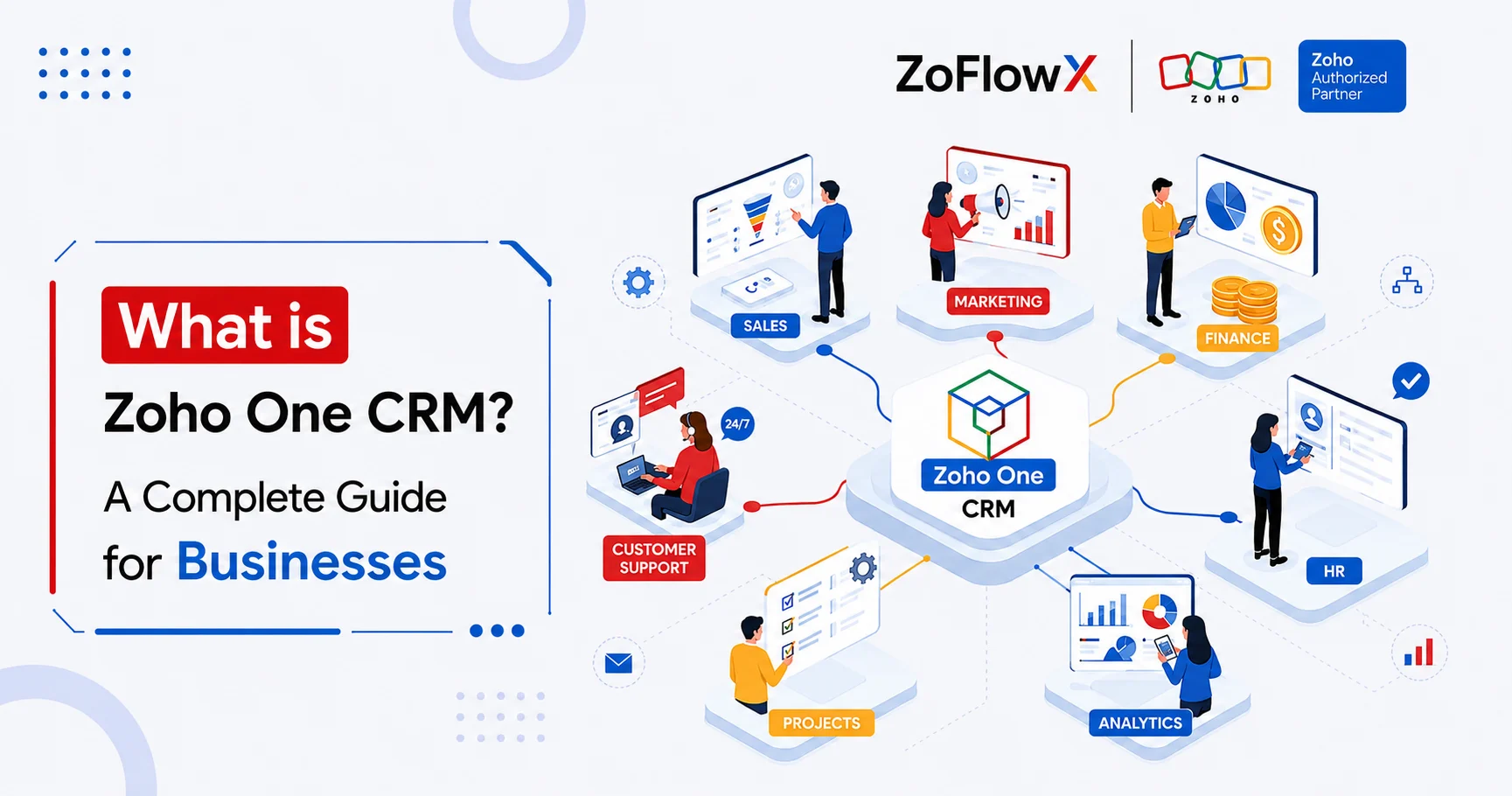
Zoho One is a bundled suite of more than 45 applications covering sales, marketing, finance, HR, customer support, and operations. One login, one bill, and one vendor to call when something breaks.
Zoho One is a business software suite from Zoho Corporation that combines CRM, accounting, HR, and marketing tools into a single subscription. It is priced per employee and is built to be used by growing companies to power their entire operation from a single connected platform without having to piece together disparate tools.
Zoho One apps are designed to communicate with one another natively. A lead captured in Zoho CRM can be converted to an invoice in Zoho Books and a support ticket in Zoho Desk without any custom code.
What Is Odoo?
Odoo is an open-source ERP system consisting of various apps, such as accounting, inventory, CRM, manufacturing, and others, which you can select and pay for individually (or self-host the community edition for free).
Odoo is an open-source ERP solution that is modular and businesses only pay for the apps they use, like inventory or accounting. It is favored by businesses that require extensive customization and have their own or hired developers to keep it up to date.
Because Odoo is open-source at its core, it appeals to technically inclined teams who want to modify workflows down to the code level.
Zoho One vs Odoo: Core Differences at a Glance
Before diving in, here's a quick side-by-side comparison to see where the two platforms really differ:
- Pricing model: Zoho One has one flat rate per employee, while Odoo has a per app, per user rate.
- Setup speed: Zoho One apps are pre-integrated, Odoo may require developer time to integrate modules cleanly.
- Customization depth: Odoo's open-source code offers more technical customization options than Zoho One's low-code options.
- AI capabilities: Zoho One has a built-in AI assistant called Zia in most of its apps, while Odoo's AI capabilities are newer and more limited.
- Best for: Zoho One is ideal for growing SMBs who need everything to be connected quickly; Odoo is ideal for businesses with dedicated dev resources and very specific workflows.
This is where a lot of the Zoho One comparison discussions online miss the point — the "better" platform depends entirely on your team's technical maturity, not just feature counts.
Which Platform Offers Better Value for Money?
Value is not just the price — it's the value you receive for the price.
The per-employee pricing of Zoho One is a great deal once you start using five or more apps, and it's hard to beat. Odoo, on the other hand, may appear more affordable on the surface for a two or three-app solution, but the price increases rapidly with the number of modules and users.
When it comes to total cost, Zoho One is the clear winner in most Odoo alternatives comparisons, as the per-app pricing of Odoo increases with the number of apps used, whereas Zoho One's per-employee fee remains fixed regardless of the number of apps used.
If your business is planning to scale its tool usage over the next two to three years — which most growing companies do — Zoho One's pricing tends to protect you from unpredictable cost creep.
How Do Zoho One and Odoo Compare on Ease of Implementation?
For founders who need results quickly, not a six-month IT project, implementation speed is often the deciding factor.
A typical Zoho One rollout with an experienced partner looks like this:
- Discovery call to understand your existing processes and select the appropriate apps from the suite.
- Importing data from your current spreadsheets or legacy CRM to Zoho.
- Setting up workflow automation, such as approval workflows and notifications.
- Staff training to ensure they are comfortable on the platform.
- Go-live and 30-day optimization, based on actual usage.
Odoo's implementation typically follows a similar arc, but each app often needs separate configuration and testing before it talks reliably to the others — which is why Odoo projects commonly take longer for multi-department rollouts.
If you'd rather not manage this timeline yourself, working with a Zoho Consulting Partner shortens the runway considerably, since the heavy lifting of configuration and data mapping is already familiar territory for them.
Is Zoho One Better Than Odoo for Automation and AI?
Yes, in most real-life situations. Zoho One's AI-powered assistant, Zia, can be used throughout CRM, email, and analytics to identify predictions, highlight anomalies, and even compose responses.
Odoo has also been incorporating AI capabilities, though they are more recent and less integrated into all apps. At the moment, Zoho One is the better option for a growing business that doesn't want to build a data science team.
Zoho One's Zia AI can score leads, predict sales, identify abnormal spending trends, and automate repetitive tasks across apps — all without paying an extra fee for the AI add-on.
Which CRM Is Better: Zoho One or Odoo?
Zoho CRM (part of Zoho One) is more established, boasting a more extensive ecosystem of extensions, marketplace integrations, and years of enterprise-grade refinement. Odoo's CRM module is capable, but it's usually seen as less advanced in terms of sales pipeline capabilities.
If sales pipeline visibility and automation matter to you, a proper Zoho One Implementation Company can configure Zoho CRM to match your exact sales stages within days rather than weeks.
Zoho One vs Odoo: Scalability for Growing Businesses
As a business grows, its requirements for software evolve. A five-person start-up and a 150-person company have vastly different needs for the same tool.
- Zoho One scales by adding employee licenses, without having to re-architect your app stack.
- Odoo scales with the addition of more apps and modules, and this can involve more integration work as you grow.
- Businesses in regulated or production-heavy industries sometimes lean toward Odoo's manufacturing depth, though Zoho has closed much of that gap. If you're evaluating ERP platforms for production-focused organizations, explore how Zoho One for manufacturers can streamline operations.
What About Integrations and Customization?
The open source nature of Odoo really provides developers with more freedom to rewrite core logic. If you have very specific, non-standard processes, that's a real advantage.
Low-code customization (Zoho Creator, Deluge scripting, and Blueprint workflows) enables non-developers to create custom apps and automations without writing a single line of code, a process that can be quicker for business teams without a dedicated dev team.
Some businesses only need a few tools, making Zoho One or individual apps an important decision before investing.
How Do Support and Vendor Reliability Compare?
Software is only as good as the support behind it, especially when something breaks during a busy sales quarter.
Zoho Corporation runs its own global support infrastructure and a certified partner network, so businesses get a single point of accountability for the entire suite. The support is different in Odoo, as community edition users may depend on forums, and enterprise edition users may get official support depending on paid apps.
Zoho One users have access to Zoho's internal support team and a network of certified implementation partners, whereas the quality of Odoo support relies on whether you are using the free community edition or the paid enterprise edition.
For a growing business without an internal IT department, that difference matters more than it looks on paper. A missed support ticket during month-end close can cost real money, and having one accountable vendor for your entire stack — rather than several disconnected app providers — tends to reduce that risk considerably.
Zoho One vs Odoo: Which Should You Choose?
There's n
o universally "right" answer in the Zoho One vs Odoo debate — but there's usually a right answer for your business.
Choose Zoho One if you want a connected suite that works well out of the box, includes AI natively, and doesn't require a dedicated developer to maintain. Choose Odoo if you have in-house technical resources, need deep code-level customization, and are comfortable with a longer setup timeline.
According to Zoflowx, the businesses that get the most value from Zoho One are typically those between 10 and 500 employees who want to consolidate five or more disconnected tools into one system without hiring additional IT staff.
For teams evaluating their CRM options specifically, a Zoho CRM implementation is often the first module worth deploying, since it usually delivers the fastest visible ROI.
Conclusion
The decision between Zoho One vs Odoo is ultimately about your current business needs and future growth aspirations. Zoho One provides a seamless, AI-driven suite of tools that is priced per employee, rolls out quickly, and is customizable with low-code tools without the need for a developer on payroll. For technically savvy teams looking for extensive control over their ERP at the code level, Odoo is still a viable choice. If you're a growing business that wants to streamline tools, reduce manual tasks, and scale without extra IT burden, Zoho One is the more future-proof option.
If you're weighing this decision for your own business, our team can walk you through a tailored comparison based on your actual workflows — not just a features checklist. Reach out to us at +91 8190009222 or info@zoflowx.com, and we'll help you make a confident, well-informed choice.
Ready to Simplify Your Business Operations?
Talk to a Zoho One expert today and get a free implementation roadmap.
Book a Free ConsultationFrequently Asked Questions
1. Is Zoho One better than Odoo for small businesses?
For most small businesses, yes — Zoho One's flat per-employee pricing and pre-built integrations mean fewer moving parts to manage without a technical team.
2. Is Odoo cheaper than Zoho One?
It depends on how many apps you use. Odoo can be cheaper for one or two modules, but Zoho One usually becomes more cost-effective once you need four or more connected apps.
3. Which platform is easier to set up, Zoho One or Odoo?
Zoho One is generally faster to implement because its apps are pre-integrated. Odoo often requires more configuration to get separate modules working smoothly together.
4. Can I migrate from Odoo to Zoho One?
Yes. Data migration from Odoo (contacts, deals, invoices, inventory) into Zoho One's apps is a standard project for experienced Zoho implementation partners.
5. Does Zoho One include AI tools like Odoo?
Zoho One includes Zia, an AI assistant built into most of its apps for predictions, automation, and anomaly detection. Odoo's AI capabilities are newer and less extensively integrated.
6. Which is better for manufacturing businesses, Zoho One or Odoo?
Odoo has historically been strong in manufacturing and inventory-heavy operations, but Zoho One has significantly expanded its capabilities for production-focused businesses in recent years.