What Is Zoho One? A Simple Guide for Growing Businesses
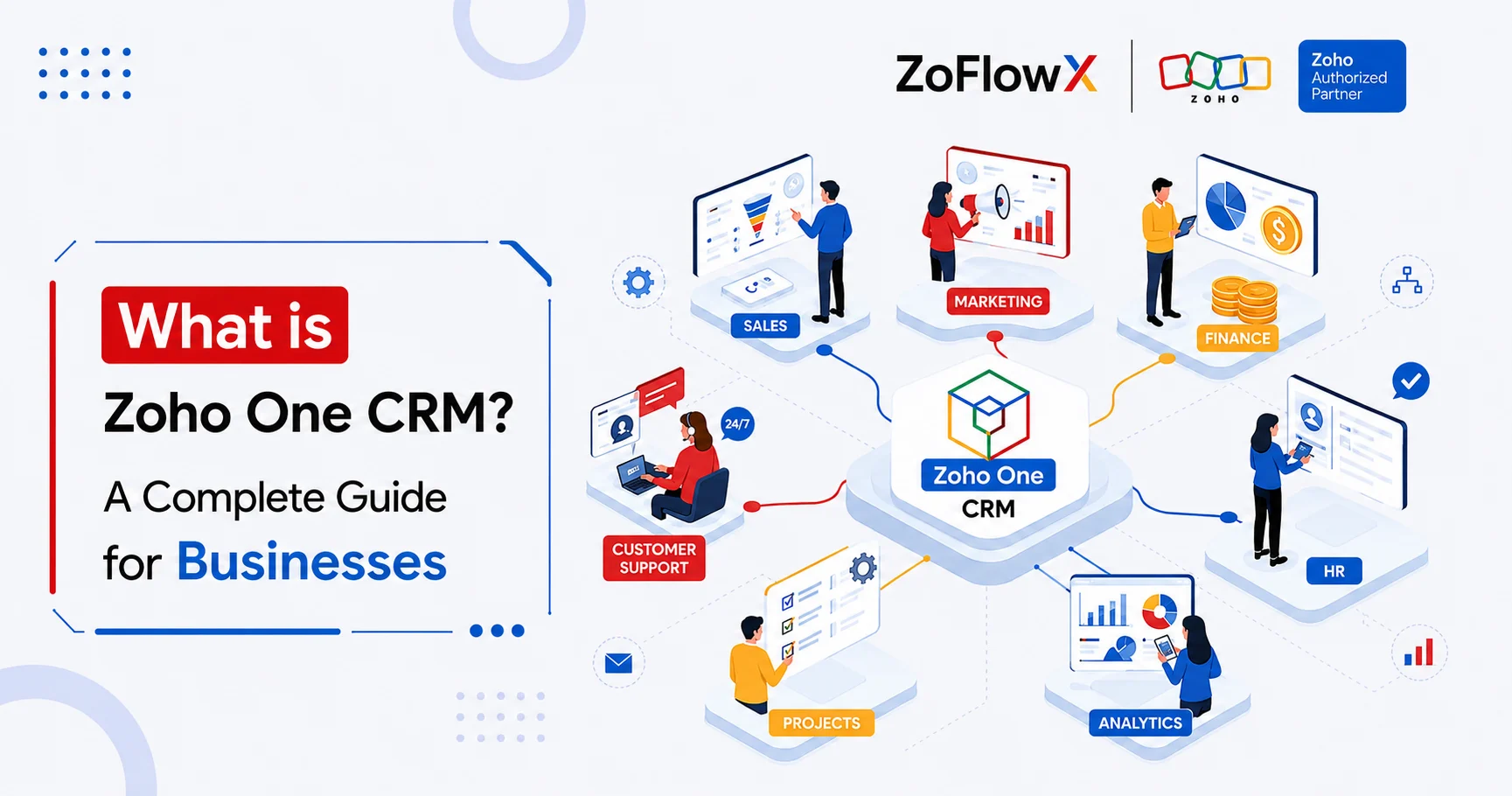
- Zoho One is a business software suite that brings sales, marketing, finance, HR, customer support, and other business tools into one ecosystem.
- Instead of using many separate subscriptions, businesses can use connected Zoho applications through one platform.
- Zoho One can be useful for growing businesses that want to reduce manual work, connect their teams, and manage business data more easily.
- It is not only for large companies. Small businesses, growing teams, and companies with multiple departments can also use Zoho One.
- The value of Zoho One depends on how many tools your business needs and whether a connected software ecosystem makes sense for your workflow.
Zoho One is a collection of 45+ business applications available through one platform. It can help businesses manage customer relationships, accounting, projects, employees, marketing, support, and other daily operations using connected software. Instead of moving data between many separate tools, teams can use applications designed to work together.
If your business currently uses one tool for sales, another for accounting, another for customer support, and several spreadsheets in between, Zoho One may be worth understanding.
The important question isn’t just “What apps are included?”, but “Can those apps solve your business problems today?”
What Is Zoho One?
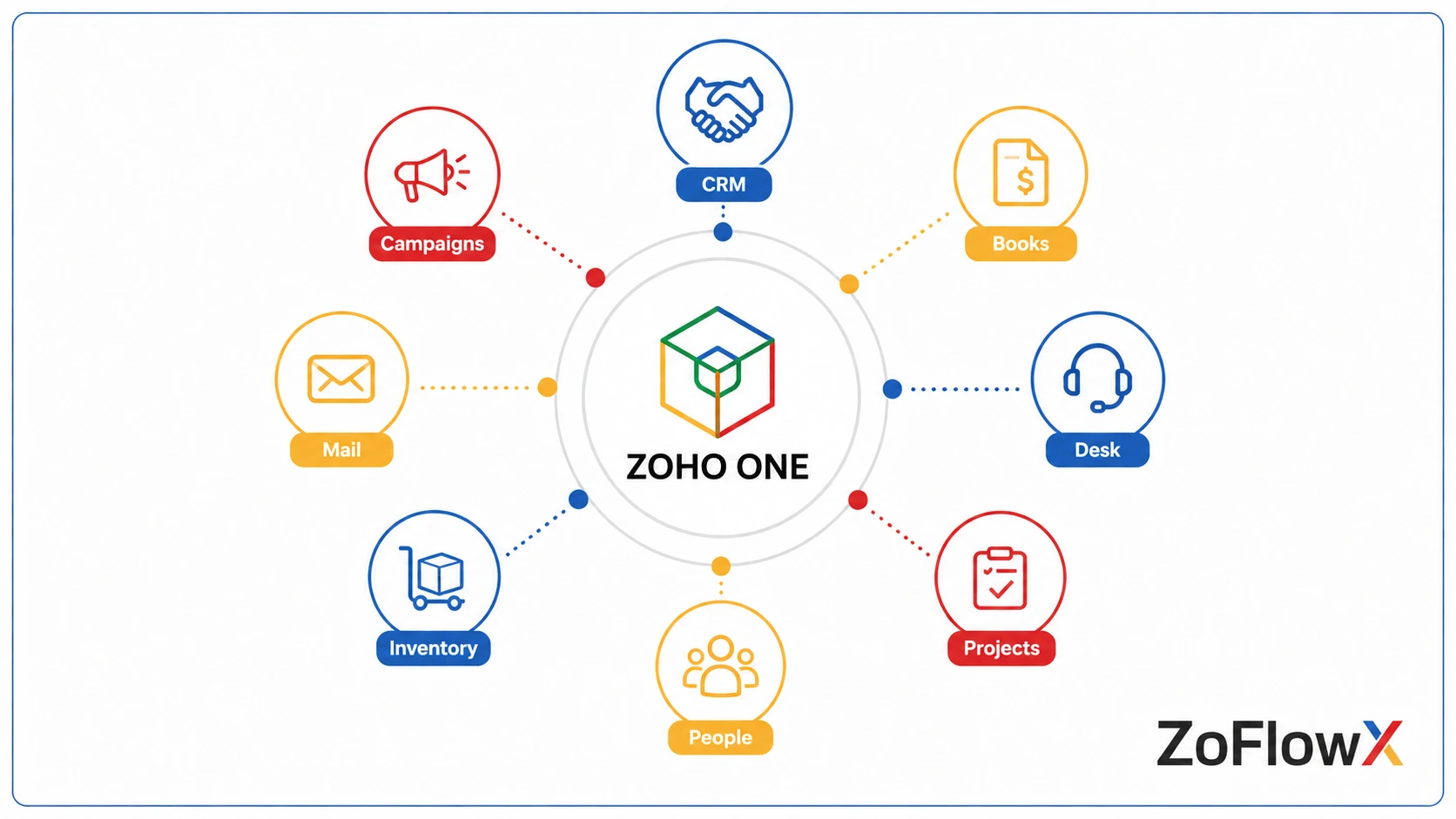
Zoho One is a business software suite that brings many Zoho applications together under one ecosystem.
According to Zoho, the suite is designed to provide businesses with a broad set of applications for different functions instead of requiring separate software from multiple vendors.
For example, a business may use:
- Zoho CRM for sales
- Zoho Books for finance
- Zoho Desk for customer support
- Zoho People for HR
- Zoho Projects for project management
- Zoho Campaigns for marketing
- Zoho Analytics for reporting
The exact apps a business uses will depend on its needs.
The main idea behind Zoho One is simple: different teams can use different tools while keeping their work more connected.
How Does Zoho One Work?
Zoho One gives businesses access to multiple applications within the Zoho ecosystem.
Each application handles a specific business function.
For example, your sales team may work in Zoho CRM while your finance team works in Zoho Books.
When the applications are connected properly, information can move between systems without your team manually entering the same details repeatedly.
Example
Imagine a new customer is added to your CRM.
That customer information may also be useful for:
- Finance
- Customer support
- Marketing
- Project delivery
Instead of every department creating a completely separate customer record, connected systems can help teams work from more consistent information.
This does not mean every process is automatic.
The actual workflow depends on how the applications are configured and how your business operates.
What Is Included in Zoho One?
Zoho One includes applications across several business areas.
The exact list can change as Zoho updates and expands its products, but the suite covers many common business functions.
Sales and Customer Management
Businesses can use tools such as:
- Zoho CRM
- Zoho SalesIQ
- Zoho Bigin
These applications can help businesses manage leads, customers, sales activities, and customer interactions.
For a sales team, this can mean having one place to track leads and deals instead of relying on spreadsheets and personal notes.
Marketing
Zoho One includes applications that can support marketing activities.
Depending on the business, these may be used for:
- Email campaigns
- Marketing automation
- Social media management
- Website visitor engagement
- Lead nurturing
A marketing team does not necessarily need every application.
The goal is to choose the tools that match the way the business works.
Finance and Accounting
Zoho One also includes finance-related applications such as:
- Zoho Books
- Zoho Invoice
- Zoho Expense
- Zoho Inventory
These tools can help businesses manage invoices, expenses, accounting, and inventory-related processes.
This is why some users also search for Zoho One finance when trying to understand whether the suite can support financial operations.
HR and Employee Management
Businesses can also use Zoho applications for employee-related tasks.
These can include:
- Employee information
- Leave management
- Attendance
- Recruitment
- HR processes
For growing businesses, having HR information in a dedicated system can be easier than managing everything through spreadsheets.
Customer Support
Zoho Desk is designed to help businesses manage customer support requests.
Support teams can use it to organize tickets, track customer issues, and manage communication.
This can be useful when customer requests are arriving through multiple channels and the team needs a clearer process.
Projects and Operations
Businesses can also use applications such as:
- Zoho Projects
- Zoho Creator
- Zoho Flow
These tools can support project management, custom business processes, and connections between applications.
Some businesses only need basic project management.
Others may have unique processes that require more flexibility.
Reporting and Analytics
Zoho Analytics can help businesses bring data together for reporting and dashboards.
For example, a business may want to understand:
- How sales are performing
- Which products are generating revenue
- How different teams are performing
- Where delays or problems are happening
The quality of the reports will still depend on the quality of the data being entered.
What Is Zoho One Used For?
Zoho One can be used for managing sales, marketing, customer relationships, accounting, HR, customer support, projects, reporting, and other business activities. It is most useful when a company needs several connected applications rather than only one standalone tool.
Instead of buying a completely separate tool for every function, a business can use applications from the same ecosystem.
Here are some common use cases.
Managing Sales
A sales team can track:
- Leads
- Contacts
- Deals
- Follow-ups
- Sales activities
Managing Customers
Customer information can be stored and managed across relevant systems.
This can make it easier for sales, support, and other teams to access the information they need.
Managing Business Finances
Finance teams can use relevant Zoho applications for accounting, invoicing, expenses, and other financial activities.
Managing Employees
HR teams can use Zoho applications to manage employee information and HR processes.
Managing Projects
Teams can plan tasks, assign work, and track project progress.
The combination of applications used will depend on the business.
Why Do Businesses Choose Zoho One?
The main reason is not simply that Zoho One includes many applications.
The bigger benefit is that businesses can use applications from the same ecosystem, which can reduce some of the problems caused by disconnected software.
One Connected Ecosystem
Many businesses start with one tool.
As the business grows, they add another tool, then another.
Over time, they may end up with separate subscriptions for sales, finance, marketing, support, and project management.
Zoho One gives businesses the option to bring many of these functions into one ecosystem.
Less Manual Data Entry
When systems are not connected, employees may need to enter the same information more than once.
For example, customer information may be copied from a CRM into an accounting system or support tool.
Connected applications can reduce some of this repeated work when the workflow is designed correctly.
More Tools Available as the Business Grows
A small business may initially need only a few applications.
As the business grows, it may later need:
- HR tools
- Customer support software
- Project management
- Marketing automation
- Advanced reporting
Zoho One gives businesses access to a wider range of applications as their needs change.
Is Zoho One Good for Small Businesses?
Zoho One can suit small businesses that are using multiple disconnected tools or expect to add more business functions as they grow. If a business only needs one simple application, buying that application separately may be a better option.
Zoho One may be worth considering if your business:
- Uses several software subscriptions
- Manages important work through spreadsheets
- Re-enters the same data in multiple places
- Wants sales and customer information to be better organized
- Plans to grow its team
- Needs tools for more than one department
The best decision depends on what your business actually needs today and what it may need in the future.
Can Zoho One Help Sales Teams?
Yes. Zoho One includes sales-related applications that can help teams manage leads, customer information, deals, and sales activities.
For a sales team, the most relevant application may be Zoho CRM.
A sales process can involve several steps, such as:
- Capturing a lead
- Assigning the lead
- Following up
- Moving the opportunity through the sales process
- Tracking the final outcome
The exact process will differ from one business to another.
The tools are there, but each business needs to decide how they fit into its own workflow.
Can Zoho One Be Used for Customers and Clients?
Yes. One reason businesses consider Zoho One is that customer information can be relevant across several departments.
A sales team may need customer details in the CRM.
A support team may need the same information when handling a request, while a finance team may need customer details for invoicing.
When systems are connected properly, businesses can reduce the need to maintain completely separate customer records.
How Is Zoho One Different From Buying Individual Apps?
Zoho offers many applications separately.
Zoho One brings a large collection of those applications together under one suite.
The better option depends on how many applications your business actually needs. If you are comparing Zoho One with individual apps, the key question is whether a full suite provides better value than paying separately for only the tools you use.
Buying Individual Apps May Make Sense When:
- You only need one or two applications
- Your business processes are simple
- You do not expect to need additional tools soon
Zoho One May Make More Sense When:
- You need applications across several departments
- Your business is growing
- You want to reduce the number of separate software subscriptions
- You want more connected business data
There is no single answer that works for every company.
The right choice depends on the size of your business, your current software, your team, and your future plans.
Is Zoho One an ERP?
Not exactly in the traditional sense.
Zoho One includes applications that can support many business functions commonly associated with ERP systems, such as finance, operations, inventory, and reporting.
However, Zoho One is a broader business software suite rather than a single traditional ERP product.
For some businesses, the combination of applications may cover many of their operational needs.
For others, especially businesses with highly specialized processes, additional tools or customization may be required.
What Are the Main Benefits of Zoho One?
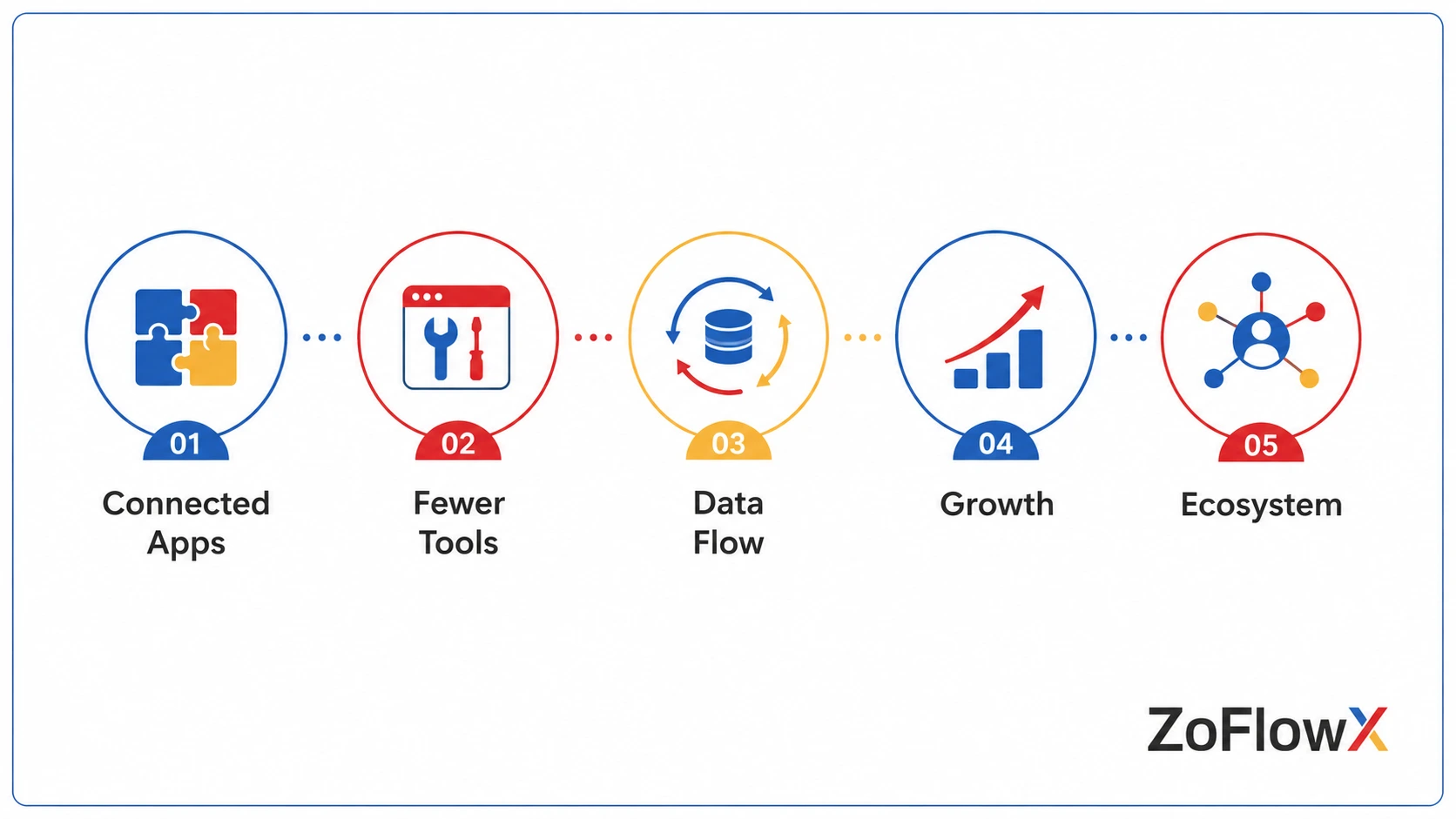
The benefits depend on how a business uses the platform.
However, the main potential advantages include the following.
Connected Applications
Different teams can use applications from the same ecosystem.
Fewer Separate Software Tools
A business may be able to reduce the number of individual subscriptions it manages.
Better Data Flow
Connected applications can reduce some manual data movement between departments.
Room to Grow
Businesses can start with the applications they need and explore additional tools as their requirements change.
One Broader Ecosystem
Instead of managing software from many vendors, businesses can work within a larger connected suite.
What Should You Consider Before Choosing Zoho One?
Zoho One is a large suite.
That can be an advantage, but businesses should avoid subscribing simply because there are many applications available.
Before choosing Zoho One, ask yourself:
- Which software tools does my business currently use?
- Which of those tools are causing problems?
- Which departments need better-connected information?
- Are we paying for software that employees rarely use?
- Do we expect to add more teams or business functions?
- Do we need a few tools or a complete business software ecosystem?
You do not need to use every application in Zoho One.
In many cases, it makes more sense to start with the applications that solve your immediate problems.
Who Is Zoho One Best For?
Zoho One can be useful for several types of businesses.
Growing Businesses
A growing business may need more tools as new departments and employees are added.
Zoho One can provide access to applications that support those changing needs.
Businesses Using Too Many Separate Tools
If your team constantly moves between different applications, a connected ecosystem may simplify some processes.
Sales-Focused Businesses
Businesses with active sales teams may use Zoho CRM and related applications to manage leads and customer interactions.
Businesses With Multiple Departments
Companies with sales, marketing, finance, HR, and support teams may benefit from having more connected systems.
Different types of businesses may need Zoho One for different reasons. You can also explore the best-fit industries to understand where a connected suite can be particularly useful.
The important point is that Zoho One should match your business needs.
A large software suite is not automatically better if your business only needs a small number of tools.
What Are the Limitations of Zoho One?
A balanced decision should also consider the possible limitations.
It Includes Many Applications
The number of applications can feel overwhelming for a new user.
You do not need to learn everything at once.
Different Businesses Need Different Configurations
There is no single setup that works perfectly for every company.
Your sales process, reporting needs, team structure, and business workflow all matter.
More Features Can Mean More Decisions
Having many available applications gives businesses flexibility.
It also means they need to decide which tools they actually need.
The best approach is usually to focus on real business problems rather than trying to use every application.
Is Zoho One Right for Your Business?
A simple way to decide is to look at your current situation.
Zoho One may be worth considering if you answer yes to several of these questions:
- Are we using multiple disconnected software tools?
- Does our team enter the same information in different systems?
- Are important business processes still managed through spreadsheets?
- Do different departments struggle to access the information they need?
- Are we planning to grow our team or add new functions?
- Would a connected ecosystem make our daily work easier?
If the answer is yes, Zoho One may be worth exploring.
If your business only needs one simple application, a full suite may not be necessary.
The goal is not to buy more software. The goal is to choose software that solves real business problems.
Before making a decision, it can also help to review current Zoho One pricing and compare the cost with the tools you already pay for.
If you decide Zoho One is the right fit, planning how you will configure and roll it out is the next step. See what getting started with Zoho One implementation looks like for your business.
Conclusion: What Is Zoho One and Is It Worth Considering?
Zoho One is a connected business software suite that brings together applications for sales, marketing, finance, HR, customer support, projects, reporting, and other business activities.
For businesses using several disconnected tools, Zoho One can provide a simpler way to manage software and connect information across teams.
According to Zoho, the suite is designed to give businesses access to a broad range of applications within one ecosystem. Whether it is the right choice depends on your current software, business processes, team size, and future plans.
If you are still unsure whether Zoho One fits your business, speaking with someone who understands your requirements can help you make a more confident decision before spending time and money on the wrong setup.
You can contact ZoFlowX at +91 8190009222 or info@zoflowx.com to discuss your business requirements and understand whether Zoho One is the right fit.
Choose software based on what your business actually needs today—and where you want it to go next.
Don't Let the Wrong Software Stack Slow You Down
Find out whether Zoho One fits your business before disconnected tools create more work for your tea
Find Out if Zoho One FitsFrequently Asked Questions
What is Zoho One in simple terms?
Zoho One is a business software suite that gives companies access to 45+ applications for functions such as sales, finance, marketing, HR, customer support, and operations. The applications are part of the Zoho ecosystem and can be used together based on a business's needs.
What is included in Zoho One?
Zoho One includes a wide range of applications, including tools for CRM, accounting, invoicing, customer support, project management, HR, marketing, analytics, collaboration, and more.
What is Zoho One used for?
Zoho One is used to manage different parts of a business through connected applications. Businesses can use it for sales, customer management, marketing, finance, HR, customer support, projects, reporting, and other business activities.
How does Zoho One work?
Zoho One gives businesses access to multiple applications within the Zoho ecosystem. Each application handles a specific business function, and relevant applications can be connected to help information move between different teams and processes.
Is Zoho One good for small businesses?
Zoho One can be a good option for small businesses that need several business applications or expect to grow. However, if a business only needs one or two simple tools, purchasing those tools separately may be more suitable.
Can Zoho One be used for sales teams?
Yes. Zoho One includes sales-related applications, including Zoho CRM, that can help businesses manage leads, contacts, deals, follow-ups, and other sales activities.
Can Zoho One be used for finance?
Yes. Zoho One includes finance-related applications that can support accounting, invoicing, expenses, inventory, and other financial processes.
Is Zoho One the same as an ERP?
Zoho One is not a traditional single ERP product. It is a broader suite of connected business applications. Some of its applications can support finance, operations, inventory, and other functions commonly associated with ERP systems.
Do I need to use every app in Zoho One?
No. Businesses can focus on the applications that are relevant to their current needs. As the business grows or processes change, additional applications can be explored.