Zoho CRM vs Salesforce: Pricing, Features & Which Is Better in 2026?
- Zoho CRM is generally more affordable and may be easier for small and growing teams to manage.
- Salesforce offers deeper customization and can be a stronger fit for large organizations with complex processes.
- Both platforms offer free options, but the limits and available features differ.
- The real cost includes more than subscription fees. Implementation, customization, migration, training, and support can also affect your budget.
- The right choice depends on your team size, budget, sales process, technical resources, and future plans.
If you are comparing Zoho CRM vs Salesforce, you are probably close to making a CRM decision. Both platforms can manage leads, customers, deals, and sales activity, but they are designed for different levels of complexity.
Zoho CRM may be the better fit if you want lower costs, easier adoption, and strong CRM features without building a highly complex system. Salesforce may make more sense if your business needs deep customization, complex processes, and dedicated resources to manage the platform.
The sections below compare the two platforms based on the factors that usually matter before making a purchase or implementation decision.
Zoho CRM vs Salesforce: Pricing & Features at a Glance
Zoho CRM is generally more affordable and easier for smaller teams to adopt, making it a practical option for businesses comparing Zoho CRM pricing 2026 and small business CRM features, while Salesforce offers deeper customization and enterprise-level flexibility. Zoho CRM may suit startups and growing businesses, whereas Salesforce can be a stronger option for organizations with complex processes and dedicated CRM resources.
Factor | Zoho CRM | Salesforce |
Pricing | Generally lower | Generally higher |
Free option | Available | Available |
Ease of use | Easier for many small teams | More complex for advanced setups |
Customization | Strong | More extensive |
Automation | Strong for sales processes | Highly advanced for complex operations |
AI capabilities | Zia and related capabilities | Salesforce AI capabilities |
Integrations | Zoho ecosystem and third-party apps | Large AppExchange ecosystem |
Scalability | Suitable for growing businesses | Strong for complex enterprise environments |
Implementation | Can be simpler for standard setups | Can require more configuration |
Best fit | Small to mid-sized businesses | Larger or highly complex organizations |
Pricing, features, and capabilities can change by edition, add-on, and billing cycle. Always check the current vendor details before purchasing.
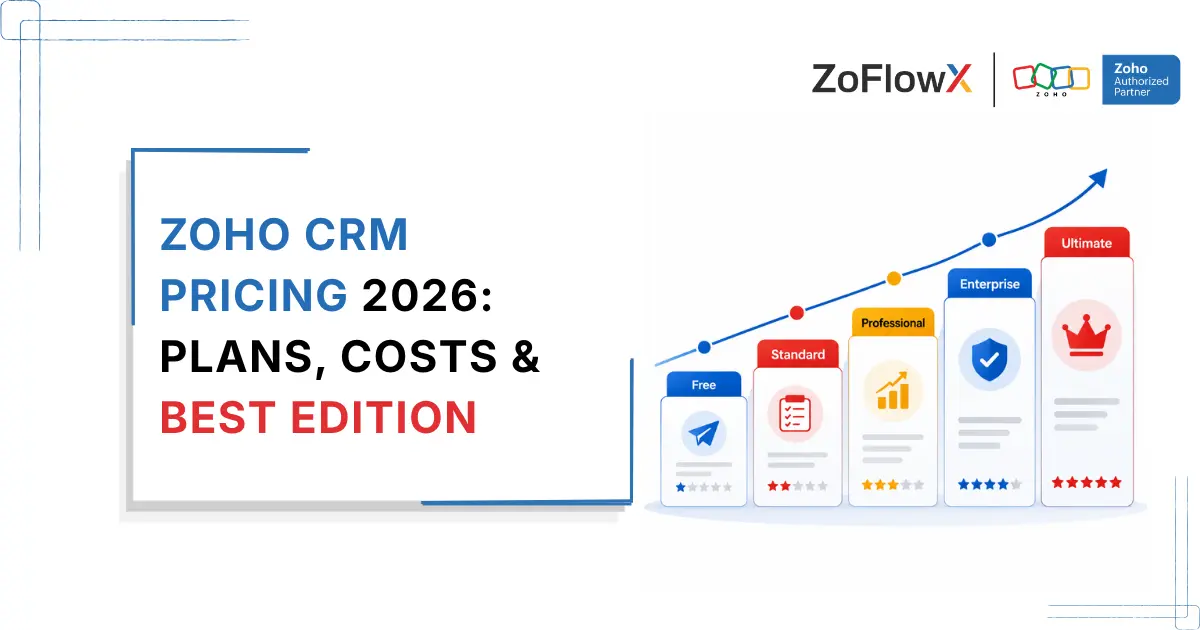
Zoho CRM Pricing 2026: Which Is Cheaper, Zoho CRM or Salesforce?
Zoho CRM generally has a lower entry price than Salesforce, which makes Zoho CRM pricing 2026 an important consideration for small businesses that are paying for several users.
However, subscription price alone should not decide the winner.
A CRM that costs less but requires additional products, customization, or manual work may not always be cheaper in the long run. At the same time, paying for enterprise-level features that your team will never use can also waste money.
When comparing costs, look at:
- Number of users
- CRM edition
- Monthly or annual billing
- Required add-ons
- Implementation
- Customization
- Data migration
- Training and support
For a detailed breakdown of Zoho's editions and costs, you can also read our guide to Zoho CRM pricing and plans.
Which One Gives Better ROI?
The better ROI depends on how much of the platform your team actually uses.
Zoho CRM may provide better value when your business needs a practical CRM for managing leads, deals, automation, and reporting without paying for enterprise-level complexity.
Salesforce may justify its higher cost when your organization genuinely needs advanced customization, large-scale integrations, or highly complex processes.
The better question isn't “Which CRM is cheaper?” but “Which CRM gives us what we need without paying for features we won't use?”
Zoho CRM Free Plan Features 2026: Which CRM Has the Better Free Plan?
Both Zoho CRM and Salesforce offer free options, but the plans have different limits.
Zoho CRM's Free edition is designed for basic CRM use and can be useful for very small teams looking for Zoho CRM free plan features 2026 to manage leads, contacts, deals, and sales activities.
Salesforce also offers free options, but businesses should carefully review the current user limits and included features before choosing a plan.
The GSC data shows that this page is receiving strong impressions for free-plan queries. For that reason, this comparison should answer the question clearly without turning this article into a separate free-plan guide.
If the free edition is a major factor in your decision, see our complete breakdown of Zoho CRM's free plan, including its features and limits.
When Is a Free CRM No Longer Enough?
You may need to move to a paid plan when:
- Your team grows beyond the available user limit.
- You need deeper automation.
- Your sales process requires more customization.
- You need advanced reporting.
- You need more integrations.
- Your CRM becomes central to several business processes.
A free CRM can be a good starting point, but it should not limit your ability to grow.
Zoho CRM Small Business Features 2026: How Do the Features Compare?
Both Zoho CRM and Salesforce cover the main functions businesses expect from a CRM, including the core Zoho CRM small business features that growing teams typically need.
These include:
- Lead management
- Contact management
- Deal and pipeline tracking
- Tasks and follow-ups
- Sales automation
- Reporting
- Mobile access
- Integrations
The difference is usually in the depth of those capabilities and the amount of configuration needed.
For a straightforward sales process, both platforms may offer more than enough functionality. The bigger difference becomes visible when you need complex workflows, advanced reporting, or highly customized processes.
Which CRM Is Easier to Use?
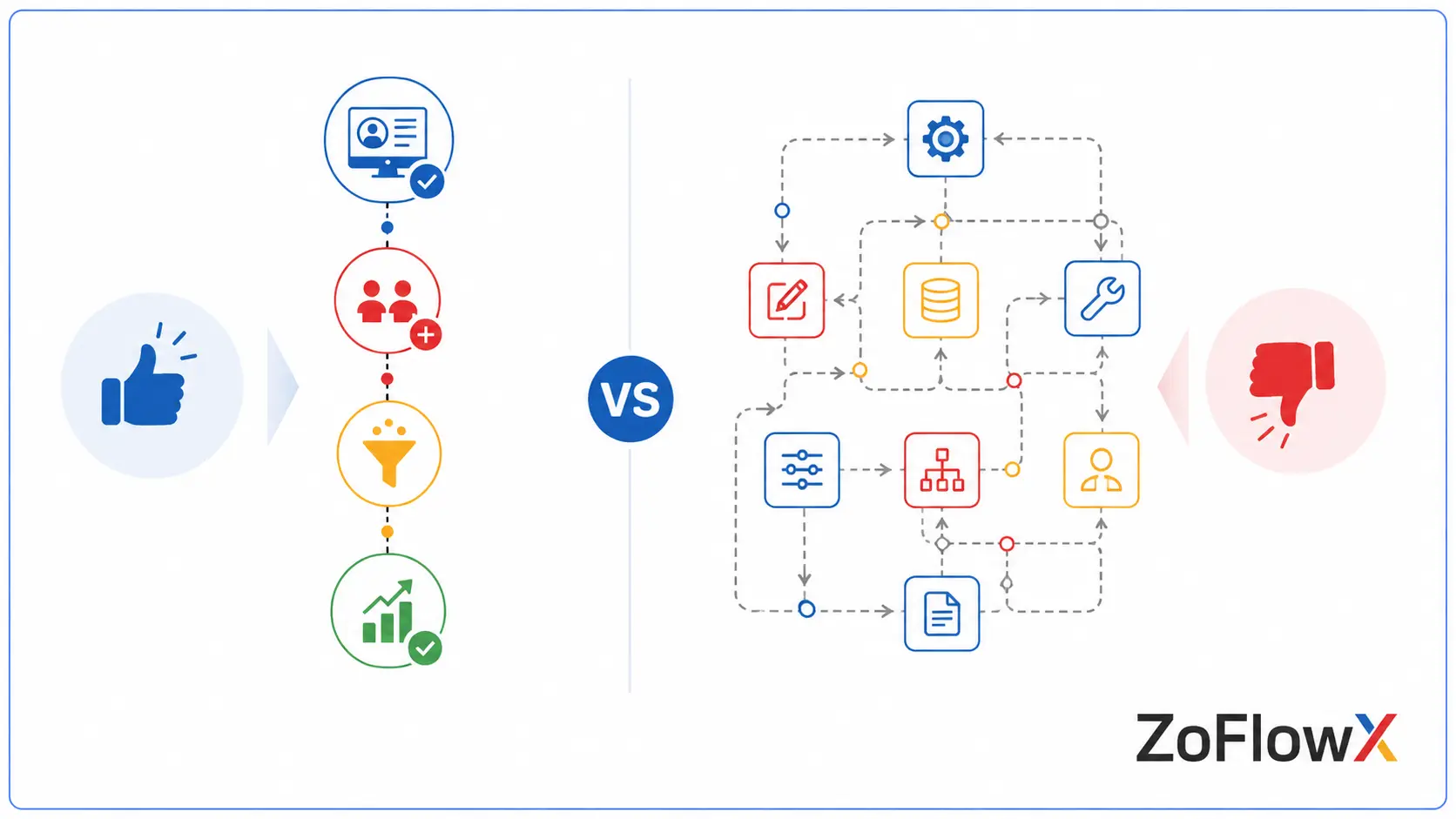
For many small and mid-sized teams, Zoho CRM may feel easier to start using.
A smaller business may not have a dedicated CRM administrator. In that situation, a platform that is easier to understand and manage can reduce the time spent maintaining the system.
Salesforce offers more flexibility, but complex flexibility can also require more planning and administration.
This does not mean Salesforce is difficult for every business. Organizations with experienced CRM teams may benefit from the additional control.
The better choice depends on who will manage the CRM after implementation.
How Do Sales Automation Features Compare?
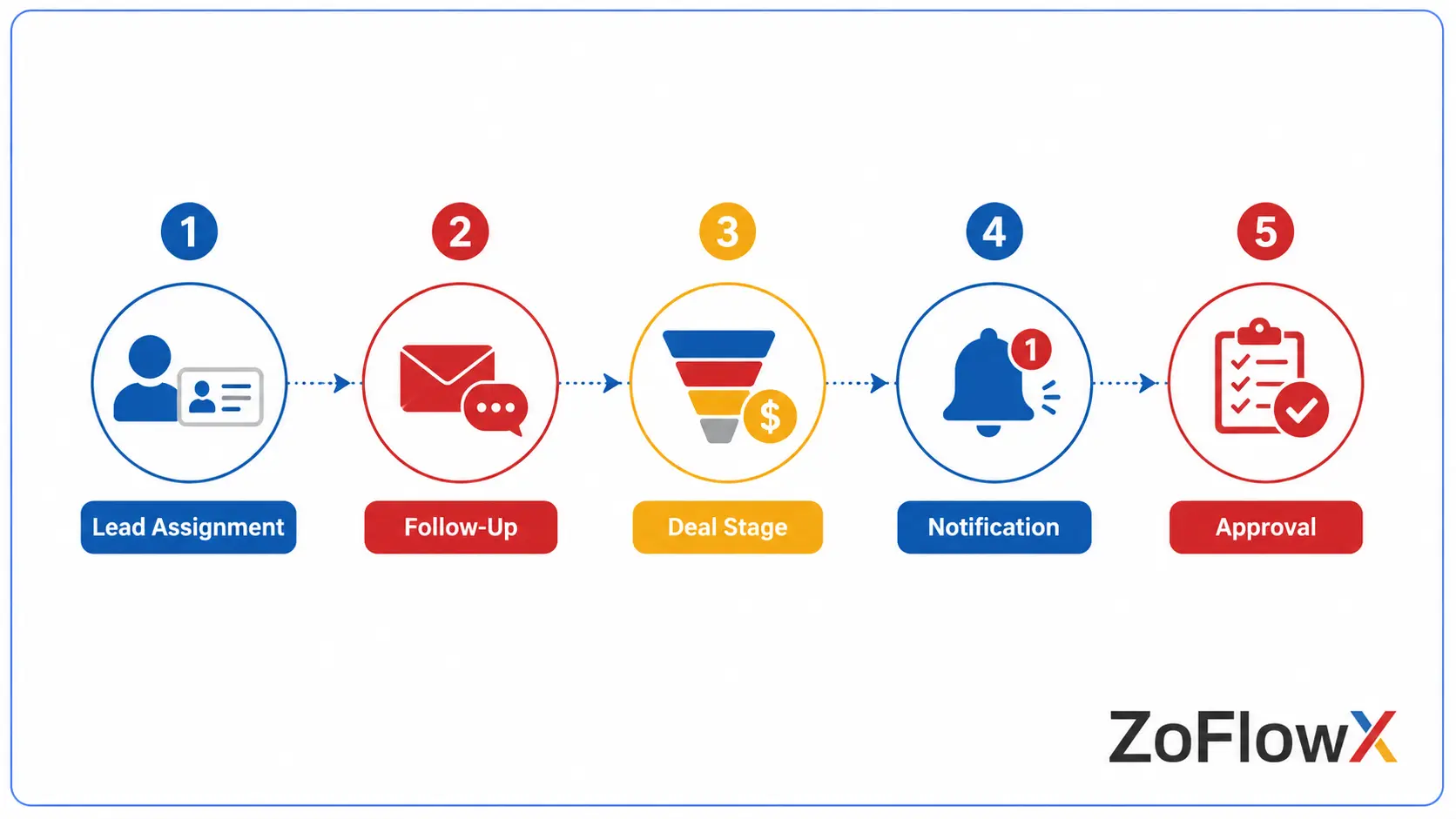
Both platforms can automate repetitive sales tasks.
Examples include:
- Assigning leads.
- Sending follow-up reminders.
- Updating records.
- Moving deals through stages.
- Triggering notifications.
- Managing approval processes.
Zoho CRM may be sufficient for many businesses that want to automate common sales activities without building highly complex processes.
Salesforce can provide more depth for organizations with advanced workflow and process requirements.
Before choosing based on automation, list the tasks your team currently performs manually. This gives you a clearer way to compare which platform can handle those tasks.
Which Has Better AI and Analytics?
Both platforms provide AI and analytics capabilities, although the available features can depend on the edition and products you choose.
Zoho CRM uses Zia for various AI-related capabilities. Salesforce provides AI capabilities across its platform and related products.
Instead of choosing a CRM simply because it has more AI features, ask:
- What decisions do we want AI to support?
- Do we have enough clean data?
- Will our team actually use these features?
- Are they included in the edition we plan to buy?
AI can be useful, but it should support a real sales process rather than become an expensive feature that nobody uses.
Zoho CRM vs Salesforce: Which CRM Is Better for Customization?
Salesforce is known for its deep customization capabilities.
Larger organizations can build complex processes, workflows, data structures, and integrations around their specific operations.
Zoho CRM also provides substantial customization. Businesses can adapt fields, modules, layouts, workflows, and other parts of the CRM to suit their processes.
The decision usually comes down to complexity.
If your business needs flexibility without maintaining a highly complex CRM environment, Zoho CRM may be enough.
If your organization has unusual processes that require extensive customization across multiple departments, Salesforce may provide more depth.
Zoho CRM vs Salesforce: How Do Integrations Compare?
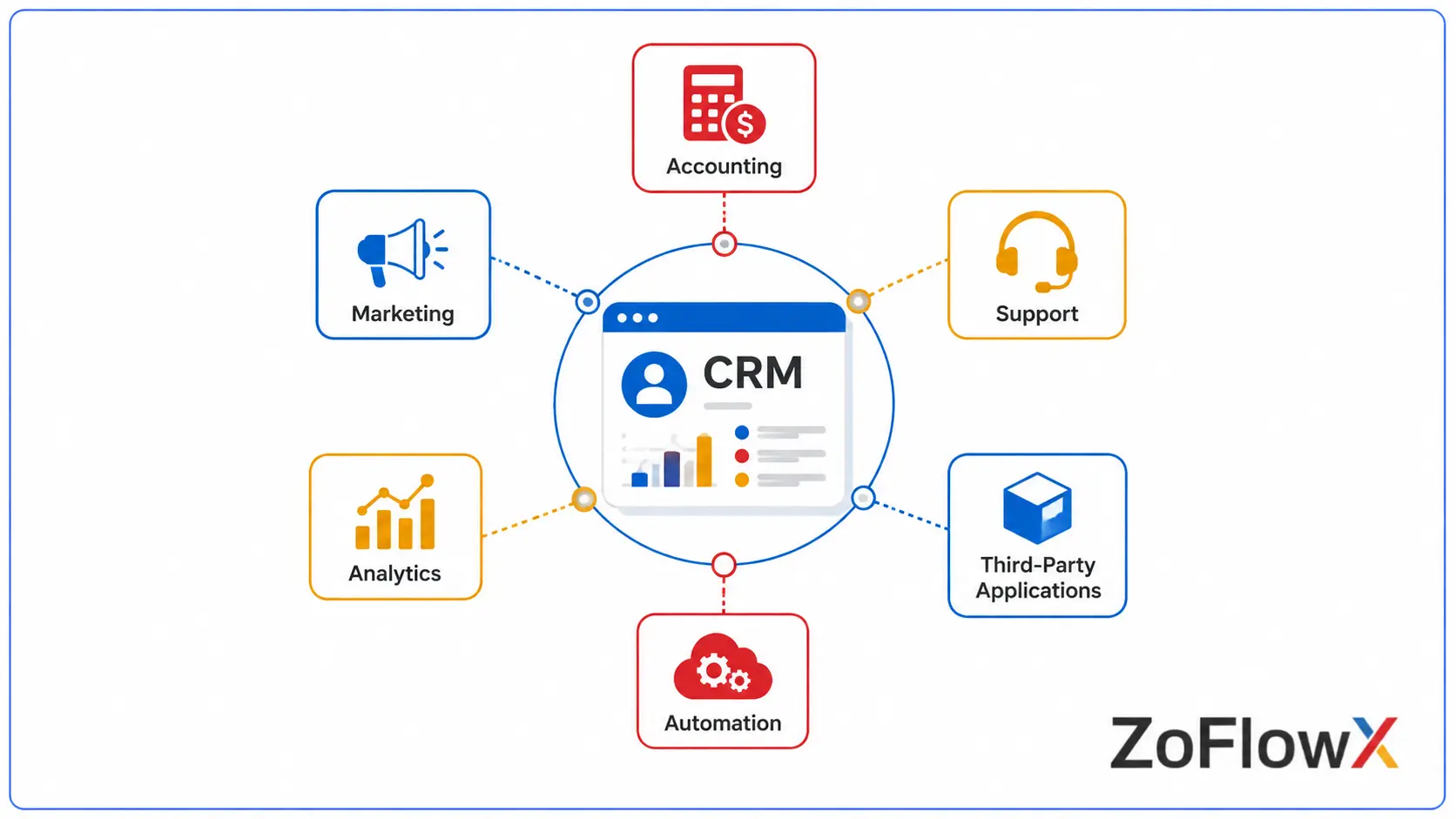
Salesforce has a large ecosystem of applications and integrations through AppExchange. This can be useful for organizations that rely on many specialized tools.
Zoho CRM also connects with other Zoho applications and third-party tools. If your business already uses products such as Zoho Books, Zoho Desk, Zoho Campaigns, or Zoho Analytics, keeping systems within the Zoho ecosystem may simplify how data moves between applications.
Before choosing either platform, make a list of the tools your business already depends on.
Then check:
- Is the integration available?
- Does it support the data you need?
- Does it require an additional cost?
- Will it need custom development?
Zoho CRM vs Salesforce for Startups and Small Businesses: Which CRM Scales Better?
Both platforms can scale, but they scale differently.
Zoho CRM can support businesses as they grow from a small team into a larger organization, making it relevant for businesses comparing Zoho CRM vs Salesforce for startups. Businesses can move to higher editions and add more capabilities when required.
Salesforce is particularly well known for supporting complex enterprise environments with multiple teams, processes, and integrations.
The key question is not whether the CRM can scale. Both can.
The real question is whether the cost and complexity of that growth match your business. A startup does not necessarily need an enterprise-level CRM on day one. At the same time, a rapidly growing company should avoid choosing a system that it will quickly outgrow.
How Do Implementation and Total Costs Compare?
The subscription price is only one part of the investment.
Your total CRM cost may include:
- Software licenses
- Implementation
- Customization
- Data migration
- Integrations
- User training
- Ongoing support
A simple CRM setup may require much less work than a project involving multiple teams, custom processes, large amounts of data, and several integrations.
Zoho CRM implementations can range from relatively simple configurations to highly customized projects. Salesforce implementations can also vary significantly depending on complexity.
Before choosing either platform, ask for a realistic view of what the complete project will involve.
The cheapest monthly subscription is not always the lowest total cost.
Zoho CRM Small Business Features, Pricing & Free Plan
Zoho CRM may be a strong option for small businesses that need to organize leads, manage deals, automate follow-ups, and improve sales visibility.
Smaller teams often care about:
- Affordable pricing
- Ease of use
- Faster adoption
- Basic to advanced automation
- Room to grow
Salesforce can also work for small businesses. However, the company should consider whether its requirements justify the additional cost and complexity.
A small business should not choose a CRM based only on the biggest feature list. The best system is one that the team can afford, understand, and use consistently.
Is Salesforce Better for Enterprises?
Salesforce can be a strong option for large organizations with complex business requirements.
For example:
- Multiple sales teams.
- Different workflows across departments.
- Complex approval processes.
- Large volumes of customer data.
- Extensive integrations.
- Dedicated CRM administrators.
These requirements may justify a more complex platform.
However, a large business does not automatically need Salesforce. If its processes are relatively straightforward, a simpler platform may still be the better choice.
Business complexity matters more than business size alone.
How to Migrate From Salesforce to Zoho CRM
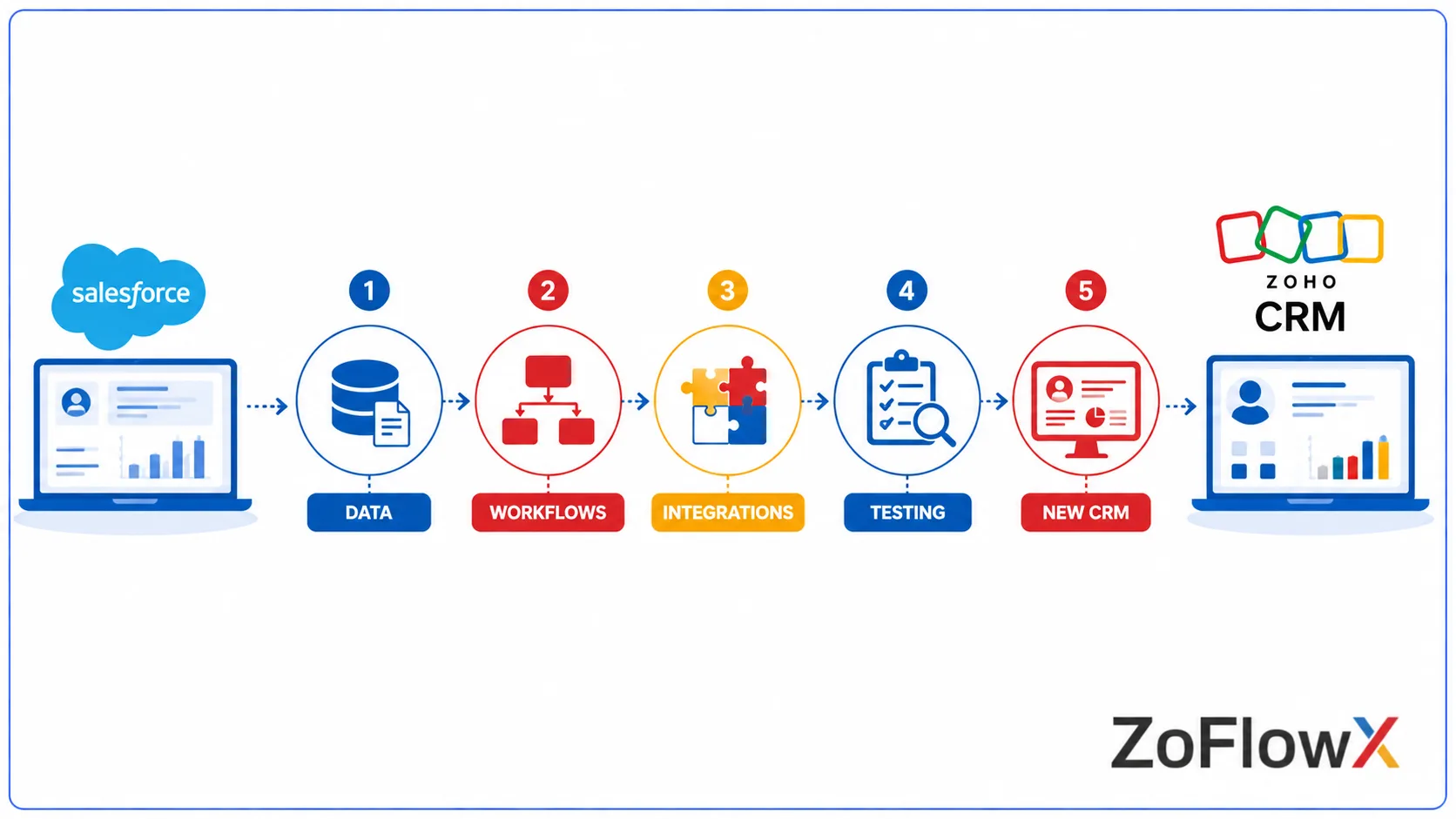
Switching platforms should be a business decision, not just a reaction to subscription costs.
Before moving, review:
- Your current Salesforce costs.
- Features your team actually uses.
- Custom workflows.
- Data that needs to move.
- Integrations that must continue working.
- Processes that need to be rebuilt.
If Zoho CRM can support your actual requirements with less cost or complexity, switching may make sense.
If you have already decided to make the move, our guide to moving from Salesforce to Zoho CRM explains the migration process in more detail.
When Is Zoho CRM the Better Choice?
Zoho CRM may be the better choice when:
- You want lower CRM costs.
- Your team needs an easier starting point.
- You run a startup, small business, or growing company.
- You need strong sales automation without excessive complexity.
- You already use other Zoho products.
- You want customization without maintaining a highly complex CRM system.
For a broader view beyond this direct comparison, you can also explore Zoho CRM advantages and limitations before making your final decision.
When Does Salesforce Make More Sense?
Salesforce may be the better choice when:
- Your business has highly complex processes.
- You need deep customization.
- Multiple departments depend on the CRM.
- You require a large ecosystem of specialized applications.
- You have dedicated CRM administrators or technical resources.
- Your organization can justify the higher investment.
Salesforce is not automatically the better CRM because it has more advanced capabilities.
Those capabilities need to match a real business requirement.
Zoho CRM vs Salesforce Comparison: Which CRM Should You Choose?
Here is the simplest decision framework.
Choose Zoho CRM if your priority is:
- Affordability.
- Ease of use.
- Faster adoption.
- Sales automation.
- Flexible customization.
- A practical system for a growing business.
Choose Salesforce if your priority is:
- Enterprise-level complexity.
- Deep customization.
- Large-scale integrations.
- Multiple advanced business processes.
- Extensive administrative control.
The right CRM is not the one with the longest feature list.
It is the one that fits your business without creating unnecessary cost, complexity, or work for your team.
Final Verdict: Zoho CRM or Salesforce?
Zoho CRM and Salesforce are both capable CRM platforms, but they are not designed for exactly the same type of buyer.
Zoho CRM may offer better value for businesses that want a flexible and affordable CRM that can support sales growth without unnecessary complexity.
Salesforce may be worth the investment for organizations with complex processes, large teams, and advanced customization requirements.
The final decision should come down to your budget, team size, sales process, technical resources, and future plans.
If you decide that Zoho CRM is the better fit, getting the implementation right is just as important as choosing the platform. ZoFlowX can help with planning a Zoho CRM setup around your actual business requirements.
Call +91 8190009222 or email info@zoflowx.com to discuss your requirements before making an expensive CRM decision.
Still Not Sure Which CRM Is Right for You?
Compare your needs, budget, and sales process before choosing Zoho CRM or Salesforce.
Talk to a CRM ExpertFrequently Asked Questions
Is Zoho CRM better than Salesforce?
It depends on your business. Zoho CRM may be a better fit for companies that want lower costs and a simpler system. Salesforce may be better for organizations with complex processes and advanced customization requirements.
Which Is More Affordable: Salesforce or Zoho CRM?
Zoho CRM generally has lower subscription pricing than Salesforce. Your total cost will also depend on users, editions, implementation, customization, integrations, and support.
Does Zoho CRM Have a Free Plan? What Are the Free Plan Features in 2026?
Yes. Zoho CRM offers a Free edition with limits on users and available features. It can be useful for very small teams that need basic CRM functionality.
Which CRM is easier to use?
Many smaller teams may find Zoho CRM easier to get started with. Salesforce provides more flexibility but can require more configuration for complex setups.
Is Salesforce more customizable than Zoho CRM?
Salesforce generally provides deeper customization for complex enterprise requirements. Zoho CRM also offers substantial customization and may be enough for many small and mid-sized businesses.
Is Zoho CRM Good for Startups and Small Businesses?
Zoho CRM can be a good option for startups that need lead management, deal tracking, automation, and room to grow without a large initial software budget.
Is Salesforce better for large businesses?
Salesforce can be a strong option for large organizations with complex workflows, multiple teams, and advanced integration requirements. However, business size alone should not decide the platform.
Should I switch from Salesforce to Zoho CRM?
Consider switching after reviewing your current costs, workflows, data, integrations, and customization requirements. A lower subscription price is useful only if the new CRM can support the processes your business depends on.