What Is CRM? A Beginner’s Guide for Small Businesses
Introduction
What is CRM and why is it such an important topic for small businesses today? CRM stands for Customer Relationship Management, and it refers to how businesses organize, track and manage their interaction with leads and customers.
For small businesses, CRM is no longer about storage of contact details. It is extremely important in tracking follow-ups to keep conversations on track and not lose an opportunity to either not communicate or lose track of information here and there. This is a beginner guide to learn what CRM is, how does it work and why is it important for growing businesses?
What Does CRM Mean in Simple Terms?
At its most simplest level, CRM is an organized method by which to manage relationships with customers. Instead of relying on memory, notebooks, spreadsheets or searches of the inbox, a CRM system allows all customer-related information to be stored in one location.
CRM helps businesses to record who their customers are, what conversations have happened, and what actions need to happen next. Whether it's a sales call, an email inquiry or a support request, CRM ensures that every interaction is tracked and accessible.
For beginners, understanding what CRM is starts with understanding one simple thing: CRM is what helps businesses to be organized and consistent when it comes to dealing with customers.
Why CRM Exists: The Problem It Solves
Most small businesses do not lose customers because of poor products or services. They lose them because of follow-ups missing, delay, and their invisibility.
Without CRM:
- Customer information is scattered across emails and spreadsheets
- Follow-ups depend on memory instead of a system
- Business owners struggle to track sales activities consistently
- CRM solves these issues by creating one system that keeps customer data structured, accessible, and actionable
How Small Businesses Managed Customers Before CRM
Before the widespread presence of CRM systems in particular, small businesses were supported by:- Lead tracking maintained in separate Excel sheets
- Communication history stored across individual email inboxes
- Follow-ups written in personal notebooks
- Critical business knowledge locked in individual employees’ minds

What a CRM System Actually Does
A CRM system is an outcry of putting a lot of customer-related activities into one. At a basic level, CRM is good for businesses because:- Store customer and lead information in one place
- Track all conversations and interactions
- Set up and manage follow-ups easily
- View complete customer history as a single timeline
Who Uses CRM in a Small Business?
CRM isn't just for your sales team. In a small business CRM can be utilized by:- Sales teams to manage leads and opportunities efficiently
- Marketing teams to track campaigns and customer responses
- Customer support teams to handle inquiries and resolve issues
- Business owners to gain clear visibility into overall performance
Benefits of CRM for Small Businesses
For small businesses, CRM has a number of practical benefits:- Better follow-up management
- Greater transparency into leads and customers
- Reduced dependence on individual team members
- Improved organization and process consistency
- Time savings through automation
Common CRM Misconceptions
Many small business owners have been putting off CRM adoption because of common misconceptions
Myth: CRM Is Only for Big Companies
CRM is often more useful for small businesses because it helps manage growth efficiently.
Myth: CRM Is Too Expensive
Many modern CRM systems offer affordable plans for small teams.
Myth: CRM Is Complicated
Today's CRM tools are user-friendly and designed for everyday business use.
When Should a Small Business Start Using CRM?
Small business needs to consider CRM when:- Leads are increasing
- Follow-ups are being missed
- Customer information is dispersed
- Teams are growing
- Manual tracking becomes time-consuming

What CRM Is Not
CRM is not a magic solution. It will not automatically fix sales and customers without proper usage.
CRM is:
- Not just the installation of software
- Not a substitute for well-defined business processes
- Not a one-time activity, but an ongoing practice
Choosing the Right CRM for Your Business
As businesses begin to just get past the awareness of the basics of CRM, the next logical step is to learn how to select a system that resembles their needs. CRM requirements vary with the size of the team and industry as well as future plans for expansion, so it is an important factor in selecting the right platform. Exploring and comparing the best CRM options for small businesses can help provide clarity to what systems can be used with different use cases and long term goals.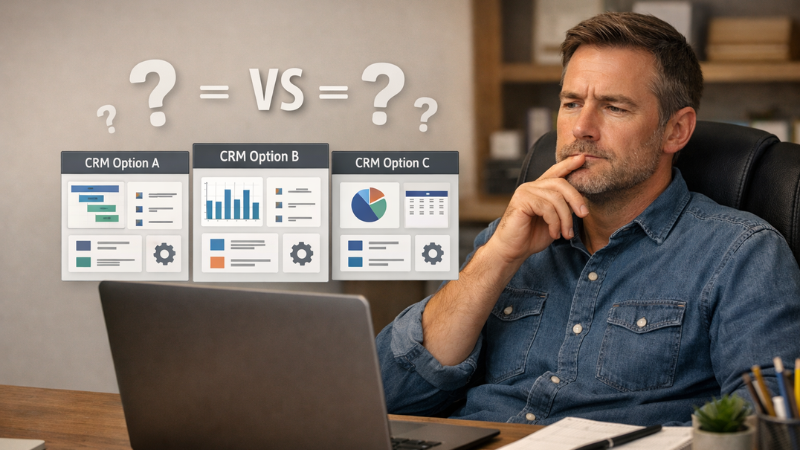
Conclusion
Understanding what CRM is is helpful for small businesses to develop better and more consistent relationships with their customers. CRM is not about technology: it is about managing interactions, better following up, and visibility throughout the customer lifecycle. Need Help Understanding CRM for Your Business Specific Needs? If you would like direction on what CRM to choose or how to set one up, you can book a free introductory call with our team to discuss your options.Final Thoughts
CRM is not merely software - it's a method to organize relationships, enhance follow-ups and create consistency as a business grows. Understanding the basics of CRM is useful for small businesses to make better decisions and prepare for scalable customer management.
Frequently Asked Questions
What is CRM in simple words?
CRM (Customer Relationship Management) is a system that helps businesses store customer details, track conversation and follow-ups in one central place.
Why do small businesses need a CRM?
Small businesses need to have a CRM to avoid missing follow-ups, organize sales customer information, and manage their sales activities as they grow efficiently.
Is CRM only for sales teams?
No. CRM is used by sales, marketing, customer support and business owners to manage customer relationships to improve coordination.
Can a small business use CRM without technical knowledge?
Yes. Most modern CRM Systems are easy to use and user-friendly for non-technical persons when configured properly.
What problems does CRM solve for small businesses?
CRM addresses issues such as dispersed customer data, manual customer data tracking, missing follow-ups, lack of visibility and reliance on single employees.
Is CRM software expensive for small businesses?
Not necessarily. Many CRM platforms have reasonable pricing and flexible plans for small teams and startups.
When should a small business start using CRM?
A business should begin using CRM if leads are increasing, follow-ups are difficult to track or customer data is dispersed among various tools.
Is CRM the same as contact management?
No. Contact management is just one area of CRM. CRM also tracks interaction, followings, opportunities, and customer history.
Can CRM replace spreadsheets completely?
Yes. CRM replaces the use of spreadsheets by providing a structured way, which is automated and provides more reliability to manage customer and sales data.
Does CRM guarantee more sales?
No. CRM does not guarantee sales but it also helps businesses to stay organized, follow up consistently with customers and make better decisions which improves results over time.