Manufacturing Inventory Management: Complete Guide for Small & Mid-Sized Manufacturers
- Manufacturing inventory management is the process of tracking and controlling every material a factory buys, uses, and sells, from raw material to finished product.
- It exists to answer three questions: what do we have, where is it, and how much more do we need?
- Poor stock control shows up as stalled production lines, rushed purchases, and cash sitting on shelves.
- The system works in a loop: record stock, deduct it as it gets used, reorder before it runs out, and count regularly to check the numbers are honest.
- Accurate data matters more than fancy tools. A clean spreadsheet beats a costly system full of wrong numbers.
- Best practices are simple: one record for everything, clear reorder points, regular counting, and a close eye on supplier lead times.
Manufacturing inventory management is the way a manufacturer keeps track of all the materials and goods in the business, from the raw material in the store room to the finished product waiting to be shipped. It includes the quantity of stock you have, its location, its speed, and when to purchase additional stock. The goal is simple. Be sure to have sufficient inventory to maintain production, but not so much that you are investing in inventory that you don't need yet.
Most small and mid-sized manufacturers already do some version of this. The problem is that it is typically stored in a combination of registers, spreadsheets, and one experienced person's memory. This guide will tell you how it really works and how to make it steady.
What is manufacturing inventory management?
Manufacturing inventory management is the process of tracking, controlling and planning of all materials in a manufacturing facility, such as raw materials, part finished goods and finished goods. It informs you of the stock you have, where it is located, how much is being used, and when to reorder to ensure that production does not stop and cash is not wasted.
It's like the running list of all your factory's physical assets. Each time material is received, issued to the shop floor or shipped out as a completed order, that record should be updated.
If the record is accurate, planning is simple. If it doesn't, you have surprises, and manufacturing surprises are costly.
What kinds of stock does a manufacturer hold?
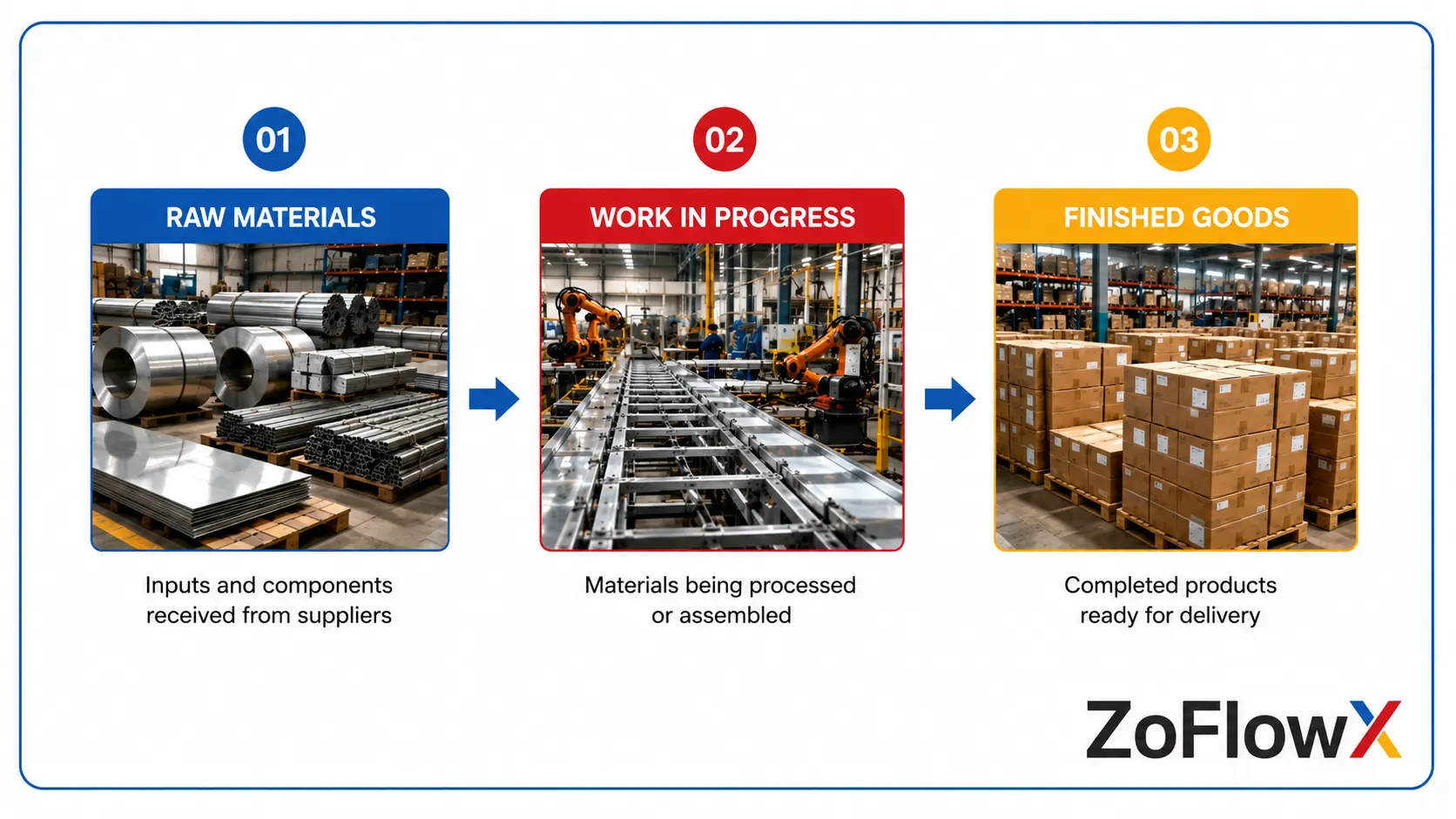
Manufacturers carry three broad types of stock, and it helps to know them by name:
- Raw materials. The materials you purchase, such as steel sheets, resin, fabric, packaging, or parts.
- Work in progress (WIP). Products that are in production but not completed, such as a partially completed product or a batch of products awaiting painting.
- Finished goods. Goods that are finished and ready for sale or shipment.
You may also carry spares, consumables, and tooling. These are not included in the product but they still cost money and they still run out at the wrong time.
How is this different from normal inventory management?
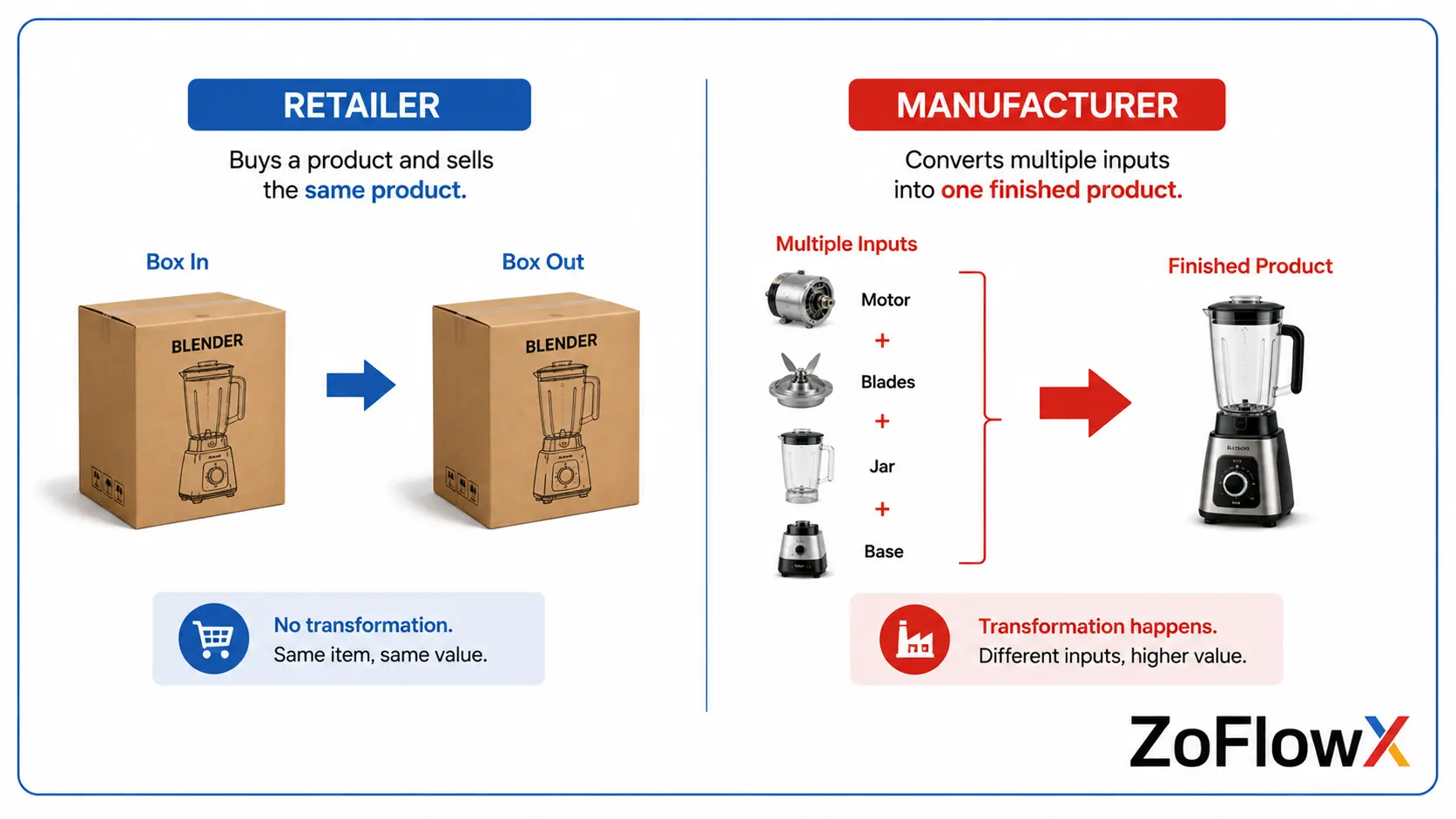
A retailer purchases an item and resells the same item. There is no change between.
A manufacturer purchases numerous products and transforms them into different products. So the record needs to be able to convert, not just move.
That is the real difference. Your system needs to know that ten metres of fabric plus one zip becomes one bag, and it needs to reduce those inputs automatically when that bag is made.
Why is manufacturing inventory management important?

Good inventory management keeps production running, protects cash flow, and improves delivery reliability. If it is not there, factories are left with sudden stockouts, the need to buy at higher prices, idle machines and money tied up in slow-moving material. It also provides you with accurate costing, which is what you need to know if a product is actually making a profit.
Here is what usually goes wrong when this is weak:
- Production stops. A single missing component can hold up an entire order.
- You overpay. Emergency purchases are invariably more expensive and freight is an additional expense.
- Cash gets stuck. Excess stock is money you cannot use for salaries, tooling, or growth.
- Deliveries slip. Late dispatch damages the customer relationships you worked hard to build.
- Costing is guesswork. If you do not know what material went into a job, you do not really know your margin.
- Waste builds up. Material expires, rusts, or becomes obsolete while sitting unnoticed.
According to ZoFlowX, the most common issue we see in small and mid-sized factories is not a lack of software. It is that stock is recorded in one place, purchases in another, and production in a third, so nobody has a single reliable number to work from.
There's also a more subtle upside. If your numbers are reliable, then your decisions are quicker because your team doesn't have to debate whose sheet is right.
How does manufacturing inventory management work?
It works as a continuous loop. You log in what comes in, subtract what is used in production, add finished goods when a batch is finished, and reorder before a minimum stock level is reached. Physical counts are made periodically to ensure that the records are accurate, and the loop is repeated for each order.
Let us walk through the loop step by step.
Step 1: Set up your item list
Each material, part and product is assigned a code and name. Ensure that the naming style is consistent, otherwise two people may create two entries for the same thing.
This one step fixes more problems than anything else. Duplicate items are the main reason stock reports look wrong.
Step 2: Define what goes into each product
For each product, list the materials and quantities needed to make one unit. This is commonly referred to as a bill of materials (BOM).
Once this exists, the system can work backwards. If you are going to produce 500 units, it can tell you exactly what to purchase.
Step 3: Record everything that comes in
When goods arrive, compare with purchase order and note the quantity received. If you have to deal with expiry, quality or traceability, note the batch or lot number.
Do this at the time of receipt, not at the end of the week. Delayed entries are the way records get out of touch with reality.
Step 4: Deduct what production uses
The stock record should be reduced when material is issued to the shop floor. When the batch is finished, finished goods should go up.
If this is occurring just in a notebook, then your primary record is already out of date.
Step 5: Reorder before you run out
Set a minimum level for each key material. When stock falls to that level, a purchase gets triggered.
The minimum should cover how long the supplier takes to deliver, plus a small buffer for delays.
Step 6: Count and correct
Physical counting is mandatory. The only way to determine whether the record is honest.
Most factories do cycle counting, which is a small number of items counted weekly rather than closing for an annual count.
Step 7: Review what the numbers are telling you
Examine the things that are moving quickly, the things that are not moving, and the places where there are shortages. Then adjust your minimum levels and order quantities.
The loop is only enhanced when someone reads it.
What problems do manufacturers usually run into?
There are a few common causes of most stock issues:
- Entries made late. The material moved on Monday but got recorded on Friday.
- No single source of truth. Each purchase, store and account has its own version.
- Unclear ownership. Everyone assumes that someone else has updated the record.
- Scrap and rework not recorded. Material is used but not deducted.
- No lead time planning. Reorder points are guessed rather than based on how long suppliers actually take.
- Too much safety stock. Buying extra "just in case" feels safe but quietly drains cash.
All of these can be corrected without costly technology. They require clear rules and someone to be responsible for enforcing them.
What are the best practices for manufacturing inventory management?
Have one common record for all stock, record movements as they occur, use actual supplier lead times to set reorder points, count regularly using cycle counts, and prioritize fast moving items over slow moving items. Check the numbers every month and make adjustments as needed.
Keep one record that everyone trusts
Choose one location for stock and use it as the official location. All other sheets are copies, not competitors.
If two departments have separate numbers, you will spend more time reconciling than producing.
Record movements as they happen
Receipt, issue, production, scrap and dispatch should all be recorded on the same day. The one habit that ensures records are accurate is same day entry.
Set reorder points using real lead times
Ask how long each supplier actually takes, not how long they promise. Use that number, add a buffer, and set the reorder level from there.
Review these levels whenever a supplier's performance changes.
Sort items by importance
Not all items are created equal. Most of your inventory value is typically in a small number of materials.
Watch those closely and manage the rest with simpler rules. This idea is often called ABC analysis, and it saves a lot of wasted effort.
Count regularly through cycle counting
It is much easier to count a few items a week than to count everything at once once a year. It also identifies errors at an early stage and can be easily tracked.
Use demand information where you can
Review historical sales, orders, and any seasonal trends you are aware of. For most small manufacturers, rough forecasting is sufficient.
There is no need for complex demand planning. All you have to do is not be taken aback by the same hectic month annually.
Trim excess without creating shortages
A best practice is to audit slow moving inventory quarterly. This frees up cash and eliminates unnecessary stock without impacting production.
Give ownership to one person
There has to be someone who is accountable for stock accuracy. Shared responsibility typically becomes no responsibility.
How does inventory management connect to the rest of the business?
Inventory is the middle man. It's needed for purchases, production, sales promises, and accounts to close the books.
It's also a component of your broader supply chain, including suppliers, logistics, and distribution. These are two different topics, but they do affect one another. Your inventory plan must take the risk if your supplier is not reliable.
Warehousing overlaps too. Where an item is physically stored affects how quickly it can be found and issued. Clear bin locations make counting and picking faster, and that supports the whole system.
Do you need software for manufacturing inventory management?
Not necessarily at the beginning. If you're a small manufacturer with a handful of products and good habits, a simple spreadsheet will work fine.
Spreadsheets can become difficult to manage accurately as your business expands. Many manufacturers opt for a connected inventory management system at that point to minimize manual effort and enhance inventory visibility. However, no system can fix poor inventory practices. Always first clean data and consistent processes.
If you need help improving your inventory processes and implementing the right business systems, work with a trusted Zoho partner who can help make the transition much smoother.
How do you know it is working?
A few simple checks tell you most of what you need:
- Stock accuracy. What is the accuracy of the physical count? Set a high goal and measure the difference.
- Stockout frequency. How many times does production stop or slow down due to missing material?
- Inventory turnover. How many times does your stock cycle through in a year? Slow turnover means cash is stuck.
- Ageing stock. How much material has not moved in six months?
- On-time dispatch. Are you shipping when you said you would?
Track these monthly. You do not need a dashboard to start, a single sheet reviewed regularly is enough.
Conclusion
Manufacturing inventory management is not complicated in theory. Know what you have, record every movement, reorder before you run out, and count often enough to trust your own numbers.
The difficult part is consistency. Systems fail not because the method is incorrect, but because entries are delayed and no one is responsible for the accuracy. That's the solution to most inventory issues, and it's a solution that goes away quietly.
If you are ready to get your stock, purchase, and production data working together, our team is happy to help. Call us at +91 8190009222 or write to info@zoflowx.com, and we will look at where your current process is leaking time and money.
Stop Guessing What Is On Your Shelves Before It Costs You Another Order
Every day of messy stock data quietly drains cash and delays deliveries, and the longer you wait the harder it gets to fix.
Fix My Inventory ChaosFrequently Asked Questions
1. What is manufacturing inventory management in simple terms?
Manufacturing inventory management is the process of tracking all materials in your manufacturing facility, from raw materials to finished goods. It informs you of what you have, where it is, how much production is consuming, and when to purchase more. The aim is to keep the line running without holding more stock than you need. If done properly, it can help you save both time and money.
2. Why is inventory management so important for manufacturers?
Because a single missing part can stop an entire production run. With good inventory control, you will never experience a stock out, you will never have to buy things at a rush price, and you will never have to tie up cash in material that you will not use for months. It also provides you with the correct product costing, which means you will know which products are profitable. If you don't have it, you're operating the factory on memory and hope.
3. What are the three main types of manufacturing inventory?
Raw materials, work in progress and finished goods. Raw materials are the materials that you purchase, like steel, fabric, or parts. Work in progress is anything that is partially completed and still in the production process. Finished goods are products that are ready to be shipped. Many factories also monitor consumables, spares and packaging separately as these are used up rapidly and are easy to forget until they are no longer able to produce.
4. How often should a manufacturer count physical stock?
Most manufacturers prefer cycle counting, which involves counting a small number of items each week or month rather than all items at once. Items of high value and high velocity should be counted more frequently, such as monthly. Items that move slowly can be checked every 3 months. This helps to distribute the workload, prevents a complete shutdown of production, and detects errors before they become difficult to trace.
5. What is a reorder point and how do I set one?
A reorder point is the stock level at which you place a new purchase order. To set it, multiply your average daily usage by the actual delivery time in days from the supplier, and then add a little extra for delays. Don't use promised lead times. Reorder point should be reviewed whenever usage changes or a supplier becomes less reliable, as an out-of-date reorder point will lead to shortages.
6. Can I manage manufacturing inventory with spreadsheets?
Yes, especially in the early stages with a limited number of items and one or two people updating records. Spreadsheets are OK as long as they are entered on the same day and everyone uses the same file. Issues arise when the number of items increases, when several people edit different copies, or when reports take hours to prepare. This is typically when it's time to upgrade to a connected system.
7. What causes inventory records to become inaccurate?
Mostly delayed entries and unrecorded movements. Material gets issued, scrapped, or reworked without anyone updating the record, so the gap widens over time. Duplicate item codes make it worse, since the same material appears twice with different balances. Unclear ownership is the root cause. When nobody is specifically responsible for stock accuracy, everyone assumes someone else handled it.
8. How much stock should a manufacturer keep?
Enough to cover production through the supplier lead time, plus a small buffer for delays and demand swings. There is no universal number, since it depends on your usage rate, supplier reliability, and how critical each item is. Keep tighter levels on cheap, easily available items and slightly larger buffers on critical or long lead time materials. Review these levels every quarter.