10 Best Travel CRM Software 2026: Compare Features & Pricing
- The best travel CRM software depends on your business model, team size, sales process, operational requirements, and the level of customization you need.
- Travel agencies, tour operators, DMCs, B2B travel companies, and enterprise travel businesses should compare enquiry management, sales pipelines, quotations, costing, itineraries, supplier management, bookings, operations, finance, reporting, and integrations.
- Some CRM platforms are designed specifically for travel workflows, while general-purpose CRMs such as Zoho CRM, HubSpot, and Salesforce can be customized to support travel businesses.
- ZoFlowX provides customized travel management systems for DMCs, tour operators, B2B travel companies, and enterprise travel businesses using the Zoho ecosystem.
- ZoFlowX connects enquiries, sales, quotations, costing, itineraries, suppliers, bookings, operations, finance, and reporting in one system designed around each company's existing workflow.
- Other travel CRM software options include Tutterfly, Tourwriter, Travefy, Kapture CRM, WeTravel, Lemax, HubSpot, Zoho CRM, and Salesforce.
Which Is the Best Travel CRM Software in 2026?
There is no single travel CRM that is the best choice for every travel business. A CRM that works well for a solo travel advisor may not be the right fit for a growing travel agency, tour operator, or DMC.
The right choice depends on how your business handles enquiries, leads, quotations, itineraries, bookings, supplier coordination, customer communication, and reporting.
For example, solo travel advisors and smaller agencies may prefer a simple travel CRM that makes it easy to manage clients, create proposals, build itineraries, and follow up with leads. Tour operators and DMCs, on the other hand, often need more advanced capabilities such as supplier management, costing, booking coordination, operations, and reporting.
If your business has more complex workflows, a customizable CRM such as Zoho CRM can provide more flexibility. A customized travel management system such as ZoFlowX may be a better fit when you need to connect sales, quotations, costing, operations, bookings, finance, and reporting into a single workflow.
10 Best Travel CRM Software in 2026
If you're short on time, here's a quick comparison of travel CRM software and travel management platforms worth considering in 2026:
How We Evaluated These Travel CRM Platforms
Choosing the best travel CRM is not only about the number of features a platform offers. We evaluated these platforms based on how well they support the workflows travel businesses actually manage every day.
Our evaluation considers:
- Lead and enquiry management
- Sales pipeline management
- Quotations and proposals
- Travel costing and margins
- Itinerary management
- Supplier and vendor management
- Booking and payment workflows
- Automation and follow-ups
- Reporting and business visibility
- Integrations and customization
- Ease of implementation
- Suitability for different types of travel businesses
We also considered whether a platform is built specifically for travel or whether it requires customization to support travel-specific workflows.
Important: There is no single best travel CRM for every business. A solo travel advisor, a mid-sized travel agency, a DMC and a large tour operator can have very different requirements.
CRM | Best For | Starting Price | Travel-Focused |
ZoFlowX | DMCs, tour operators & B2B travel companies | Custom | Yes |
Tutterfly | Travel agencies & B2B tour operators | ~$19/user/month | Yes |
Tourwriter | Tour operators & DMCs | ~$165/month | Yes |
Travefy | Travel advisors & agencies | ~$59/month | Yes |
Kapture CRM | Travel agencies needing WhatsApp & automation | Contact vendor | Yes |
WeTravel | Group tour operators | Free + 1% fee | Yes |
Lemax | Tour operators & DMCs | Custom | Yes |
HubSpot CRM | Travel agencies needing sales & marketing | Free + paid plans | No |
Zoho CRM | Agencies needing customization | From $14/user/month | No |
Salesforce Sales Cloud | Enterprise travel companies & DMCs | From $25/user/month | No |
For businesses that need a travel management system designed around their existing processes, ZoFlowX uses the Zoho ecosystem to connect enquiries, sales, quotations, costing, itineraries, suppliers, bookings, operations, finance, and reporting in one customized system.
The right option depends on your business model, workflow complexity, team size, budget, and level of customization required.
Why a Travel CRM Matters in 2026
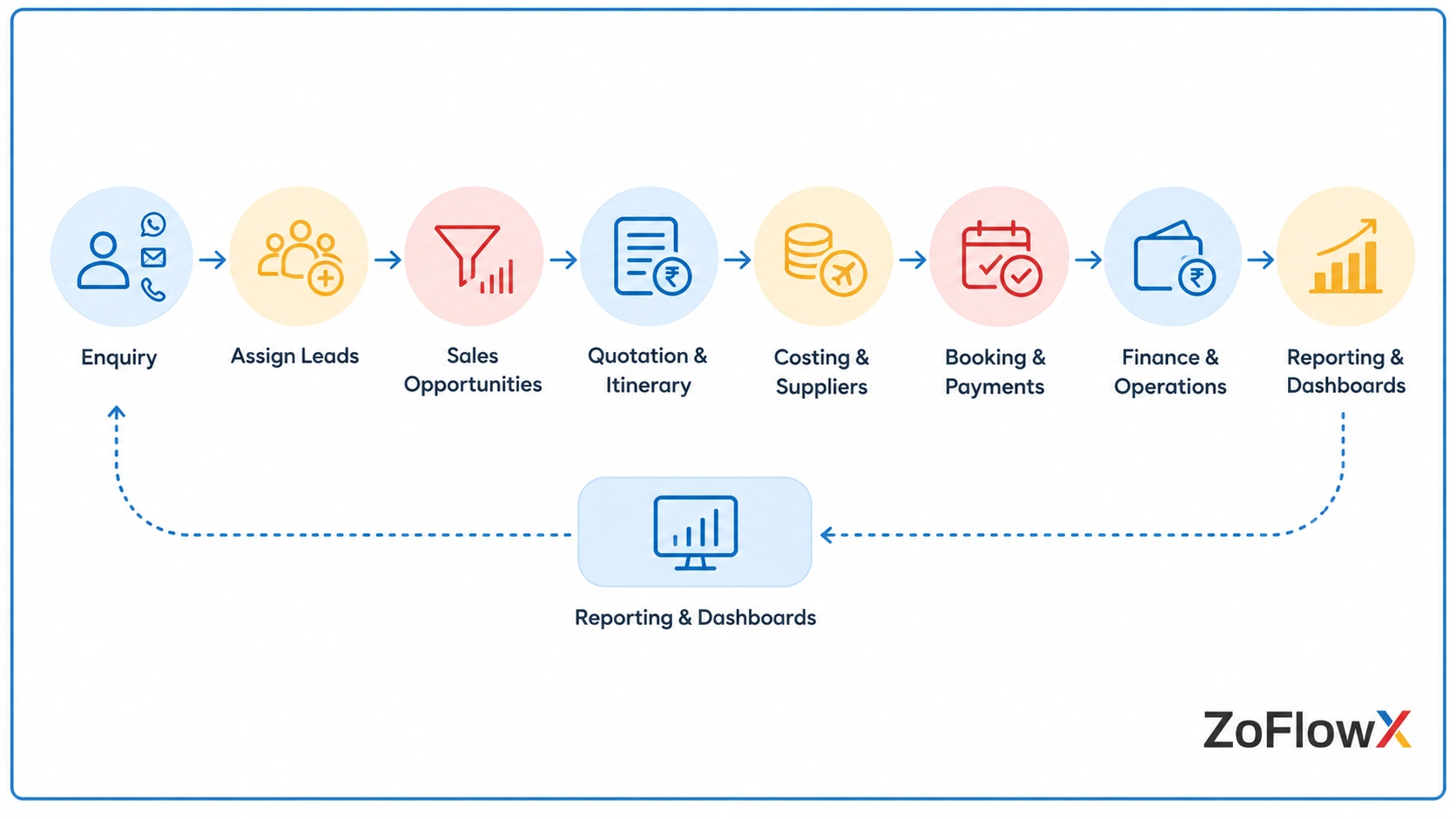
As a travel agency, tour operator, DMC, B2B travel company, or enterprise travel business, managing the entire customer and booking journey across disconnected tools can make it difficult to maintain visibility and respond quickly.
Industry research also shows that travelers increasingly expect faster and more digital experiences throughout their journey. IATA's latest passenger research provides useful insights into changing traveler preferences and digital travel behavior.
For businesses operating in the Indian travel market, WTTC's latest India research also provides useful context on the scale and growth of the Travel & Tourism sector.
Many travel businesses still manage different parts of their workflow through:
- WhatsApp and social media enquiries
- Email enquiries from website forms
- Notes from phone calls
- Quotes created in Word or Google Docs
- Supplier rates stored in PDFs and spreadsheets
- Separate itinerary tools
- Manual booking and payment tracking
- Different systems for finance and reporting
The result? Important information can become scattered across systems, follow-ups can be missed, quotations can take longer to prepare, and managers may lack a single view of the sales and booking pipeline.
A connected travel management system can bring these processes together by helping businesses:
- Capture and organize enquiries
- Assign leads to the appropriate team member
- Manage sales opportunities
- Create quotations and itineraries
- Manage costing and supplier information
- Track bookings and payments
- Automate follow-ups
- Connect operational and financial workflows
- Monitor performance through reporting dashboards
For a broader look at how CRM can support different travel workflows, see our guide to CRM applications across the travel industry.
What Is Travel CRM Software?
Travel CRM software is a CRM or travel management system used to manage customer relationships, sales activity, enquiries, bookings, and related travel workflows.
Depending on the platform and level of customization, a travel CRM can support processes such as:
- Multi-day and multi-destination trip planning
- Customer and traveller management
- Enquiry and lead management
- Sales pipeline management
- Quotation and costing workflows
- Supplier and vendor management
- Booking and payment tracking
- Itinerary creation
- Follow-up automation
- Reporting and business intelligence
- Integration with accounting, communication, and other business systems
The key difference between a general CRM and a customized travel management system is how closely the system matches the company's actual workflow.
A general CRM provides the underlying CRM capabilities, while customization can connect those capabilities with the processes a travel business already follows. Businesses looking for a system built around their existing travel workflows can also explore our customized travel management system.
If you are specifically evaluating Zoho for a travel business, this guide on whether Zoho CRM fits a travel agency can help you assess its features and practical use cases.
Travel CRM vs Generic CRM: The Key Differences
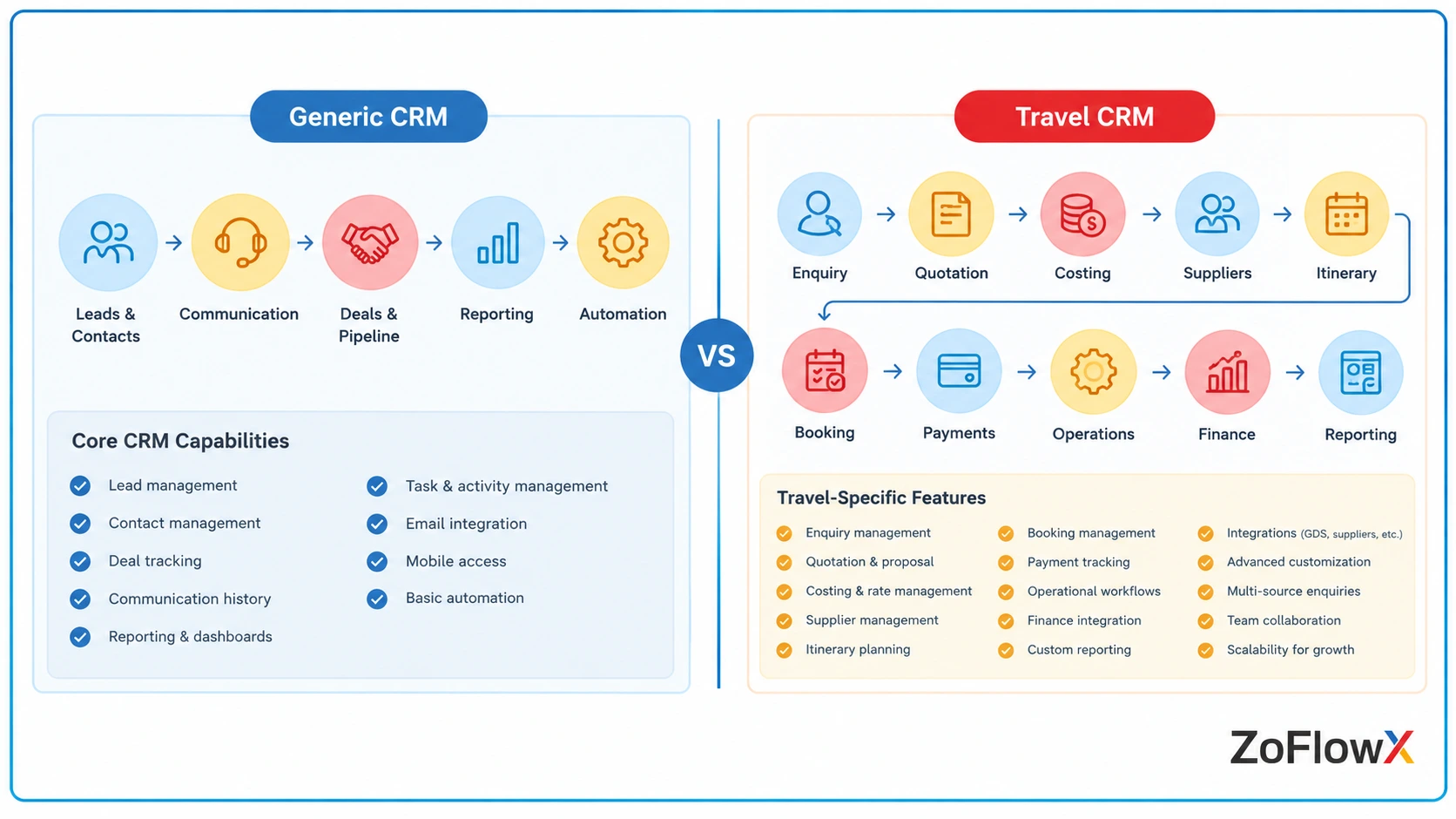
A generic CRM can provide powerful capabilities for managing leads, contacts, deals, communication, and reporting. However, travel businesses often have additional processes around quotations, costing, itineraries, suppliers, bookings, operations, and payments.
The important question is therefore not simply:
“Is this a travel CRM?”
It is:
“Can this system support and connect the way our travel business actually works?”
A travel-focused platform may provide specific travel functionality out of the box.
A general CRM such as Zoho CRM, HubSpot, or Salesforce can provide a broader foundation that may be customized to support more specific workflows. For example, businesses can review the available modules and capabilities in the official Zoho CRM feature comparison when evaluating how much customization they may need.
When comparing the two approaches, consider:
- Existing sales workflow
- Enquiry sources
- Quotation process
- Costing requirements
- Itinerary requirements
- Supplier management
- Booking workflow
- Payment tracking
- Finance integration
- Reporting requirements
- Required integrations
- Customization requirements
- Implementation timeline
For businesses with complex or highly customized workflows, the ability to configure the system around existing processes can be as important as the individual CRM features.
If you are specifically evaluating Zoho CRM for a travel business, see our guide to Zoho CRM for travel agencies and tour operators
Must-Have Features in the Best Travel Agency CRM
Not every travel CRM or travel management system will fit every business. Use this checklist when evaluating your options:
- Lead and enquiry management - Capture enquiries from website forms, email, WhatsApp, social media, calls, and other channels.
- Sales pipeline management - Track enquiries and opportunities from initial contact through quotation and booking.
- Quotation management - Create, manage, and track customer quotations.
- Costing management - Manage supplier costs, margins, markups, and other commercial information.
- Itinerary management - Build and manage day-by-day itineraries for customers.
- Supplier management - Maintain supplier information, rates, contracts, and related details.
- Booking management - Track booking stages, deposits, payments, confirmations, and outstanding amounts.
- Automated follow-ups - Automate reminders and communication throughout the customer journey.
- Reporting dashboards - Track enquiries, conversions, revenue, bookings, agent performance, and other business metrics.
- Integrations - Connect CRM, accounting, communication, payment, marketing, and other business applications.
A strong system should not only provide these capabilities individually. It should also connect them so information can flow between teams and stages of the travel workflow.
The 10 Best Travel Agency CRM Software in 2026 - Detailed Reviews
We evaluated the platforms in this list across areas such as travel functionality, CRM capabilities, customization, pricing, implementation requirements, and suitability for different types of travel businesses.
1. ZoFlowX - Customized Travel Management System Using Zoho
Best for: DMCs, tour operators, B2B travel companies, and enterprise travel businesses that need a customized travel management system built around their existing workflow.
ZoFlowX is different from a typical off-the-shelf travel CRM. It uses the Zoho ecosystem to connect CRM, sales, quotations, costing, itineraries, suppliers, bookings, operations, finance and reporting around the way a travel business already works.
This makes ZoFlowX particularly relevant for businesses that have outgrown spreadsheets, disconnected CRM tools or multiple systems that do not share the same customer and booking information.
The system can connect:
- Enquiry management
- Sales pipeline
- Quotations
- Costing
- Itineraries
- Supplier management
- Bookings
- Operations
- Finance
- Reporting
Key capabilities
- Customized enquiry and lead management
- Sales pipeline and opportunity management
- Quotation workflows
- Travel costing workflows
- Itinerary management
- Supplier and vendor management
- Booking management
- Automated follow-ups
- Finance and accounting integration through the Zoho ecosystem
- Reporting and dashboards
- Integration with other Zoho applications
- Custom workflows based on the company's existing processes
Pricing
Custom, based on business requirements, team size, modules, integrations, and customization.
Pros
- Customized around the company's existing workflow
- Uses the broader Zoho ecosystem
- Can connect sales, operations, finance, and reporting
- Suitable for complex travel workflows
- Can be adapted as the business grows
- Professional implementation and configuration support
Cons
- Requires implementation rather than simple self-service setup
- Pricing depends on customization and business requirements
- May require more planning than a basic off-the-shelf CRM
Who Should Choose ZoFlowX?
ZoFlowX is most suitable for travel businesses that need more than basic contact and lead management.
It can be a strong option for businesses that need to connect:
- enquiries
- sales
- quotations
- costing
- itineraries
- suppliers
- bookings
- operations
- finance
- reporting
It may be less suitable for a small travel business looking for a simple, ready-to-use CRM that requires little configuration.
2. Tutterfly - Best for Mid-Sized Travel Agencies and B2B Tour Operators
Best for: Mid-sized agencies handling B2B and B2C travel.
Tutterfly is a travel-focused CRM that brings together enquiry management, itinerary building, supplier management, and other travel processes.
Key features
- Enquiry capture
- Itinerary builder
- Supplier and hotel database
- Booking voucher and invoice generation
- Multi-currency support
- WhatsApp integration through add-ons
Pricing
Starts around $19/user/month (verify with vendor).
Pros
- Travel-focused
- Suitable for small-to-mid-sized agencies
- Easy learning curve
Cons
- Reporting may be less extensive than more customizable CRM ecosystems
- Customization options may be limited depending on requirements
Who Should Choose Tutterfly?
Tutterfly can be considered by mid-sized travel agencies and B2B tour operators that want travel-focused functionality without building a CRM from scratch. It is particularly relevant when itinerary, supplier and enquiry workflows are more important than extensive CRM customization.
3. Tourwriter - Best Itinerary Builder for Tour Operators & DMCs
Best for: Tour operators and DMCs focused heavily on itinerary creation and customized trips.
Tourwriter is particularly focused on itinerary building and tour operations.
Key features
- Itinerary builder
- Supplier database
- Contracted rates
- Booking and operations workflow
- Document generation
- Integrations with major GDS and channel managers
Pricing
Starts around $165/month (verify with vendor).
Pros
- Strong itinerary functionality
- Suitable for FIT and luxury operators
- Mature feature set
Cons
- Higher cost than entry-level travel CRM platforms
- Less focused on lead capture and marketing
- Learning curve may be higher for some teams
Who Should Choose Tourwriter?
Tourwriter can be a strong option for tour operators and DMCs where itinerary creation, supplier information and tour operations are central to the business. Businesses looking primarily for advanced marketing automation or a highly flexible general CRM may want to compare other options as well.
4. Travefy - Best for Solo Travel Advisors & Host-Agency Agents
Best for: Solo travel advisors, IATA agents, and host-agency travel agents.
Travefy focuses strongly on proposals, itineraries, and the client-facing experience.
Key features
- Drag-and-drop itinerary builder
- Traveller app
- Electronic quotes and proposals
- Marketing email tools
- CRM for clients and trips
- Client forms and questionnaires
Pricing
Starts around $59/month for the Pro plan (verify with vendor).
Pros
- Strong client-facing experience
- Proposal and e-sign capabilities
- Easy to learn for individual advisors
Cons
- Less suited to larger tour operators or DMCs with complex supplier workflows
- Limited team and pipeline reporting compared with broader CRM platforms
Who Should Choose Travefy?
Travefy is particularly relevant for solo travel advisors and smaller travel businesses that need proposals, itineraries and client-facing travel planning tools. Larger operators with complex supplier, costing and operational workflows may need a more comprehensive platform.
5. Kapture CRM - Best for High-Volume Travel Teams
Best for: Travel businesses handling high inbound volumes and communication through channels such as WhatsApp and calls.
Kapture's travel capabilities focus on enquiry-to-booking workflows, omnichannel communication, and sales automation.
Key features
- Travel-specific lead management
- Omnichannel inbox
- WhatsApp, email, calls, and social channels
- Itinerary functionality
- Booking and invoice management
- Sales agent dashboards
- AI-assisted lead routing
Pricing
Custom - request a quote.
Pros
- Strong omnichannel capabilities
- Suitable for high-volume operations
- Travel-focused functionality
Cons
- More complex interface
- Customization may require consulting support
Who Should Choose Kapture CRM?
Kapture CRM can be a good option for travel agencies that want to improve lead management, customer communication and sales automation. It is particularly worth considering for businesses that handle a high volume of enquiries and want to organize sales conversations and follow-ups in one system.
6. WeTravel - Best for Group Tour Operators & Retreats
Best for: Group tour operators, retreat hosts, educational travel businesses, and multi-day group programs.
WeTravel combines travel booking functionality with payment management and basic CRM capabilities.
Key features
- Branded trip pages
- Online booking
- Traveller payment plans
- Deposits
- Group roster management
- Waiver management
- Basic CRM
- Email automation
- Payment processing
Pricing
Free plan + 1% transaction fee; paid plans are available for advanced features.
Pros
- Strong group payment functionality
- Good traveller-facing experience
- No initial subscription fee on the free plan
Cons
- Not a full CRM
- Limited pipeline and supplier management
Who Should Choose WeTravel?
WeTravel is particularly suitable for tour operators and travel businesses that need to manage trips, bookings, payments and traveler information in one platform. Its travel-focused CRM is connected with trip, itinerary, booking and payment workflows, which can reduce the need to connect separate systems.
7. Lemax - Best for Tour Operators at Scale
Best for: Established tour operators and DMCs managing large-scale multi-day travel operations.
Lemax is an end-to-end tour operator platform covering CRM, booking, contracting, and accounting.
Key features
- CRM
- Booking management
- Contracting
- Accounting
- Channel manager
- Supplier APIs
- Yield and markup management
- Document automation
- Group, B2B, and FIT modules
Pricing
Custom - typically enterprise-tier.
Pros
- Comprehensive operator functionality
- Strong contracting and supplier capabilities
- Suitable for established travel operators
Cons
- May be excessive for smaller agencies
- Longer implementation timelines
Who Should Choose Lemax?
Lemax is designed for mid-sized and larger tour operators and DMCs that need to manage sales, operations, suppliers, products, bookings and finances in a more comprehensive travel management system. Its platform covers areas including product inventory, booking and sales automation, package building, operations and CRM.
8. HubSpot CRM - Best for Travel Businesses Prioritizing Marketing
Best for: Travel businesses focused heavily on inbound marketing, email marketing, lead generation, and sales.
HubSpot is a general-purpose CRM that can be customized for travel businesses.
Key features
- CRM
- Email marketing
- Marketing automation
- Landing pages
- Forms
- Chatbots
- Pipeline management
- Reporting and attribution
Pricing
Free tier available; paid plans vary by product and usage.
Pros
- Strong marketing capabilities
- User-friendly interface
- Useful free CRM functionality
Cons
- Not travel-specific by default
- Itinerary and supplier workflows may require customization or third-party solutions
- Costs can increase as requirements grow
Who Should Choose HubSpot CRM?
HubSpot CRM is a good option for travel businesses that want to combine sales, marketing, customer management and reporting in one general-purpose CRM. Its core CRM includes contact management, deals, tasks, pipeline management and reporting.
9. Zoho CRM - Best for Businesses Wanting a Highly Customizable CRM
Best for: Travel businesses with internal technical resources or a partner that can customize the CRM around their workflow.
Zoho CRM is a general-purpose CRM platform that can be configured using custom modules, layouts, blueprints, workflows, integrations, and other Zoho applications.
Key features
- Custom modules
- Custom layouts
- Blueprints
- Workflows
- Reporting
- Email and telephony integrations
- Zoho ecosystem integrations
- Marketplace extensions
Pricing
From $14/user/month for the referenced plan levels; verify current pricing with Zoho.
Pros
- Highly customizable
- Broad Zoho ecosystem
- Strong integration possibilities
- Flexible for different business models
Cons
- Travel workflows require configuration
- Can have a learning curve for teams without implementation support
- Building a complex travel system requires planning and customization
Who Should Choose Zoho CRM?
Zoho CRM is a strong option for travel businesses that want a flexible CRM they can customize around their own sales process. It provides lead and deal management, automation, omnichannel communication, reporting and extensive customization options.
10. Salesforce Sales Cloud - Best for Enterprise Travel Companies
Best for: Large travel companies, multi-country DMCs, and enterprise travel businesses with complex CRM requirements.
Salesforce is a general-purpose enterprise CRM platform with extensive customization and integration capabilities.
Key features
- Sales pipeline management
- Forecasting
- Customization
- AppExchange ecosystem
- Enterprise security
- Compliance capabilities
- Travel-related extensions and custom solutions
Pricing
Plans vary significantly by edition and requirements.
Pros
- Extensive customization
- Large integration ecosystem
- Suitable for complex enterprise environments
Cons
- Licensing and implementation costs can be substantial
- Travel workflows may require customization
- Implementation can be complex
Who Should Choose Salesforce Sales Cloud?
Salesforce Sales Cloud is best suited to larger travel companies, enterprise travel businesses and DMCs that need a highly customizable CRM with advanced sales, automation, reporting and integration capabilities. Salesforce positions Sales Cloud as a central platform for lead management, customer engagement, pipeline management, quoting, forecasting and sales automation.
Best CRM for Travel Agents, Agencies & Tour Operators by Use Case
There is no single CRM that is the best choice for every travel business. A solo travel advisor may prioritize proposals and itineraries, while a DMC may need supplier contracts, costing, bookings and operational workflows. Use the recommendations below as a starting point, then compare each platform against your actual workflow.
Best CRM for Solo Travel Agents & Advisors
Solo travel advisors usually need simple client management, proposals, itineraries, communication and follow-up without the complexity of a large enterprise system.
Recommended options: Travefy and other lightweight travel-focused platforms.
Best choice when: Your main requirements are client communication, proposals, itinerary creation and simple trip management.
Consider a more customizable CRM when: You need advanced lead routing, automation, integrations, reporting or a more complex sales process.
Best CRM for Travel Agencies
Travel agencies managing multiple sales agents usually need more than contact management. Lead assignment, sales pipelines, follow-ups, quotations, reporting and communication tracking can become important as enquiry volume grows.
Recommended options: Tutterfly, Kapture CRM, Zoho CRM, HubSpot and ZoFlowX, depending on workflow complexity.
Best choice when: You need better control over enquiries, sales follow-ups and agent performance.
Consider a customized solution when: Your agency also needs complex costing, supplier management, itinerary workflows, bookings and operations in the same system.
Best CRM for Tour Operators & DMCs
Tour operators and DMCs often have more complex workflows because sales activity needs to connect with itineraries, supplier rates, costing, bookings and operations.
Recommended options: Tourwriter, Lemax and customized travel management systems such as ZoFlowX.
Best choice when: Your business needs strong itinerary, supplier, costing and booking workflows.
Consider customization when: Your existing process is unique or requires sales, operations, finance and reporting to work together.
DMCs with more complex operational requirements can also explore our guide to software solutions for destination management companies.
Best CRM for B2B Travel Companies
B2B travel businesses often need to manage partner relationships, travel agents, commissions, multi-level pricing, quotations, bookings and reporting across multiple teams.
Recommended options: ZoFlowX, Salesforce, Zoho CRM and other customizable CRM platforms.
Best choice when: Your business needs strong partner management, sales pipelines, quotations, pricing, commissions, bookings and reporting.
Consider customization when: Your B2B workflow involves complex pricing, partner-specific processes, commission structures or requires sales, operations, finance and reporting to work together.
Best CRM for Travel Businesses That Need Customization
Businesses with complex workflows should not choose a CRM based only on its standard feature list. The more important question is whether the system can be configured around the way the business already operates.
Customization becomes particularly important when a company needs to connect enquiries, sales, quotations, costing, itineraries, suppliers, bookings, operations, finance and reporting.
Recommended options: Zoho CRM, Salesforce and customized Zoho-based travel management systems such as ZoFlowX.
A customizable CRM can require more implementation work than a simple travel-focused platform, but it can provide greater flexibility when the business has unique processes or needs multiple departments to work from the same information.
Best CRM for Group Tour & Retreat Operators
Group tour and retreat businesses often need to manage travellers, deposits, payment plans, group rosters, booking pages, itineraries and customer communication in one workflow.
Recommended options: WeTravel for group bookings and payment workflows, along with broader CRM or customized travel management platforms for more complex sales and customer management requirements.
Best choice when: Your business needs efficient group booking, payment collection, traveller management and customer communication.
Consider customization when: Your business also needs advanced sales pipelines, quotations, costing, supplier management, operations, reporting or other workflows beyond group bookings and payments.
How to Choose the Best Travel CRM Software: 5-Step Framework
Use this framework to make a practical decision:
Before comparing software, write down your current travel sales workflow from the first enquiry to the final booking and payment.
For example: Enquiry → Lead Qualification → Sales Follow-up → Quotation → Costing → Itinerary → Booking → Payment → Operations → Reporting
Then check which CRM can support each stage without unnecessary manual work or duplicate data entry.
Step 1 - Map your top 3 pain points.
Are you losing leads because of slow follow-up? Spending too much time preparing quotations? Struggling to manage supplier costs? Lacking visibility into bookings or agent performance?
Start with the workflow problems you need the system to solve.
Step 2 - Decide whether you need a travel-focused platform or a customizable CRM ecosystem.
Travel-focused platforms may provide specific functionality out of the box.
General-purpose CRM platforms such as Zoho CRM, HubSpot, and Salesforce can provide a flexible foundation that can be customized around your workflow.
Step 3 - Compare the 10 must-have capabilities.
Evaluate:
- Enquiry management
- Sales pipeline
- Quotations
- Costing
- Itineraries
- Supplier management
- Bookings
- Operations
- Finance
- Reporting
Step 4 - Demo the system using your real workflow.
Don't rely only on a generic product demo.
Give the vendor a real example and ask them to demonstrate:
Enquiry → Sales → Quotation → Costing → Itinerary → Booking → Operations → Finance → Reporting
This will show whether the system actually fits your business.
Ask These Questions During the Demo
Before choosing a travel CRM, ask the vendor:
- Can enquiries from website forms, email and WhatsApp be captured in one place?
- Can leads automatically be assigned to sales agents?
- Can quotations be created from customer and trip information already stored in the CRM?
- Can supplier costs and margins be tracked?
- Can the same customer information flow into the itinerary and booking process?
- Can follow-ups be automated?
- Can management see sales, bookings and revenue through dashboards?
- Can the system integrate with accounting, payment, communication and marketing tools?
- What requires customization?
- What will implementation, migration, training and ongoing support cost?
Step 5 - Validate total cost of ownership.
Consider:
- Software licenses
- Implementation
- Data migration
- Training
- Integrations
- Customization
- Ongoing support
The cheapest software license isn't necessarily the lowest-cost solution once implementation and customization are included.
Travel CRM Pricing: What to Expect in 2026
Travel CRM pricing varies significantly based on team size, software capabilities, customization, integrations, and implementation requirements.
Comparing only the monthly subscription price can give a misleading picture of the total cost of a travel CRM.
A business may also need to pay for implementation, customization, data migration, integrations, training and ongoing support.
For example, a low-cost CRM may appear cheaper initially but require additional development or third-party tools to support travel-specific workflows. A higher-cost platform may include more functionality out of the box.
Always compare the total cost of ownership, not just the monthly subscription.
Tier | Typical Monthly Cost | What You May Get |
Lightweight | $30–$70 | Basic CRM, client management, proposals and itinerary tools |
Mid-market | $20–$60/user | CRM, automation, reporting and travel workflows |
Operator-grade | $50–$150/user | Advanced travel operations, supplier and itinerary capabilities |
Enterprise | $100–$500+ | Advanced CRM, customization, integrations and enterprise controls |
Additional costs to consider
- Implementation
- Data migration
- Custom integrations
- Workflow customization
- Training
- Ongoing support
- Administration
The actual cost of a travel CRM should therefore be evaluated based on total cost of ownership, not only the monthly software license.
Implementation Tips & Common Mistakes to Avoid
Rolling out a CRM is only half the battle. How you implement it determines whether your team actually uses it.
Avoid these common pitfalls:
5 Mistakes That Derail Travel CRM Rollouts
- Choosing based on price alone. A cheaper CRM that doesn't fit your workflow can create additional manual work.
- No data migration plan. If customer information is stored in Excel or another system, plan how it will be cleaned and migrated.
- Skipping team training. Even a powerful CRM can fail to deliver value if employees don't know how to use it.
- Trying to migrate everything at once. Start with the most important workflows and expand systematically.
- No internal owner. Assign someone internally to oversee CRM adoption and data quality.
30-60-90 Day Implementation Plan
- Days 1–30: Configure enquiry and sales processes, migrate initial data, connect core communication channels, and train the sales team.
- Days 31–60: Add automated follow-ups, quotation workflows, itinerary processes, supplier information, and reporting dashboards.
- Days 61–90: Connect finance, payment, operations, and marketing systems. Review performance data and optimize the workflow based on actual usage.
Travel CRM Buying Checklist
Before choosing a travel CRM, make sure the platform can support the workflows your team actually uses.
Sales & Enquiries
- Lead capture
- Lead assignment
- Sales pipeline
- Follow-up reminders
- Email and WhatsApp communication
Travel Operations
- Quotations
- Costing
- Margins
- Itineraries
- Supplier management
- Bookings
- Payment tracking
Management
- Sales reports
- Booking reports
- Revenue tracking
- Agent performance
- Management dashboards
Technology
- Integrations
- Automation
- Data migration
- Customization
- User permissions
- Scalability
Implementation
Before signing up, ask:
- How long will implementation take?
- What data can be migrated?
- What customization is required?
- Who will train the team?
- What ongoing support is available?
- What will the complete implementation cost?
The best travel CRM is the one that supports your actual workflow without creating unnecessary manual work.
Conclusion
Choosing the right travel CRM is not simply about finding software with the longest feature list.
For travel agencies and travel professionals with straightforward requirements, a travel-focused platform may provide the functionality they need.
For DMCs, tour operators, B2B travel companies, and enterprise travel businesses with more complex workflows, a customized travel management system can connect the different stages of the business in one environment.
ZoFlowX is one option for businesses that need a customized travel management system rather than a standard CRM. Using the Zoho ecosystem, it can connect enquiries, sales, quotations, costing, itineraries, suppliers, bookings, operations, finance and reporting around the company's existing workflow.
However, the right choice depends on the business. Smaller travel businesses may prefer a simpler travel-focused platform, while DMCs, tour operators and B2B travel companies with complex processes may benefit from a more customizable system.
Need help evaluating your travel workflow? Talk to a ZoFlowX expert to discuss how your existing travel processes can be connected using the Zoho ecosystem. For enquiries, email us at info@zoflowx.com or call us at +91 8190009222.
Build a Travel Management System Around Your Workflow
Connect enquiries, sales, quotations, costing, itineraries, suppliers, bookings, operations, finance, and reporting in one customized system using the Zoho ecosystem.
Book a MeetingFrequently Asked Questions
What is the best CRM for small travel agencies?
The best option depends on the agency's workflow, budget, team size, and requirements. Small agencies can consider travel-focused platforms such as Tutterfly and Travefy, as well as customizable CRM platforms such as Zoho CRM and HubSpot.
How much does travel CRM software cost?
Travel CRM pricing varies depending on the platform, number of users, features, customization, integrations, and implementation requirements. Basic platforms may cost tens of dollars per user per month, while customized and enterprise implementations can cost substantially more.
Can travel CRM integrate with WhatsApp and Instagram?
Many CRM platforms can integrate with communication channels such as WhatsApp and social platforms through native integrations, APIs, or third-party connectors. The exact functionality depends on the platform and implementation.
How does a travel CRM help with itinerary creation?
A travel CRM or customized travel management system can connect itinerary creation with customer records, quotations, costing, suppliers, and bookings. This can reduce duplicate data entry and make it easier for teams to maintain consistent customer information.
What's the difference between a generic CRM and travel-specific CRM?
A travel-specific CRM typically provides functionality designed around common travel workflows.
A generic CRM provides broader CRM capabilities and can sometimes be customized to support travel-specific processes. The better option depends on how closely the platform needs to match your business workflow.
How long does it take to implement a travel CRM system?
Implementation time varies significantly depending on the platform, workflow complexity, integrations, data migration, and level of customization required. A simple CRM setup may take considerably less time than a customized travel management system connecting sales, quotations, costing, itineraries, suppliers, bookings, operations, finance, and reporting.
Can I migrate existing customer data to a new travel CRM?
Yes. Most CRM platforms support data imports from formats such as CSV or Excel. More complex migrations may require data cleaning, mapping, validation, and custom migration processes.
Does travel CRM software work for tour operators and DMCs?
Yes. Tour operators and DMCs can use either travel-focused CRM platforms or customizable CRM systems depending on their requirements. Businesses with complex workflows may need functionality covering enquiries, quotations, costing, itineraries, suppliers, bookings, operations, finance, and reporting.