CRM in the Travel Industry: What It Fixes and Why It Fails
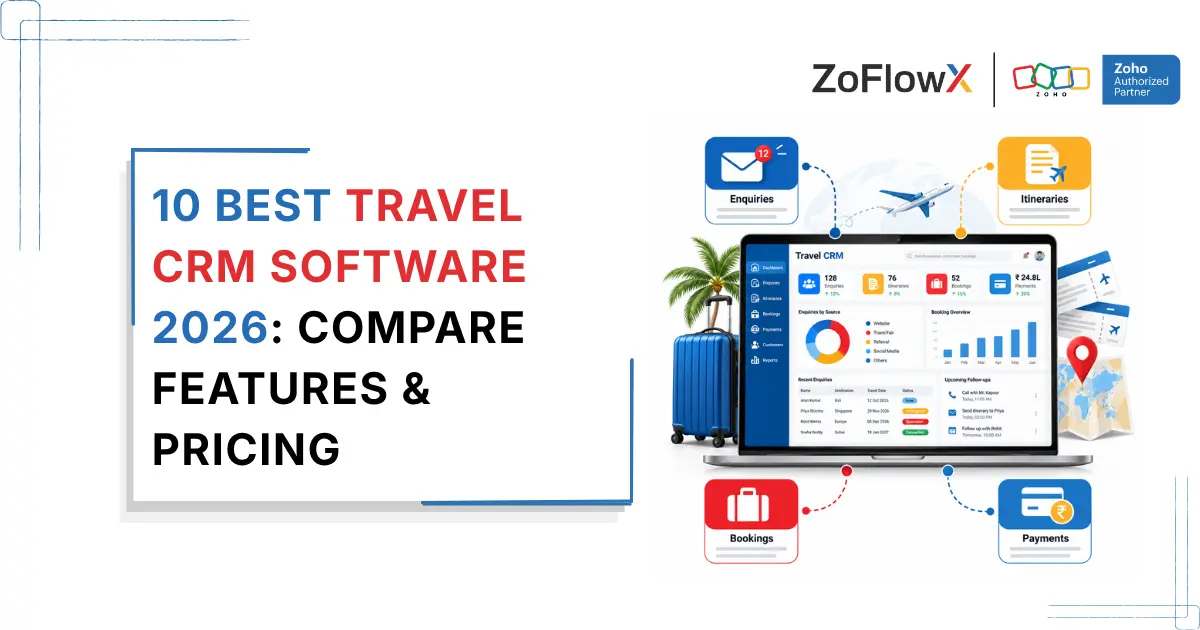
- A travel CRM records enquiries, quotations, bookings, payments and customer history in one place, so the detail does not live in individual inboxes and WhatsApp threads.
- The problems it fixes first are lead leakage, slow follow-up and lost context, in that order.
- Most travel CRM projects stall for process reasons rather than software reasons: unclear ownership, dirty data, and automation built before anyone understands the workflow.
- A CRM manages the customer relationship. It does not, on its own, handle supplier costing, multi-service itineraries or operational handoffs, which is where agencies and tour operators diverge.
What CRM means in the travel industry
A travel CRM is a system for managing enquiries, customer relationships and the sales process from first contact to departure.
The difference from a generic CRM is less about features than about shape. A standard sales CRM assumes a deal is one transaction with a value and a close date. A travel enquiry is rarely that: it carries dates, a destination, a traveller count, a budget range, several revisions, and a set of services that each have their own supplier and cost.
That is why travel businesses outgrow generic configurations. The record structure does not match what they sell.
The problems a CRM fixes first
Slow follow-up. Response speed matters more in travel than in most sectors, because the same traveller is usually enquiring with several agencies at once. Research published in the Harvard Business Review found that companies contacting a lead within an hour were nearly seven times more likely to qualify it than those waiting one additional hour, and more than sixty times more likely than those waiting a day or longer.
Lost context. When a repeat customer calls, the person answering either knows the history or does not. In an inbox-based process, that depends on who picks up.
Manual booking tracking. Spreadsheets hold up to roughly fifty active bookings. Past that, version conflicts and missed payment deadlines appear faster than anyone can reconcile them.
Why travel CRM implementations fail
Nobody owns it. A CRM without an internal owner responsible for data quality and adoption drifts within a quarter. The team reverts to the tools it trusts and the CRM becomes a record nobody updates.
The old process is copied rather than redesigned. Rebuilding a messy spreadsheet inside a CRM produces a messy CRM. The spreadsheet's workarounds exist because the process has gaps, and software will not close them.
Dirty data is migrated. Once a manager sees two versions of the same customer, they stop believing the dashboard, and reporting never recovers.
Automation arrives too early. Automating a process before anyone understands it encodes the wrong assumptions, and unpicking it later is harder than building it was.
Training is treated as a launch event. Short, recorded, role-based sessions outperform a single all-hands demonstration.
What changes when it works
The visible change is speed. Enquiries get assigned within minutes, follow-ups fire without anyone remembering them, and payment reminders go out on schedule.
The less visible change matters more: management can answer questions that were previously guesswork. How many enquiries arrived, which sources convert, which agents have overdue follow-ups, how much quotation value is open, and where deals stall.
A CRM that cannot answer those is an address book.
Where a CRM stops being enough
A CRM handles the customer relationship. It does not inherently handle supplier rates, multi-service costing, markup and margin calculation, itinerary construction, or the handoff from sales into operations.
For a small agency selling standard packages, that gap rarely matters. For a business running multi-service itineraries across several suppliers, or coordinating departures and group capacity, the gap becomes the whole problem, and the requirement shifts from a CRM to a connected travel management system linking sales, costing, operations and finance.
Knowing which of the two you need is worth more than any feature comparison, and one question usually settles it: when a booking is confirmed, how many separate systems does the information get re-entered into?
Frequently asked questions
What is CRM in the travel industry?
A system for managing enquiries, customer relationships and the sales process, structured around travel-specific records such as destinations, travel dates, traveller counts and multi-service bookings rather than single-value deals.
Can a CRM manage travel bookings?
Most travel CRMs track a booking from enquiry through to confirmation, holding itinerary details, payment status, supplier confirmations and customer communication on one record. Depth varies considerably between platforms.
How long does a travel CRM implementation take?
A basic configuration typically takes two to four weeks. Adding customisation, automation and data migration usually extends that to six to eight weeks. Data quality moves this timeline more than any other factor.
Do travel agents and tour operators need different systems?
The foundations are the same: lead management, booking tracking and customer communication. They diverge on operations. Tour operators additionally need group capacity, departure tracking and supplier coordination, which a contact-centred CRM does not provide.