Destination Management Software: How to Choose the Right System for Your DMC
- Choose DMC software that fits your business workflow.
- Manage enquiries, suppliers, quotations, bookings, and operations in one system.
- Automate repetitive tasks to save time and reduce manual work.
- Look for customization, integrations, and scalability.
- Choose a solution that grows with your DMC business.
Running a destination management company may look simple from the outside. An enquiry comes in, your team prepares an itinerary, suppliers are contacted, bookings are confirmed, and the trip is delivered.
Behind every successful trip, however, there can be dozens of moving parts.
Your team may be checking hotel rates, coordinating with transport providers, preparing quotations, updating itineraries, managing passenger details, handling booking changes, and communicating with travel agencies—all at the same time.
As your business grows, managing these activities through spreadsheets, emails, messaging apps, and disconnected systems can become difficult. This is where destination management software can help.
But choosing the right system is not simply about finding software with the most features. It is about finding a system that fits the way your DMC actually works.
What Is Destination Management Software?
Destination management software is a technology solution designed to help DMCs manage the different processes involved in planning and delivering travel services.
Depending on the solution, it can connect enquiries, customer information, supplier details, quotations, tour costing, itineraries, bookings, operations, commissions, and reporting.
For example, imagine a travel agency sends your DMC a request for a seven-day itinerary. Your sales team collects the requirements, the costing team checks supplier rates, operations confirms availability, and the quotation goes through several revisions before the booking is confirmed.
If each team is working from different spreadsheets or email threads, even a small change can create additional work.
A well-structured dmc system can connect these stages and make relevant information easier for different teams to access and manage.
Why Does Your DMC Need Destination Management Company Software?
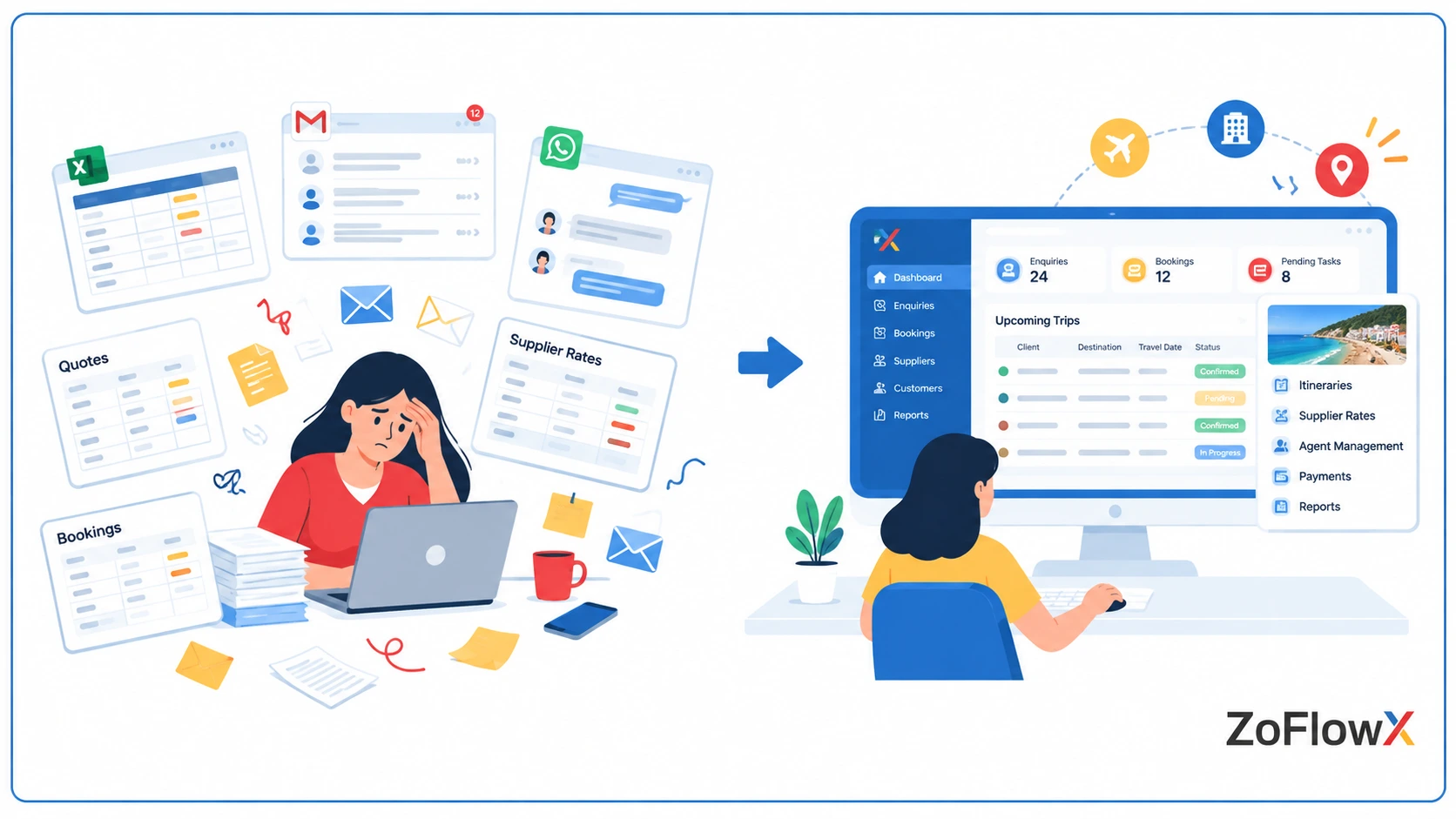
There is often a point when a growing destination management company realizes that its existing way of working is becoming difficult to control.
You may notice that:
- Quotations take too long to prepare and revise.
- Supplier rates are stored across multiple spreadsheets.
- Sales and operations do not always have the same information.
- Booking amendments require repeated manual updates.
- Managers have limited visibility into costs and margins.
- Follow-ups depend heavily on individual employees.
- Customer, supplier, and booking information is spread across different tools.
This is where destination management company software can become useful.
The purpose is not to add another complicated tool to your business. A good business solution should simplify the processes your team already follows and make important information easier to find, update, and share.
For a growing B2B travel business, this becomes particularly important as the number of clients, suppliers, destinations, and bookings increases.
Key Features of Destination Management Software
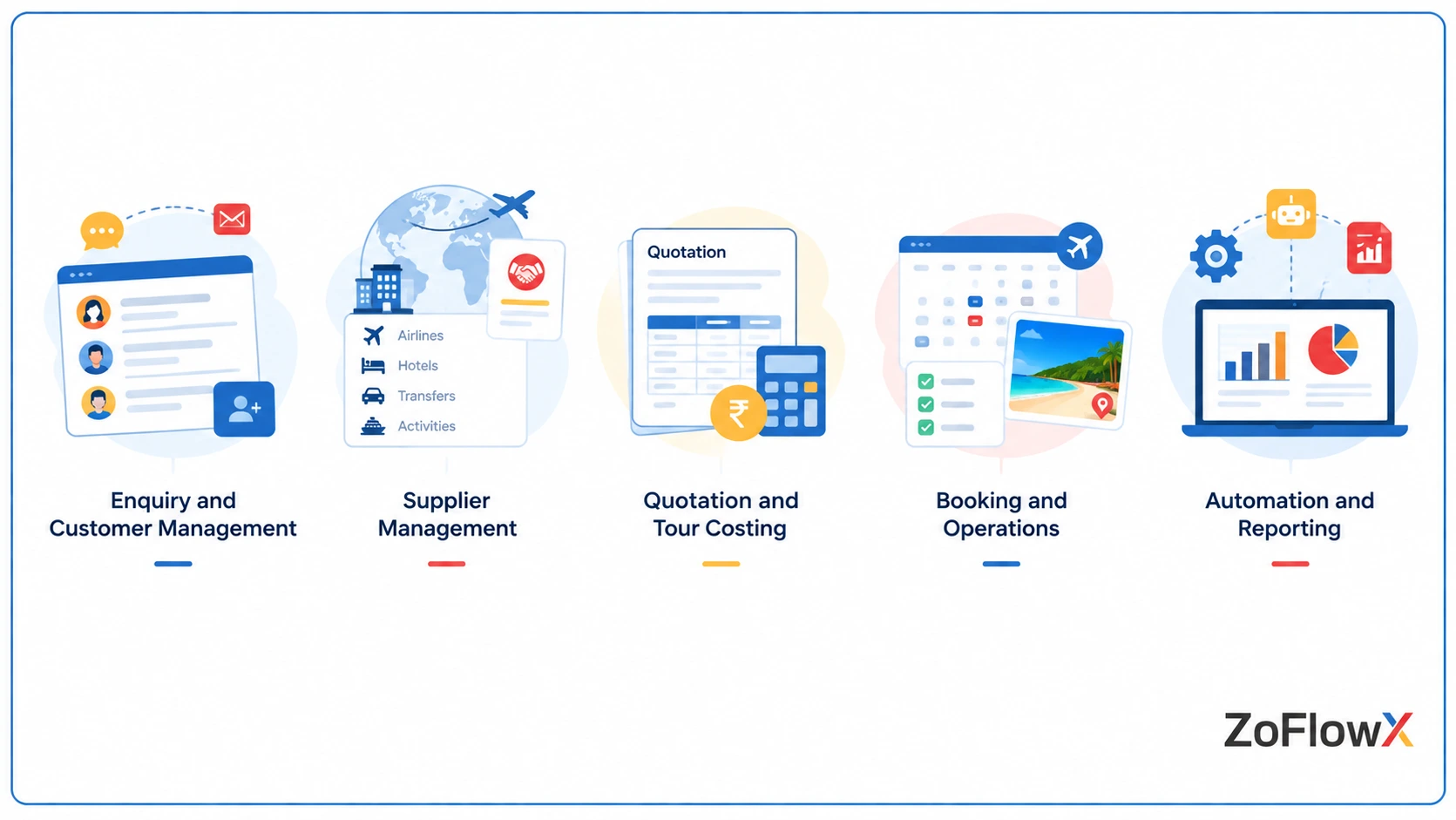
The right dmc software should support your actual workflows rather than simply offering a long list of features.
Enquiry and Customer Management
A DMC should be able to capture enquiries from travel agencies, B2B partners, corporate customers, and other sources. Customer history, requirements, communication, and previous bookings should remain accessible throughout the relationship.
Supplier Management
Supplier information is central to destination management. Hotels, transport companies, guides, activity providers, and other partners may have different rates, contracts, validity periods, and conditions.
A suitable system can organize this information and help teams work with relevant supplier details when preparing quotations or managing bookings.
Quotation and Tour Costing
A single itinerary can involve hotels, transfers, meals, activities, guides, transportation, and other services.
Your system should make it easier to calculate costs, apply markups or commissions, manage discounts, and revise quotations without rebuilding the entire quotation from the beginning.
Booking and Operations Management
Once a quotation becomes a confirmed booking, the information needs to move smoothly into the operational process.
Teams may need to coordinate passenger details, hotels, transportation, activities, guides, special requirements, and last-minute changes. A connected dmc system can help reduce unnecessary handoffs between departments.
Automation and Reporting
Simple automation can handle repetitive activities such as follow-up reminders, task assignments, approval notifications, and internal handoffs.
Reporting can also help management monitor enquiries, bookings, revenue, costs, margins, supplier activity, and other important business indicators.
What Should You Consider Before Investing in DMC Software?
Before comparing dmc software providers, start by looking at your own operation.
Ask yourself: Where is the team losing the most time today?
It could be quotation preparation, supplier rate management, booking coordination, data entry, reporting, or communication between departments.
Then map the complete journey:
Enquiry → Quotation → Costing → Approval → Booking → Operations → Completion → Finance
Look at each stage and identify where information is duplicated, processes are manual, or errors commonly occur.
You should also consider future growth. A system that works for a small travel agency may not necessarily support a DMC managing multiple destinations, branches, currencies, suppliers, and B2B partners.
Integrations are another important consideration. Your business may already use accounting software, CRM tools, booking platforms, or other applications. Replacing every existing tool may not always be necessary.
In some situations, integration can be a more practical approach.
How to Evaluate DMC Software Providers Before You Buy
The software itself is only part of the decision. The provider's understanding of your business can have an equally important impact.
Instead of asking only whether a system has a particular feature, ask the provider to demonstrate it using your actual workflow.
For example, rather than asking, “Does the system support quotations?”, ask:
“How would my team create a quotation using different supplier rates, apply a markup, revise the itinerary, and send an updated version to the travel agency?”
The answer can tell you much more about whether the solution fits your operation.
You should also ask about customization, integrations, data migration, implementation, training, support, and scalability.
This is particularly important when evaluating flexible platforms such as Zoho. ZoFlowX, for example, approaches travel technology by first understanding the client's operational requirements and then determining which Zoho applications, workflows, customizations, or integrations are appropriate.
The important point is that a generic CRM configuration may not be enough for every DMC. Complex travel operations often require technology to be adapted around their specific workflows.
Common Mistakes When Choosing DMC Software
One of the biggest mistakes is choosing software based only on the number of features.
More features do not automatically mean a better system.
Another common mistake is selecting software without involving the people who will use it every day. Sales, reservations, operations, finance, and management can have very different requirements.
DMCs should also avoid overlooking data migration and integration. Existing spreadsheets, customer records, supplier information, quotations, and booking data may contain years of valuable business information.
Finally, do not make the decision based only on price. Consider implementation effort, customization, support, scalability, and the operational improvements the system can provide.
How Destination Management Software Can Improve Your Business
When implemented around the right workflows, destination management software can improve how different teams work together.
Sales can access customer requirements more easily. Costing teams can work with supplier information.
Operations can see booking and itinerary details. Management can gain better visibility into revenue, costs, and margins.
For growing travel companies, this can reduce repetitive administrative work and make increasing booking volumes easier to manage.
The real benefit is not simply having another software platform. It is creating a more structured way to manage information from the first enquiry through to trip completion.
Final Thoughts
Choosing the right destination management software is not simply about selecting a system with the most features. The right solution should fit your DMC’s existing workflows, simplify day-to-day operations, and give your team the flexibility to scale as your business grows.
Before investing in DMC software, evaluate your enquiry process, quotation and costing workflow, supplier management, booking operations, reporting, automation, integrations, and customization requirements. A solution that works around your actual business processes can help reduce manual work, improve coordination, and give your team better visibility across the customer journey.
If you need help choosing the right technology solution for your destination management company, contact ZoFlowX at +91 8190009222 or info@zoflowx.com to discuss how a customized Zoho ecosystem can support your travel business.
Choose a system based on what your DMC actually needs today—and build a stronger technology foundation for tomorrow.
Not Sure Which DMC Software Could Work Best for Your Business?
Explore a customized Zoho ecosystem designed around your DMC's sales, operations, automation, and integration requirements.
HELP ME CHOOSE THE RIGHT DMC SOLUTION
Frequently Asked Questions About Destination Management Software
What does destination management software do?
It helps DMCs manage processes such as enquiries, suppliers, quotations, costing, itineraries, bookings, operations, and reporting in a connected environment.
Is destination management software useful for a B2B travel business?
Yes. It can support travel agency enquiries, B2B partner relationships, supplier management, quotations, commissions, bookings, and operational coordination.
Can DMC software integrate with existing systems?
Depending on the platform, it may be possible to connect CRM, accounting, booking platforms, communication tools, and other applications through integrations or APIs.
Should a DMC choose standard or customized software?
It depends on the complexity of the operation. Standard software may work well for straightforward processes, while customization can be useful when a DMC has specific costing, supplier, booking, approval, or operational requirements.
How should I choose destination management software?
Start by mapping your existing workflows and identifying operational problems. Then evaluate software based on functionality, customization, integrations, scalability, migration, implementation, training, and support.