Employee Travel Risk Management: A Smarter Approach to Safer Business Travel
- Identify travel risks before employees begin their journey.
- Improve visibility into employee travel and itineraries.
- Create faster communication during disruptions and emergencies.
- Connect travel approvals, risk checks, alerts, and reporting.
- Build a flexible travel workflow around your business processes.
Employee travel risk management helps businesses identify, monitor, and respond to risks employees may face during business travel. It brings together travel risk assessment, traveler tracking, travel risk monitoring, communication, and emergency response to create a more organized approach to employee safety.
Business travel can involve unexpected disruptions, security concerns, severe weather, health emergencies, or transportation issues. A clear process helps businesses prepare for these situations instead of trying to manage everything manually when an incident occurs.
What Is Travel Risk Management?
Travel risk management is the process of identifying, assessing, monitoring, and responding to risks associated with business travel. It covers what happens before, during, and after an employee's trip.
A practical process can include destination risk checks, travel approvals, traveler information, alerts, communication, incident management, and post-trip reporting.
The goal is not to remove every travel risk. It is to help businesses prepare for risks and respond to them more effectively.
Why Corporate Travel Risk Management Matters
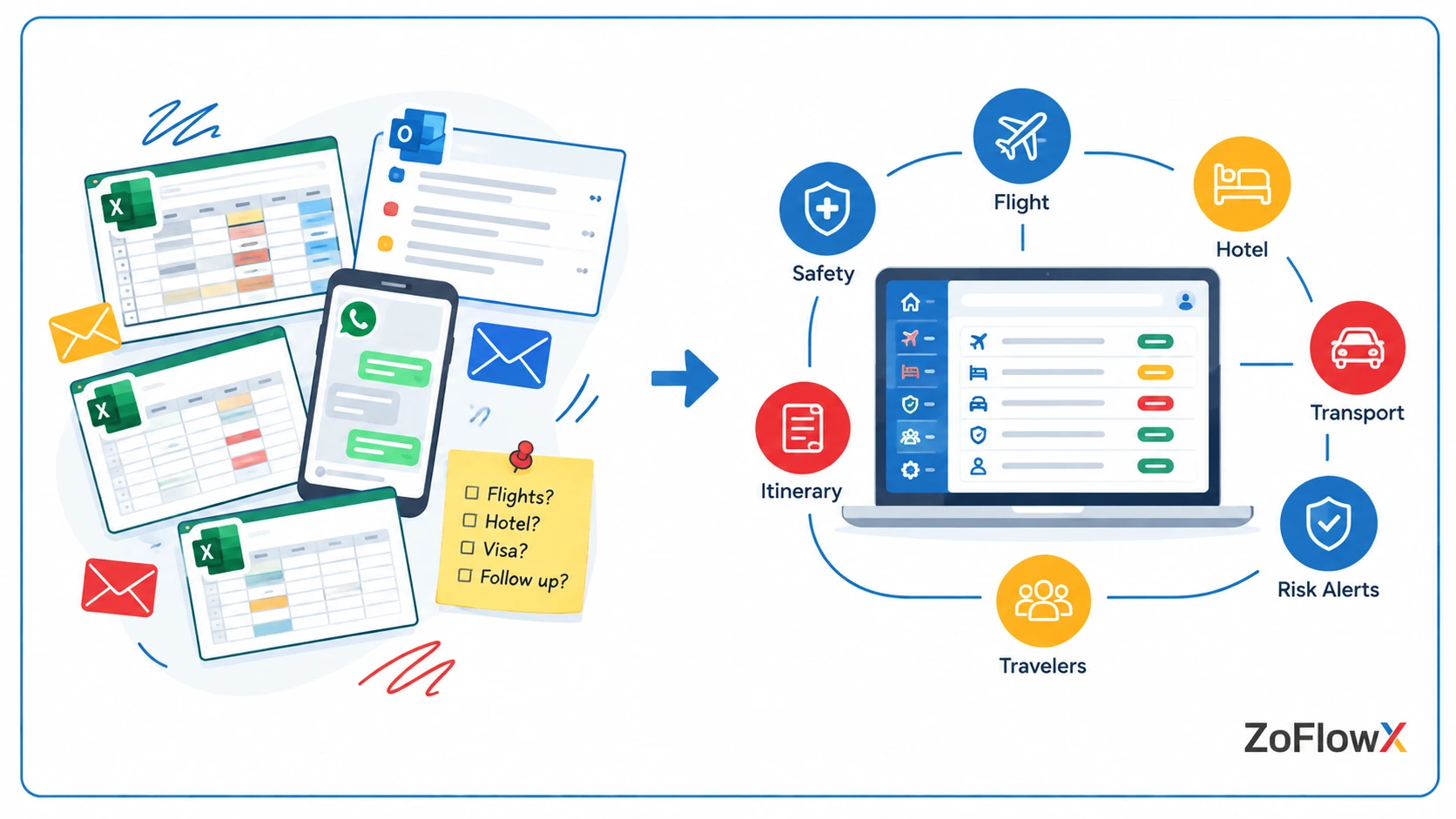 Corporate travel risk management gives businesses a structured way to support employees who travel for work. Instead of keeping travel information across spreadsheets, emails, and disconnected systems, companies can create a more organized workflow.
This becomes especially important when several employees are traveling at the same time or when trips involve multiple destinations.
A connected process can help teams quickly understand who is traveling, where they are going, what risks may affect them, and what action may be required.
Business Travel Risk Management: Where Should You Start?
Business travel risk management should begin before an employee leaves for a trip. The company can establish clear approval steps, assess potential risks, collect relevant traveler information, and define how communication should happen during an incident.
The process can then continue throughout the journey.
This creates a consistent approach instead of leaving each employee or manager to decide what to do when something unexpected happens.
How Travel Risk Assessment Supports Safer Trips
Travel risk assessment helps businesses identify potential concerns before an employee travels. The assessment can consider the destination, travel dates, itinerary, transportation, local conditions, and traveler-specific requirements.
For example, a trip involving several destinations may require different checks from a short visit to a familiar location.
A good travel risk assessment gives teams useful information before they need to respond to a problem.
Building a Strong Corporate Travel Safety Process
Corporate travel safety should continue throughout the employee's journey, not just during the booking stage.
Businesses can establish processes for travel approvals, risk checks, alerts, communication, and incident reporting. These processes give employees clearer guidance while helping internal teams coordinate their response.
The right workflow will depend on the company's travel volume, destinations, employee requirements, and internal responsibilities.
Business Travel Safety Beyond the Travel Policy
Business travel safety requires more than simply creating a travel policy. Employees need practical processes that help them understand what to do before and during a trip.
For example, employees may need access to emergency contacts, travel information, important alerts, and clear escalation procedures.
When these steps are connected to the wider travel workflow, businesses can make travel safety easier to manage consistently.
Corporate Duty of Care and Employee Travel
Corporate duty of care is closely connected to employee travel risk management. Businesses need to take reasonable steps to support employees traveling for work, while specific responsibilities can vary based on the jurisdiction and circumstances.
From an operational perspective, this means having processes for identifying travelers, communicating important information, responding to incidents, and documenting relevant actions.
Duty of care becomes easier to manage when important travel information is organized and accessible.
Create a Practical Travel Risk Management Program
A travel risk management program should cover the complete employee travel journey.
It can include:
- Pre-trip risk assessment
- Travel request and approval
- Traveler information
- Destination risk checks
- Travel risk monitoring
- Alerts and notifications
- Emergency communication
- Incident management
- Post-trip reporting
The exact process should reflect how the business already operates. A useful program should support employees without creating unnecessary administrative work.
Build a Clear Travel Risk Management Policy
A travel risk management policy explains how a company approaches travel-related risks and what employees and internal teams should do.
The policy can define approval requirements, risk assessment procedures, emergency contacts, communication responsibilities, escalation processes, and incident reporting.
However, a policy is only useful when it connects to actual workflows.
The real value comes from turning policy requirements into actions that teams can follow consistently.
Strengthen Corporate Travel Security
Corporate travel security involves preparing for security-related risks that employees may encounter while traveling for work.
Depending on the destination and circumstances, this may involve monitoring relevant travel information, providing employee guidance, sharing alerts, and establishing communication procedures.
A connected workflow can help businesses organize this information and ensure that the appropriate teams can act when attention is required.
Use Travel Risk Monitoring to Stay Informed
Travel risk monitoring helps businesses stay aware of changing conditions that could affect employees during their trips.
When relevant information changes, teams may need to identify affected travelers and communicate with them quickly.
The process can be supported by connected employee, itinerary, and travel information so that teams do not have to search through multiple systems during an urgent situation manually.
How Traveler Tracking Improves Visibility
Traveler tracking gives businesses better visibility into employee travel information. This can help teams identify which employees may be affected when a disruption occurs.
The purpose is not unnecessary employee surveillance. It is about having relevant travel information available when it is needed for safety, communication, and response.
For organizations with frequent business travel, better visibility can make coordination easier.
Travel Emergency Response: Be Ready Before an Incident
Travel emergency response is the process of communicating with and supporting employees when a significant travel-related incident occurs.
A response workflow can be defined:
- How an incident is identified
- Which travelers may be affected?
- Who should be notified
- What communication should be sent
- Who owns the response
- How the incident should be recorded
Having these steps defined before an emergency occurs can reduce confusion when teams need to hurry.
Travel Risk Management Solutions That Fit Your Workflow
Travel risk management solutions can help businesses connect different parts of their employee travel process. Instead of treating travel requests, approvals, employee information, risk checks, communication, and reporting as separate activities, businesses can bring them into a connected workflow. This approach is also relevant Travel risk management solutions can help businesses connect different parts of their employee travel process. Instead of treating travel requests, approvals, employee information, risk checks, communication, and reporting as separate activities, businesses can bring them into a connected workflow. This approach is also relevant when building connected corporate travel operations.
With Zoho Suite, relevant applications can be connected based on the business process. Depending on requirements, this could involve Zoho CRM, Zoho Creator, Zoho Flow, Zoho Analytics, and other Zoho applications.
The focus should be on creating a workflow that matches the company's actual travel operations.
Is Travel Risk Management Software Enough?
Travel risk management software can support automation, visibility, communication, and reporting, but the technology needs to match the business process.
Different companies have different travel approval structures, employee requirements, destinations, escalation procedures, and reporting needs.
That is why simply adding software may not solve every operational challenge.
A better approach is to understand the existing workflow first and then connect the appropriate Zoho applications, automation, forms, notifications, dashboards, and processes around it. Businesses can use customized travel workflows to align these processes with their specific operational requirements.
Make Employee Travel Risk Management More Connected
Employee travel risk management is ultimately about preparation, visibility, communication, and action.
Businesses need to know what is happening before employees travel, stay informed while they are traveling, and have a clear process for responding when something changes.
A connected Zoho-based workflow can bring together travel requests, approvals, traveler information, risk checks, notifications, communication, incident records, and reporting based on the organization's requirements.
At ZoFlowX, we help businesses build and connect Zoho workflows around their operational processes so that travel-related activities can be managed in a more structured and automated way.
If your current process depends heavily on spreadsheets, emails, or disconnected systems, a connected workflow can make employee travel risk management easier to manage and scale.
For a discussion about your requirements, contact +91 8190009222 or info@zoflowx.com and book a meeting with ZoFlowX.
Build a More Connected Travel Risk Process
Create a travel process that connects employee information, approvals, risk checks, communication, monitoring, and reporting around the way your business operates.
[Book a Meeting →]Frequently Asked Questions About Employee Travel Risk Management
What is employee travel risk management?
Employee travel risk management is the process of identifying, monitoring, and responding to risks employees may face during business travel. It can include travel risk assessment, traveler tracking, travel risk monitoring, alerts, communication, and emergency response. A structured process helps businesses prepare before travel and respond more effectively when disruptions or emergencies occur.
Why is corporate travel risk management important?
Corporate travel risk management helps businesses improve employee safety, visibility, and response during business trips. Employees may encounter transportation disruptions, severe weather, security concerns, or other unexpected situations. A structured process helps companies understand who is traveling, where employees are going, and what actions may be required when circumstances change.
What does a travel risk assessment include?
A travel risk assessment evaluates potential risks associated with an employee's business trip. It can consider the destination, travel dates, itinerary, transportation, local conditions, traveler requirements, and emergency contacts. This information helps businesses identify potential concerns before travel and decide what preparation, communication, or monitoring may be appropriate.
What should a travel risk management policy include?
A travel risk management policy should explain how a company identifies, manages, and responds to travel-related risks. It may cover travel approvals, risk assessments, employee responsibilities, emergency contacts, communication procedures, escalation processes, and incident reporting. Connecting these requirements to actual workflows can make the policy easier to follow consistently.
How does traveler tracking support employee safety?
Traveler tracking supports employee safety by giving businesses better visibility into employee travel information. When itinerary and traveler information are connected, teams can identify employees who may be affected by a disruption and communicate with them more quickly. It can also support travel reporting and help teams maintain a clearer picture of ongoing business travel.
What is corporate duty of care in business travel?
Corporate duty of care refers to an employer's responsibility to take reasonable steps to support employees traveling for work. Specific legal responsibilities vary by jurisdiction and circumstances. Operationally, businesses can support duty of care through travel policies, risk assessments, traveler information, communication procedures, alerts, and emergency response processes.
Can travel risk management be automated?
Yes, many travel risk management activities can be automated. Businesses can automate travel requests, approvals, notifications, risk checks, employee records, alerts, reporting, and follow-up tasks. The right level of automation depends on the company's requirements. A connected workflow can reduce repetitive manual work while helping teams manage travel processes more consistently.
How can businesses improve employee travel risk management?
Businesses can improve employee travel risk management by connecting travel information, risk assessment, monitoring, communication, and response processes. Start by identifying gaps such as manual approvals, scattered traveler information, or delayed communication. Then create a structured workflow that gives employees and internal teams the information and actions they need at each stage of business travel.