Corporate Travel Policy: Turn Rules Into a Smart Workflow
- A corporate travel policy defines the rules, but a workflow makes those rules actionable.
- Travel policy automation can reduce manual checks, email approvals, and compliance gaps.
- Policy rules can become automated decision points for requests, approvals, bookings, exceptions, and expenses.
- A connected workflow gives employees, managers, travel teams, and finance better visibility.
- The right solution should be customized around your company's existing travel process, not force your team into a fixed process.
A corporate travel policy defines how employees should manage business travel, including spending limits, booking rules, approvals, preferred suppliers, and exceptions. But simply having a policy document does not guarantee that employees will follow it consistently.
The real challenge is turning policy into action. A travel policy workflow connects employee requests, policy checks, approvals, bookings, expenses, and reporting so the right process happens at the right time.
Policy defines the rules. Workflow puts those rules into action.
Why Corporate Travel Policy Alone Isn't Enough
A company may have detailed corporate travel policies, clear corporate travel guidelines, and a well-written business travel policy.
The problem starts when those rules remain inside documents while the actual process happens through emails, spreadsheets, WhatsApp messages, and manual follow-ups.
An employee may submit a request by email. A manager may approve it separately. The travel team may manually check the policy, while finance discovers a violation after the trip.
This creates a gap between corporate travel policy compliance and day-to-day execution.
Travel policy automation closes that gap by turning important policy rules into workflow decisions that can be applied during the travel process.
How Travel Policy Automation Turns Rules Into Actions
The first step is identifying which rules should trigger a workflow action.
For example, your company may require manager approval for domestic travel above a certain budget.
International travel might require department-head approval, while high-value trips may require an additional finance review.
Instead of expecting employees and managers to remember every rule, the workflow can evaluate the request and automatically determine what happens next.
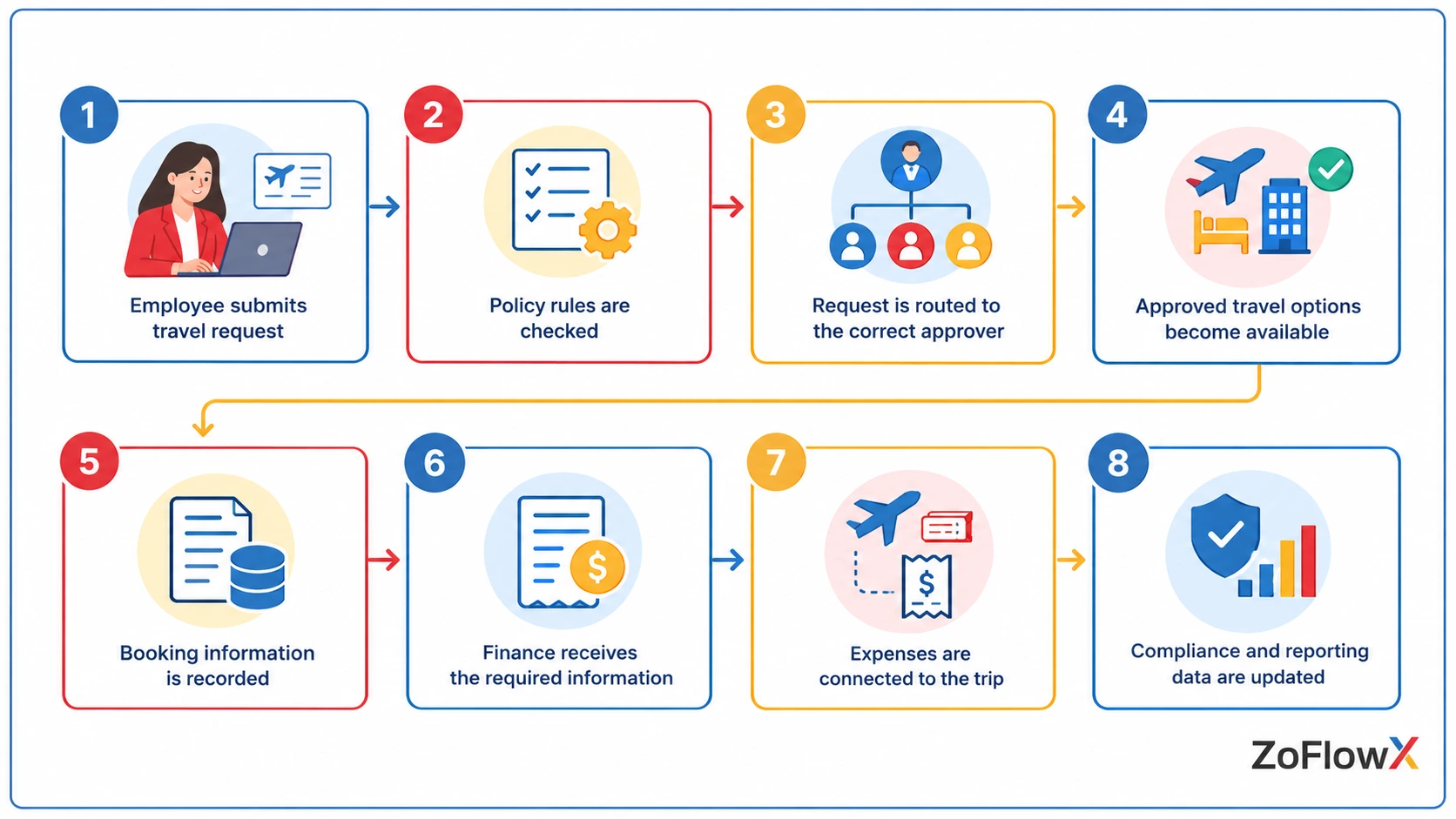
A practical travel policy workflow could look like this:
Employee submits travel request
↓
Policy rules are checked
↓
Request is routed to the correct approver
↓
Approved travel options become available
↓
Booking information is recorded
↓
Finance receives the required information
↓
Expenses are connected to the trip
↓
Compliance and reporting data are updated
This makes automated travel policy enforcement part of the actual travel process rather than a separate manual exercise.
What Should a Corporate Travel Approval Workflow Automate?
A useful corporate travel approval workflow should focus on repetitive decisions, routing, and handoffs.
Travel Requests
Employees can submit travel dates, destination, purpose, department, estimated cost, and other required information through a structured request process.
Policy Validation
The workflow can check budgets, destinations, travel class, preferred suppliers, advance-booking requirements, or department-specific rules.
This allows corporate travel policy enforcement to happen before a booking moves forward.
Approval Routing
Different requests may need different levels of approval.
A workflow can route requests based on department, destination, employee level, trip value, or other business rules.
Notifications
Instead of asking employees to follow up with managers, automated notifications can alert the right person when an action is required.
This keeps requests moving without creating another layer of manual coordination.
Managing Out-of-Policy Travel Without Breaking the Process
Real-world business travel does not always fit neatly inside standard rules.
An employee may need to book a more expensive flight because of an urgent client meeting. A preferred hotel may not be available. A last-minute trip may not meet the company's advance-booking requirement.
This is where out-of-policy travel needs an exception workflow rather than simply being blocked.
A good workflow can flag the exception, capture the reason, route it to the appropriate approver, and maintain a record of the decision.
This approach supports business travel policy enforcement while still giving employees and managers a practical way to handle genuine exceptions.
Corporate Travel Management Automation Beyond Approvals
Travel does not end after a manager approves a request.
The travel team may still need to manage booking information, while finance needs to understand what was approved, what was booked, and what was eventually spent.
This is where corporate travel management automation becomes valuable.
A connected process can bring travel requests, approvals, booking records, expenses, and reporting closer together.
It can also support travel policy compliance monitoring by giving teams visibility into recurring exceptions, policy violations, spending patterns, and approval activity.
The exact workflow should depend on how the company currently manages travel, finance, employees, suppliers, and approvals.
How to Build a Travel Policy Workflow
Before automating anything, map the existing process from start to finish.
A practical framework is:
1. Document the current process
Map what happens from the initial employee request through booking, travel, expense submission, and reconciliation.
2. Identify policy decision points
Highlight rules related to budgets, destinations, travel classes, suppliers, and booking timelines.
3. Define approval rules
Decide who should approve different types of requests and when additional approval is required.
4. Map exceptions
Determine what happens when a request falls outside normal policy.
5. Automate repetitive steps
Automate routing, notifications, policy checks, record creation, and other repeatable activities.
6. Connect relevant information
Bring travel and expense information together where appropriate.
7. Measure compliance
Track approvals, exceptions, violations, spending, and workflow performance.
The goal is not to automate every activity simply because technology makes it possible.
The goal is to create a workflow that reflects how your company actually works.
Where Zoho Fits Into a Customized Travel Workflow
Different companies have different travel policies, approval structures, departments, budgets, and finance processes.
That means a useful workflow often needs to be configured around the business rather than treated as a one-size-fits-all process.
The Zoho ecosystem can support different parts of this journey, including employee requests, approvals, records, notifications, finance-related processes, integrations, and reporting.
For example, one company may need separate approval paths for sales travel, executive travel, and international trips. Another may need department-based budgets, additional finance approvals, or a structured exception process.
ZoFlowX helps businesses configure and connect the relevant Zoho applications around these specific travel requirements, so the workflow supports the company's existing operations instead of forcing the team to change everything around a fixed system.
Conclusion
A corporate travel policy is only the starting point. The bigger challenge is making those rules part of the everyday travel process.
When policy rules become workflow decisions, employee requests can be checked, approvals can be routed, exceptions can be recorded, and relevant travel and expense information can move through a more connected process.
The result is not simply a policy document. It is a working process that helps teams follow the policy consistently.
If your current travel process still depends heavily on spreadsheets, emails, manual policy checks, or disconnected approvals, ZoFlowX can help you design and configure a customized Zoho-based travel workflow around your business requirements.
Call: +91 8190009222
Email: info@zoflowx.com
Book a meeting with our team to discuss your travel workflow.
Ready to Turn Your Travel Policy Into a Workflow?
Build a connected travel workflow around your company's actual policies, approval rules, and operational needs.
Talk to ZoFlowXFrequently Asked Questions
What is corporate travel policy automation?
Corporate travel policy automation means converting travel rules into automated workflow decisions.
Instead of employees and managers manually checking every requirement, the workflow can validate requests, apply approval rules, flag exceptions, send notifications, and maintain records. This makes the company travel policy easier to follow while giving travel and finance teams better visibility into requests and compliance.
How does travel policy automation improve compliance?
Travel policy automation improves compliance by checking policy requirements during the travel process rather than after the trip. For example, a workflow can validate budgets, travel classes, destinations, or approval requirements before a request moves forward. This helps reduce avoidable travel policy violations and creates a clearer record of approvals, exceptions, and policy decisions.
What is a corporate travel approval workflow?
A corporate travel approval workflow is a structured process that routes employee travel requests to the appropriate approver. Approval can depend on factors such as department, employee level, destination, trip purpose, or estimated cost. This reduces email-based approval processes and creates a consistent record of who reviewed and approved each travel request.
Can a travel policy workflow handle different departments?
Yes, a travel policy workflow can apply different rules to different departments. Sales teams, executives, project teams, and other departments may have different travel requirements or budgets. A customized workflow can identify the employee's department and apply the relevant business travel policy, approval path, budget rules, and exception process automatically.
How can companies manage out-of-policy travel?
Companies can manage out-of-policy travel by adding an exception and escalation process to the workflow. When a request does not meet normal corporate travel policies, the system can flag the exception, capture the reason, route it to the appropriate approver, and record the final decision. This provides flexibility without removing accountability from the process.
Can AI help with corporate travel policy compliance?
AI can support corporate travel policy compliance by helping identify patterns, exceptions, and potentially non-compliant requests. However, AI should complement clearly defined business rules rather than replace them completely. AI travel policy enforcement can be useful for highlighting unusual requests or areas that may need additional review by travel, operations, or finance teams.
What should companies automate in business travel?
Companies should automate repetitive travel activities such as requests, policy validation, approval routing, notifications, exception handling, record creation, and compliance reporting. The right level of corporate travel management automation depends on the company's existing process. Automation should reduce repetitive work while keeping important business decisions with the appropriate people.
Can Zoho be customized for corporate travel workflows?
Yes, Zoho can be configured to support customized corporate travel workflows based on a company's processes and requirements. Different Zoho applications can be connected to support requests, approvals, records, notifications, finance-related information, integrations, and reporting. The workflow can be designed around existing corporate travel guidelines rather than requiring every business to follow one standard process.