Corporate Travel Management: A Complete Guide for 2026
- Corporate travel management covers the complete business travel lifecycle, not just bookings.
- A typical process runs from travel request → approval → quotation → booking → supplier coordination → payment → travel support → changes/cancellations → reconciliation → reporting.
- Corporate travel managers need visibility across travelers, suppliers, bookings, finance and operations.
- Corporate travel software can automate and centralize important activities, but software alone cannot fix disconnected processes.
- A strong CTM program connects people, workflows, data and technology.
- The right solution should fit the way the business operates rather than forcing every business into the same workflow.
- ZoFlowX helps travel businesses design and connect customized workflows using the broader Zoho ecosystem.
Corporate travel management is no longer simply about booking flights and hotels for employees. In 2026, it involves managing the complete business travel operation—from travel requests and approvals to quotations, bookings, supplier coordination, payments, changes, reconciliation and reporting.
For companies managing frequent business travel, the challenge is often not a lack of software. It is the lack of connection between the people, processes and systems involved.
A CRM may manage enquiries. An accounting system may manage finance. A booking system may manage reservations. Spreadsheets may track suppliers. Email and WhatsApp may handle communication.
Each tool can work perfectly on its own while the overall operation remains fragmented.
This guide explains what corporate travel management really involves, how the complete process works, where businesses commonly struggle, what technology should support the operation, and why building a connected corporate travel ecosystem is more important than simply purchasing another software application.
What Is Corporate Travel Management?
Corporate travel management is the structured process of planning, approving, booking, supporting, tracking and optimizing business travel.
It can cover:
- Travel requests
- Traveler information
- Travel policies
- Approvals
- Flight and hotel arrangements
- Ground transportation
- Quotations
- Bookings
- Supplier coordination
- Payments and invoices
- Changes and cancellations
- Travel documentation
- Expense and financial reconciliation
- Reporting and analytics
The objective is not simply to arrange a trip.
The objective is to make the entire operation controlled, visible and repeatable.
For example, when an employee requests travel, the business may need to know who is travelling, why they are travelling, which department owns the cost, who must approve it, what options were quoted, which supplier was selected, what has been paid and whether the booking later changed.
When these activities are connected, teams work from the same information. When they are disconnected, employees spend time moving information between systems.
How Does the Corporate Travel Management Process Work?
A well-designed corporate travel management process can follow a clear operational journey:
Travel Request → Approval → Requirements → Quotation → Booking → Supplier Coordination → Payment → Itinerary → Travel Support → Changes/Cancellations → Reconciliation → Reporting
1. Travel request
The employee, client or travel coordinator submits the travel requirement.
Information may include destination, dates, traveller details, purpose of travel, budget, preferences and special requirements.
2. Approval
The request is routed to the appropriate manager, department head, finance team or other approver.
Approval rules can differ depending on destination, budget, traveller level or trip type.
3. Quotation
The travel team prepares suitable options and communicates costs, inclusions, availability and conditions.
4. Booking
Once the traveler or authorized person selects an option, the booking is confirmed.
5. Supplier coordination
Airlines, hotels, transport providers, DMCs and other suppliers may need to be contacted and tracked.
6. Payment and documentation
Customer payments, supplier payments, invoices, receipts and booking documents need to be recorded.
7. Travel support
The traveler receives the itinerary and assistance required before or during the trip.
8. Changes and cancellations
Travel plans frequently change. Rebooking, cancellations, refunds, additional charges and revised itineraries should remain connected to the original booking.
9. Reconciliation and reporting
Finally, operational and financial information should be reconciled and made available for management reporting.
This end-to-end view is what separates a managed travel operation from a collection of individual booking activities.
How Do Corporate Travel Managers Connect the Corporate Travel Ecosystem?
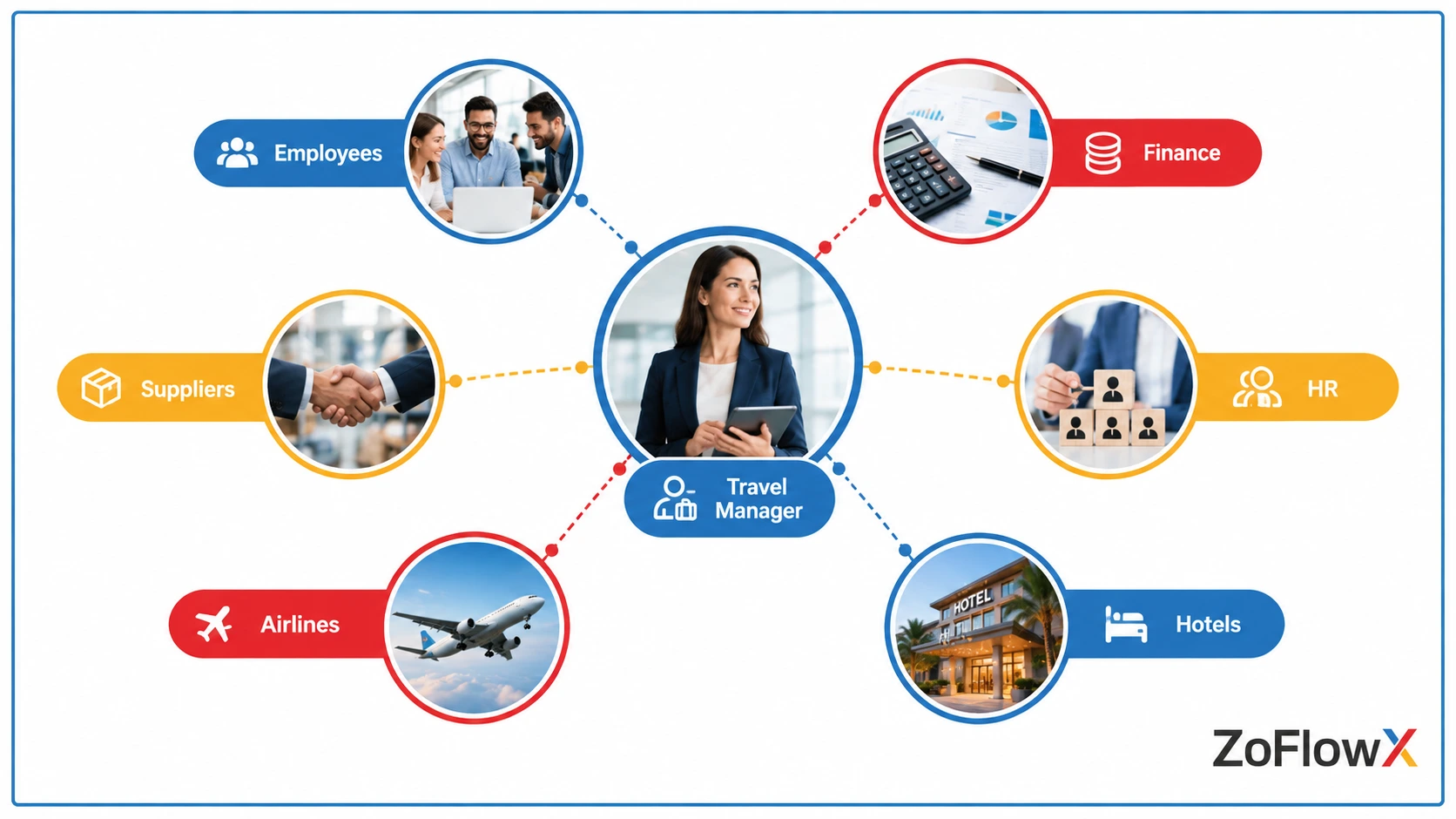
Corporate travel managers sit at the center of a surprisingly complex corporate travel ecosystem. They may coordinate with employees, executives, finance teams, HR, suppliers, travel agencies, hotels, airlines, transport providers and management.
The challenge becomes greater when each stakeholder works in a different system.
For example:
- Customer information may sit in a CRM.
- Travel requirements may be in email.
- Supplier rates may be in Excel.
- Bookings may exist in an external booking system.
- Payment information may be in accounting software.
- Follow-ups may happen through WhatsApp.
- Management reporting may require another spreadsheet.
The problem is not necessarily any individual application. The problem is that the people, processes, data and systems are not properly connected.
A corporate travel manager therefore needs more than visibility into individual bookings. They need to understand how information moves across the entire operation—from the initial request and quotation to booking, supplier coordination, payment, travel support and reporting.
This is why modern corporate travel operations should be designed as a connected ecosystem rather than a collection of disconnected tools.
How Do Corporate Travel Agencies and Corporate Travel Management Companies Manage Their Operations?
Corporate travel agencies and corporate travel management companies can play an important role in managing business travel. A TMC may provide booking support, supplier relationships, travel assistance, policy management, reporting and other services.
However, managing travel for customers does not automatically solve the agency's own operational challenges.
A business still needs clear visibility into questions such as:
- Where did the travel request originate?
- Who approved it?
- Which quotation was selected?
- Which supplier was used?
- What has the customer paid?
- What does the company still owe?
- Was the booking changed?
- What is the final cost?
- What is the margin?
- Which customer, department or project generated the travel?
These details can become difficult to manage when they are spread across CRM records, spreadsheets, emails, booking systems, accounting software and messaging platforms.
Whether travel is managed internally or through external corporate travel management companies, the underlying information should remain organized and connected.
The goal is not simply to manage bookings. It is to create an operational flow where customer information, travel requirements, quotations, bookings, suppliers, payments, finance and reporting work together.
Corporate Travel Software: Why Software Alone Is Not Enough
Corporate travel software can help businesses centralize requests, approvals, bookings, travel information and reporting.
Similarly, corporate travel management software can reduce repetitive work and provide greater visibility.
But there is an important distinction:
Software can support a process. It cannot replace a well-designed process.
Imagine a business purchases a CRM, accounting system, booking platform and analytics tool.
If employees still have to copy customer information from the CRM into a spreadsheet, send booking details through email, manually update finance records and prepare reports at the end of every month, the business has added technology without solving the underlying operational problem.
This is why the question should not simply be:
“Which corporate travel software should we buy?”
The better question is:
“How should our travel operation work, and how should our systems support that workflow?”
For businesses with unique processes, a customized approach can be more valuable than trying to force the business into a rigid ready-made workflow.
Corporate Travel Management Platform: What Should It Connect?
A corporate travel management platform should support the processes that matter to the organization.
Depending on the business, this can include:
- Customer and traveller management
- Travel enquiries
- Travel requests
- Approval workflows
- Quotations
- Booking records
- Supplier management
- Itinerary management
- Payment tracking
- Document management
- Changes and cancellations
- Financial integration
- Notifications and follow-ups
- Dashboards
- Management reporting
The most important capability, however, is connectivity.
For example, a confirmed booking should not become an isolated record.
It should remain connected to the traveller, customer, quotation, supplier, payment and financial information associated with that booking.
That creates a single operational chain instead of several disconnected records.
What Are the Biggest Corporate Travel Management Challenges?
Growing travel businesses commonly face several operational challenges.
Manual processes
Employees repeatedly enter the same information into different systems.
Scattered information
Important details are spread across email, spreadsheets, CRM, accounting systems and messaging platforms.
Delayed approvals
Travel requests wait for managers because approval processes depend on manual follow-ups.
Supplier coordination
Teams struggle to track rates, confirmations, payments, availability and supplier communication.
Booking changes
Changes and cancellations create additional work because information must be updated across multiple systems.
Financial reconciliation
Operations and finance may maintain different versions of the same transaction.
Poor reporting
Management reports require manual consolidation, making them slow and potentially unreliable.
Limited scalability
A process that works for 20 bookings a month can become difficult to manage when the business handles hundreds or thousands.
These are operational problems—not simply software problems.
How to Build a Strong Corporate Travel Management Program
A successful corporate travel management program should start with process design.
Step 1: Map the current operation
Document what happens from the first travel enquiry or request through final financial closure.
Step 2: Identify gaps
Look for duplicate data entry, manual approvals, spreadsheet dependency, communication gaps and reconciliation issues.
Step 3: Define ownership
Every stage should have a clear owner.
Who handles the enquiry? Who approves?
Who prepares the quotation?
Who manages suppliers?
Who confirms payment?
Who closes the transaction?
Step 4: Define the systems
Determine which system should manage customers, travel operations, finance, documents and reporting.
Step 5: Connect the workflows
Information should move between systems automatically wherever practical.
Step 6: Automate repetitive activities
Notifications, assignments, reminders, approvals, follow-ups and document generation are common areas for automation.
Step 7: Build meaningful reporting
Reports should help management understand revenue, costs, margins, bookings, suppliers, outstanding payments and operational performance.
Step 8: Improve continuously
The system should evolve as the business grows and its processes change.
CTM Program Technology: What Should Businesses Look For?
When evaluating a CTM program, businesses should look beyond the feature list.
Ask:
- Can the system integrate with our CRM?
- Can travel requests trigger approval workflows?
- Can quotations connect to bookings?
- Can supplier information be managed centrally?
- Can finance access accurate transaction information?
- Can changes and cancellations remain connected to the original booking?
- Can management access reliable reports?
- Can we reduce duplicate data entry?
- Can the workflows adapt to our business?
- Can the system scale as our travel volume grows?
This approach changes the buying decision from “Which software has the most features?” to “Which technology architecture will make our operation work better?”
How ZoFlowX Helps Build a Connected Travel Operation
ZoFlowX is not positioned as a generic, ready-made corporate travel software product.
Our approach starts with the business.
We look at how the travel company actually works—from enquiries and quotations to costing, itineraries, suppliers, bookings, operations, finance and reporting.
Then we identify which processes should be standardized, which should be automated and which systems should be connected.
Using the Zoho ecosystem, businesses can bring together applications such as Zoho CRM, Zoho Creator, Zoho Books and Zoho Analytics, alongside other relevant Zoho applications and integrations.
This is particularly useful when a business has workflows that do not fit neatly into a standard product.
The objective is not to add another application to the technology stack.
The objective is to build a connected operational ecosystem around the way the business works.
That means the technology supports the people and processes rather than forcing the entire business to work around the software.
Corporate Travel Management in 2026: The Connected Operations Approach
The 2026 corporate travel environment is increasingly technology-enabled. Modern travel tools can centralize booking, policy enforcement, traveller information, expenses and reporting. Zoho itself now provides integrated business-travel capabilities through Zoho Expense, including travel booking, policy controls, travel-desk functionality and travel-spend visibility.
But this makes operational design even more important—not less.
Businesses may still have customer management, supplier workflows, specialized costing, internal approvals, financial processes and reporting requirements that extend beyond a single travel application.
The real opportunity is therefore to connect the relevant systems around the complete business process.
In other words:
The goal is not more software. The goal is better-connected operations.
How to Choose the Right Corporate Travel Solution
Before selecting a technology partner or platform, evaluate the complete operating model.
A suitable solution should help your business:
- Centralize information
- Reduce duplicate data entry
- Automate approvals
- Improve supplier coordination
- Connect operations with finance
- Track bookings and changes
- Improve reporting
- Reduce manual follow-ups
- Create accountability across teams
- Adapt to unique workflows
- Scale with business growth
Most importantly, ask whether the provider understands your business process before recommending technology.
A successful implementation should begin with discovery and process mapping, followed by solution design, configuration, integration, testing, training and ongoing improvement.
Final Thoughts: Corporate Travel Management Is Bigger Than Software
Effective corporate travel management is not simply about finding a better way to book business travel.
It is about creating a connected operation in which enquiries, travel requests, approvals, quotations, bookings, suppliers, travellers, payments, finance and reporting work together.
Corporate travel software and corporate travel management platforms can play an important role. But software alone cannot eliminate fragmented processes.
The businesses that build stronger travel operations will be the ones that connect people + processes + data + technology into one organized ecosystem.
That is where ZoFlowX can help.
Rather than offering a one-size-fits-all product, ZoFlowX helps travel businesses understand their existing operation and build a customized Zoho-powered ecosystem around their actual workflows.
If your current travel operation depends on spreadsheets, disconnected applications, manual follow-ups or repetitive data entry, it may be time to look beyond another software purchase and redesign the operation itself.
Call +91 8190009222, email info@zoflowx.com, or book a meeting with ZoFlowX.
Build a Connected Corporate Travel Operation
Your business doesn't need more disconnected tools. It needs a connected operational system designed around the way your team actually works.
BOOK A STRATEGY CALLFrequently Asked Questions
What is corporate travel management?
Corporate travel management is the process of managing business travel from travel requests and approvals through booking, supplier coordination, payments, changes, reconciliation and reporting.
What does corporate travel management software do?
Corporate travel management software can centralize travel information, automate workflows, manage approvals and provide reporting. However, it works best when the underlying business processes and systems are properly designed and connected.
What is the difference between a TMC and corporate travel software?
A TMC, or travel management company, generally provides travel-management services and support. Corporate travel software is technology used to manage or automate travel processes. Businesses may use either one or combine both depending on their requirements.
Do corporate travel agencies need a customized system?
Not always, but businesses with complex workflows, multiple suppliers, specialized costing, customized approval processes or significant integration requirements may benefit from a customized operational system rather than relying entirely on generic software.
Can ZoFlowX customize a corporate travel management system?
ZoFlowX helps travel businesses design and connect customized workflows using the Zoho ecosystem. The focus is on understanding the business process first and then configuring, customizing and integrating the appropriate Zoho applications around that process.