Zoho MCP vs APIs: Choosing the Right Solution
- The Zoho MCP vs APIs decision is not about which technology wins. It is about what you are building and who or what is doing the calling.
- Zoho MCP is a protocol that lets AI assistants discover and use Zoho tools through natural language. Zoho APIs are developer interfaces that give you precise, coded control over every request.
- MCP sits on top of APIs. Every MCP action still hits a Zoho API in the background.
- Choose MCP for AI agents, conversational workflows, and cross-app automation. Choose APIs for custom apps, deterministic logic, and high-volume data operations.
- Most businesses end up using both. That combination is usually the fastest route to results.
- Security in both cases depends on your configuration, not on the protocol you picked.
So, if you are considering Zoho MCP vs APIs, here is the short answer: Use Zoho MCP when you want an AI assistant to operate within your Zoho apps, and use APIs when you want your own software to have complete control over the data. Zoho MCP integration makes your Zoho functions discoverable in plain language for an AI model to call. Zoho API integration involves coding against the traditional REST endpoints. They solve different problems, and knowing which one fits saves weeks of wasted build time.
I've used both in CRM, Books, Inventory, Recruit, and Desk projects, and the pattern is the same. Teams that pick based on the actual job get to production quickly. Hype-picked teams rebuild in three months.
What Is Zoho MCP and How Does It Actually Work?
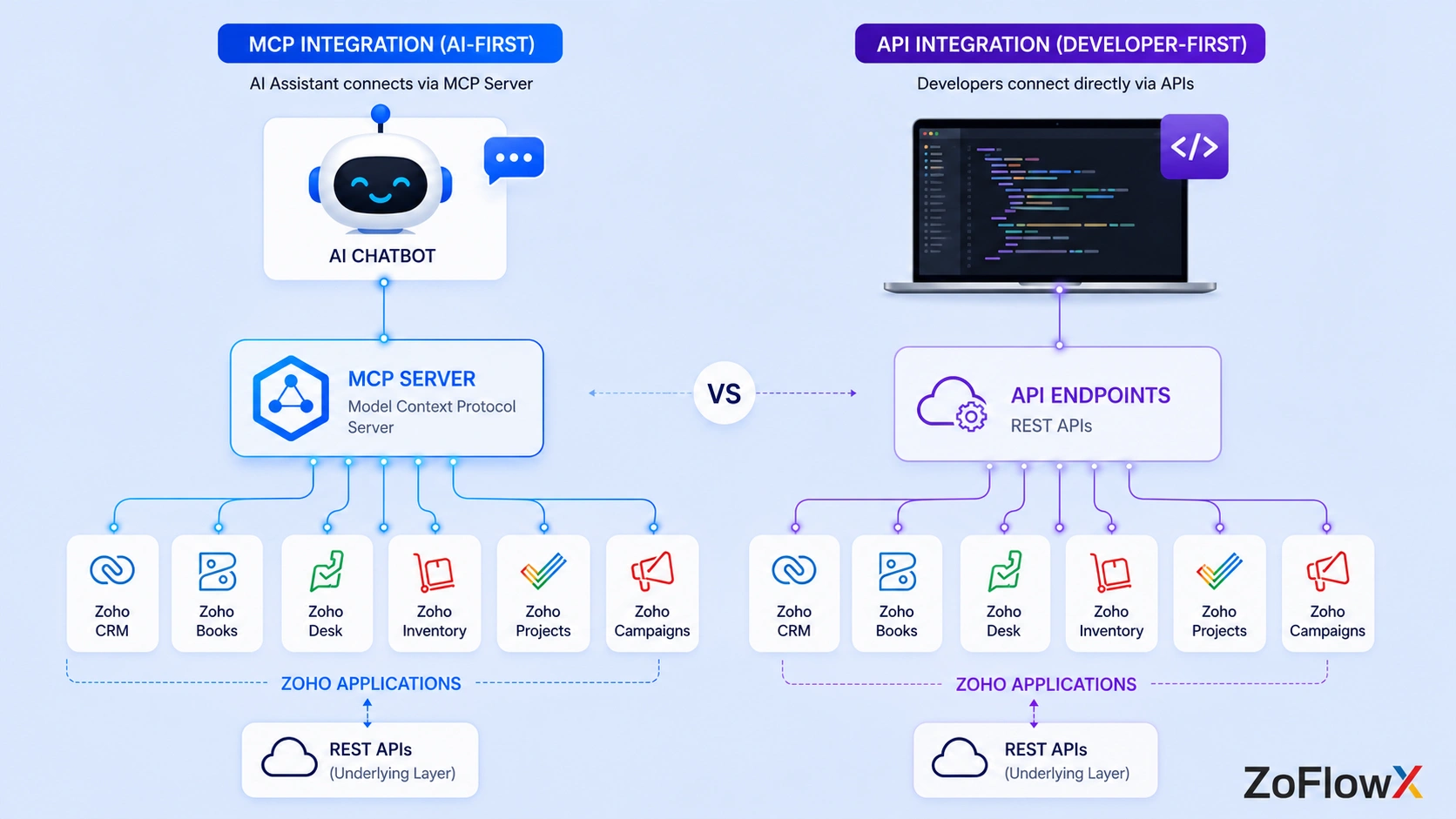
Zoho Model Context Protocol enables Zoho application functions to be discovered and executed by an AI assistant. You don't hardcode endpoints, you deploy a Zoho MCP server, publish the actions you approve, and link an AI client such as Claude or ChatGPT. The AI then reads what is available and responds to natural language instructions.
The important word there is discover. In a traditional build, you tell the code exactly what to call. With MCP-based integration, the AI will ask the server what it can do, receive a structured list of tools with descriptions and parameters, and select the appropriate tool.
That alters the work. No more writing one function to create a lead, another to update a deal stage, and another to retrieve last quarter's invoices. The toolset is exposed once and the model is the workflow.
Zoho now offers MCP servers across its product line, so a single AI client can reach CRM, Books, Projects, Desk, and more. If you want a deeper breakdown of the architecture, we covered it in Zoho MCP explained.
What Are Zoho APIs and Why Do Developers Still Rely on Them?
Zoho developer APIs are REST interfaces that power all Zoho products. They've been around for years, they're well documented, and they still drive the majority of serious integration in the ecosystem.
With APIs you get exact control. You specify the request, the fields, the pagination, the error handling, the retry logic, and the response mapping. There is no action that takes place that you did not write.
That control is what makes API-based integration the backbone of custom application development. If you have a reconciliation script that needs to reconcile 4,000 invoice lines without any mismatches, you don't want a model to interpret the task. You want code that is deterministic.
The reference material is solid too. Anyone building this way should keep the Zoho Developer Documentation open in a second tab.
What Is the Difference Between Zoho MCP and APIs?
The difference between the MCP vs API integration is all about the consumer. APIs are designed for developers who write code with hard-coded logic. MCP is designed for AI models that must be aware of what they can do and make decisions on what to do at runtime. MCP is not an API. It wraps them in a layer language models can interpret and use safely.
This is the side by side view I use when scoping projects.
Factor | Zoho MCP | Zoho APIs |
Primary consumer | AI assistants and agents | Developers and applications |
Interaction style | Natural language, tool discovery | Explicit coded requests |
Setup effort | Configure server, expose tools, connect client | Write and maintain code per endpoint |
Flexibility | High, handles unplanned requests | Fixed, handles what you coded |
Predictability | Good, but model dependent | Exact and repeatable |
Best for | Conversational automation, multi-app tasks | Custom apps, bulk data, strict logic |
Maintenance | Tool definitions evolve, AI adapts | Code updates needed when fields change |
Authentication | OAuth 2.1, scoped permissions | OAuth 2.0, manually managed scopes |
Volume handling | Better for conversational, low volume | Better for high throughput batch jobs |
Learning curve | Low for business users, moderate for setup | Steeper, requires development skill |
Vendor flexibility | Open standard, works across AI clients | Zoho specific implementation |
Zoho MCP vs APIs: What Are the Pros and Cons of Each?
Where Zoho MCP is strong
- Significantly reduced code for AI applications. Expose tools, not endpoints.
- Multiple AI clients can be served by one server without rework.
- Business users can initiate multi-step work in plain language.
- A new capability is a configuration change, not a sprint.
- Cross-app workflows get much simpler. One request can impact CRM, Books, and Desk.
Where Zoho MCP falls short
- The output is dependent on the interpretation of the request by the model, therefore the description of the tools must be precise.
- Not designed to process tens of thousands of records in a batch.
- Patterns and tooling are still evolving in newer ecosystems.
- Needs attention with permissions. An over-permissive server is a real risk.
Where Zoho APIs are strong
- Complete control and fully repeatable behaviour.
- Well-documented, SDKs, and community knowledge.
- Supports bulk operations, complex transformations and heavy volume.
- Line-by-line easy to unit test and audit.
Where Zoho APIs fall short
- Each new requirement adds more code.
- Field changes and schema updates break integrations that were working fine.
- Longer time to a first working version.
- Not directly usable by AI agents without a wrapper layer.
Which Is Easier to Implement and Maintain?
For AI-driven work, Zoho MCP implementation is easier. You set up a server, show the tools you need, attach the client, and the AI finds actions for itself. APIs are easier to use for traditional software integration, as the behaviour is explicit and debugging is simple. The same division applies to maintenance effort.
A Zoho MCP integration rollout looks like this:
- Determine which Zoho apps and actions the AI actually requires.
- Configure the server for those apps and restrict the permissions of the OAuth.
- Provide clear tool descriptions, not just parameters.
- Link your AI client and test using actual business language, not clean sample prompts.
- Record all tool calls for the first few weeks and tighten as necessary.
- Add more tools as confidence grows.
A traditional build runs differently:
- Register the client and set up OAuth authorization.
- Draw the fields, modules and relationships you require.
- Write the request and response handling for each operation.
- Implement pagination, rate limiting, and retry logic.
- Test edge cases and error states.
- Keep the code up to date when Zoho or your schema changes.
Step two matters more than people expect. Getting tokens and scopes right early prevents most production headaches, and the Zoho OAuth guide is worth reading properly rather than skimming.
How Do Zoho MCP vs APIs Compare on Performance and Security?
Direct API calls are better in terms of raw performance. No interpretation layer, no model latency, no token cost. If you're syncing 50,000 records per night, coded integration is the answer and it's not far off.
MCP is the winner of conversational performance. A user who asks which deals are stuck in negotiation for more than 30 days receives an answer in seconds without anyone having to build a report.
Security should be given a more precise answer than most comparisons provide. MCP implements OAuth 2.1 with permission-scoped access, meaning that the AI only accesses what you've allowed. APIs provide the same level of protection, but you set it up yourself.
The real risk in both cases is scope creep. I have audited servers with full admin access that were exposed to a chat client, and API tokens that could delete records that no one wanted to touch. The protocol is not the weak link. The configuration is.
According to ZoFlowX, the single most common mistake we see in early Zoho MCP implementation is granting write access to modules that only ever needed read access. Fix that before anything else.
When Should You Choose MCP for Zoho?
Pick MCP when the work looks like this:
- You want an assistant that your sales or support team can communicate with directly.
- Requests are unpredictable and diverse, so it doesn't make sense to hardcode each path.
- A single task spans multiple Zoho apps.
- You want business users to self-serve rather than raise tickets for each report.
- You need something useful this week, not next quarter, and you're prototyping.
- You want AI agents with Zoho that evolve with your process.
Demand for this pattern is climbing fast. According to Gartner, more than 30% of the increase in API demand is expected to come from AI and large language model (LLM) applications by 2026, highlighting the growing need for standards like the Model Context Protocol.
When Should You Stick With Traditional API Integration?
Choose the coded route when:
- The logic should be precise each and every time, for example, financial posting or tax calculation.
- You are moving or syncing a large amount of data.
- You are creating a product that your customers will use.
- A fully auditable code path is required for compliance.
- Tight control over rate limits, retries, and error recovery is required.
- At scale, latency and cost per operation are important.
The API-first mindset is not going anywhere either. According to Postman's research, 74% of organizations have adopted an API-first strategy, demonstrating how central APIs remain to modern software development and engineering.
If your project falls into this category, working with CRM implementation experts early usually costs less than fixing architecture later.
Can You Use Both Together?
Yes, and this is the solution for most mid-sized and larger businesses.
The hybrid pattern is easy to understand. APIs take care of the heavy, deterministic, scheduled work. MCP does the human side of the work, the conversational, the exploratory. They have the same underlying data since MCP is calling the same endpoints.
A practical example from a distribution client: nightly stock and invoice sync runs on custom scripts, while the sales head asks the AI assistant about overdue receivables and credit-hold accounts. Neither layer duplicates the other.
That layered approach is how experienced business software integration experts tend to design these systems from the start.
Can MCP Replace Traditional Zoho APIs?
No, and it was never meant to.
MCP is a translation layer. Under the APIs, there is nothing left for the protocol to call. All create, read, update and delete operations continue to pass through Zoho's REST endpoints.
It replaces the glue code you wrote so that an AI can reach those endpoints. While that's a significant saving, it's not the same as replacing the API layer itself.
Which Approach Is Better for AI Agents and Automation?
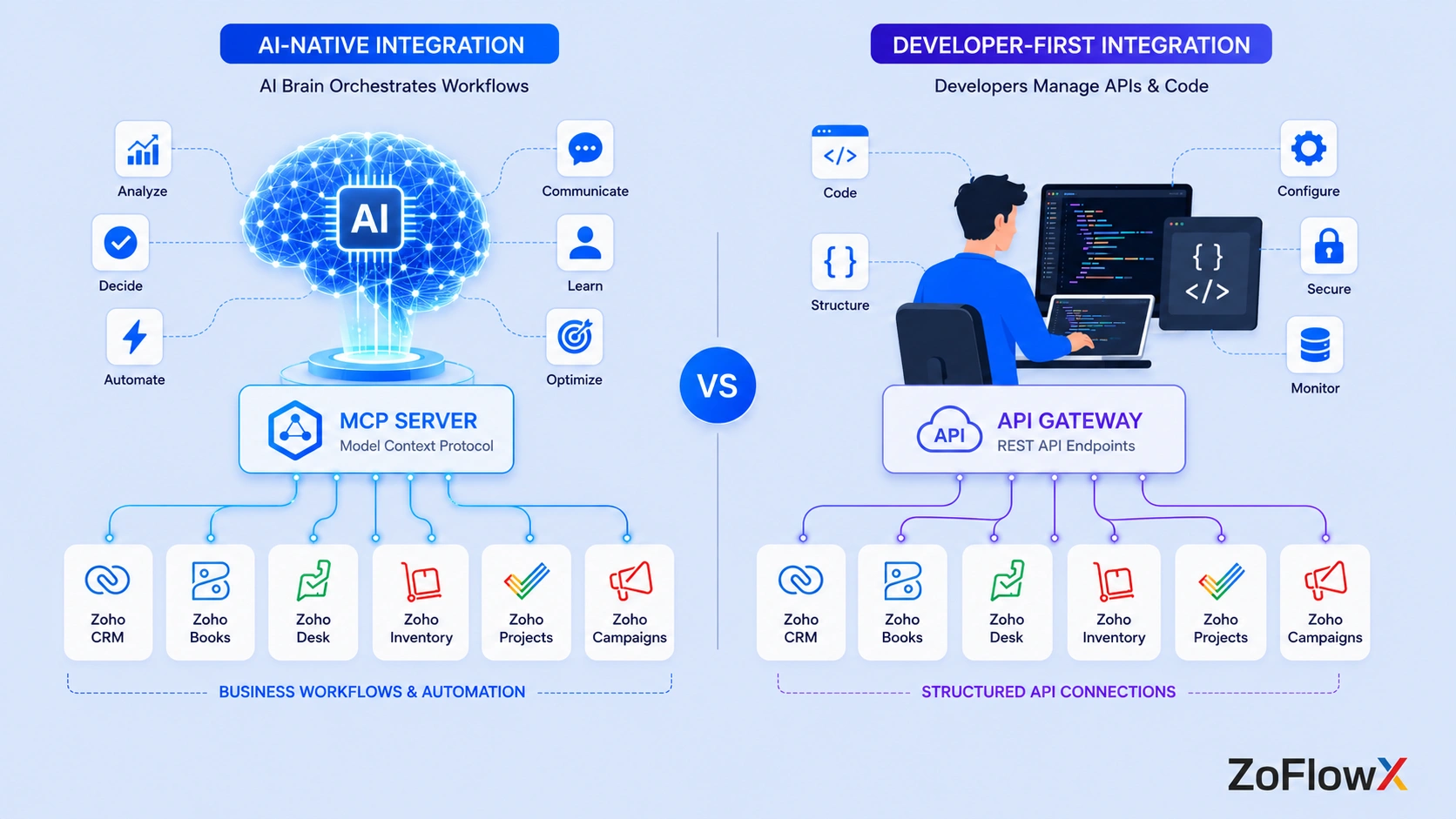
If you're working as an agent, Zoho AI integration via MCP is more suitable. The protocol allows agents to find capabilities at runtime and link actions together, exactly what they need to do.
Enterprise adoption is accelerating rapidly. According to OpenAI, more than 9,000 organizations have processed over 10 billion AI tokens through APIs, showing how quickly AI has evolved from experimentation to mission-critical business operations.
For scheduled automation with fixed rules, APIs and Deluge remain the stronger option. A workflow that fires the same three actions on every closed deal does not need a language model in the path.
Which Option Is Best for Your Business or Application?
If you ask three questions, the answer will come.
Who is initiating the request? A human in a conversation points to MCP. Another system points to APIs.
How predictable is the task? Highly variable requests suit MCP. Fixed logic suits APIs.
What is the volume? Low volume and exploratory suits MCP. High volume and repetitive suits APIs.
Quick match by profile
- Testing AI in sales: start with MCP, it's quick to set up and easy to modify.
- If you're a finance team that requires precise reconciliation, APIs are the only way to go.
- Support team that requires immediate context of a ticket: MCP.
- Embedding Zoho data in SaaS products: APIs.
- Hybrid: Growing business that requires efficiency and control.
Final Recommendation on Zoho MCP vs APIs
Use APIs as your data backbone and place MCP in front of anything human or AI.
That order matters. APIs provide reliability and auditability. MCP provides you with speed and accessibility. Reverse the order and you have a great demo on a shaky foundation.
Start small on the MCP side. Expose read-only tools first, watch how your team actually uses them, then open up write access where it earns its place. Choosing the right Zoho implementation partner for that rollout matters more than the protocol debate itself.
Conclusion
The Zoho MCP vs APIs question is not a philosophical one, but a practical one. APIs provide you with accuracy, scale, and auditability for the systems that your business relies on. MCP provides you with speed, accessibility, and real AI without months of custom development. When used together, they span the entire spectrum, and it's here that most businesses get the best return.
If you are thinking about integrating now, the best thing you can do is to get the architecture right the first time. A well-scoped server plus a solid API layer will serve you for years. A rushed build will have to be replaced within months.
We do this work weekly for clients in CRM, Books, Inventory, Desk, and Recruit and we can tell you in one conversation which approach is right for you. Call our team on +91 8190009222 or send an email to info@zoflowx.com and we will help you plan the best Zoho MCP vs APIs solution for your business. Choose wisely and begin your AI journey on a solid foundation that will support your future goals.
Don't Let a Wrong Integration Choice Cost You Months of Rework
Book Your Free Zoho Integration Audit NowFrequently Asked Questions
What is the main difference between Zoho MCP and APIs?
Zoho MCP is an AI communication protocol, while APIs are developer interfaces for software integration. Zoho MCP enables AI assistants like ChatGPT or Claude to understand available tools and execute actions using natural language. APIs, on the other hand, require developers to manually write code for every request, response, and workflow. MCP simplifies AI interactions, whereas APIs provide complete control for traditional software integrations.
Does Zoho MCP replace traditional APIs?
No, Zoho MCP does not replace APIs. Instead, it works on top of existing APIs. Every action performed through Zoho MCP ultimately calls an underlying API in the background. The difference is that MCP allows AI assistants to discover and use those APIs automatically, reducing development effort while making AI-powered automation much easier to build.
When should I use Zoho MCP instead of APIs?
Use Zoho MCP when you're building AI-powered workflows or integrating AI assistants with Zoho applications. MCP is ideal for conversational automation, multi-app tasks, and intelligent workflows. If you need precise, deterministic business logic or custom application development, traditional APIs remain the better choice because they offer full control over every request and response.
Is Zoho MCP easier to implement than APIs?
Yes, Zoho MCP is generally easier to implement for AI use cases. Instead of coding every endpoint, developers configure an MCP server, expose the required tools, and connect an AI client. The AI discovers available actions automatically, significantly reducing development time while making integrations easier to maintain as applications evolve.
Which is more secure: Zoho MCP or APIs?
Both are secure when implemented correctly. Zoho MCP uses OAuth 2.1, permission-based access, and controlled authorization to ensure AI only accesses approved data. Traditional APIs can provide the same level of security, but developers must manually handle authentication, permissions, and access controls. Ultimately, security depends on proper configuration rather than the technology itself.
Can Zoho MCP work with AI models like ChatGPT and Claude?
Yes, Zoho MCP is designed to work with multiple AI models. Because it follows the open Model Context Protocol standard, compatible AI assistants such as ChatGPT, Claude, Gemini, Cursor, and other MCP-supported clients can connect to the same MCP server. This flexibility helps businesses avoid vendor lock-in while supporting future AI advancements.
Are APIs still necessary if I use Zoho MCP?
Yes, APIs remain essential because Zoho MCP relies on them behind the scenes. MCP doesn't eliminate APIs. It provides an AI-friendly layer that makes them easier for language models to use. Developers still benefit from APIs for custom integrations, while MCP simplifies how AI assistants discover, understand, and execute available business actions.
Which is better for businesses: Zoho MCP or APIs?
Neither is universally better. They serve different purposes. Zoho MCP is the better choice for AI-driven automation, natural language workflows, and intelligent business assistants. APIs are more suitable for custom software development, complex integrations, and scenarios requiring precise execution. Many businesses achieve the best results by using both together, combining AI capabilities with traditional API integrations.